
Introduction
Rolling stock manufacturers face a paradox in 2025: demand is climbing while profit margins keep shrinking. The global market is projected to grow from USD 55.95 billion in 2025 to USD 91.68 billion by 2032, yet overcapacity and consolidation pressure threaten long-term profitability. Manufacturers that adapt to electrification, automation, and shifting customer profiles will capture growth. Those clinging to old business models risk obsolescence.
This guide examines the trends reshaping the industry, challenges squeezing margins, and opportunities for manufacturers willing to pivot. You’ll understand where the market is headed and how to position your operations for sustained growth.
Industry Status and Market Overview
The rolling stock industry generated approximately EUR 120 billion annually as of recent assessments, with projections showing steady real-term growth of 1% per year through 2025. New vehicle business is expected to grow at 2% annually, driven by emerging markets and urban transit expansion.
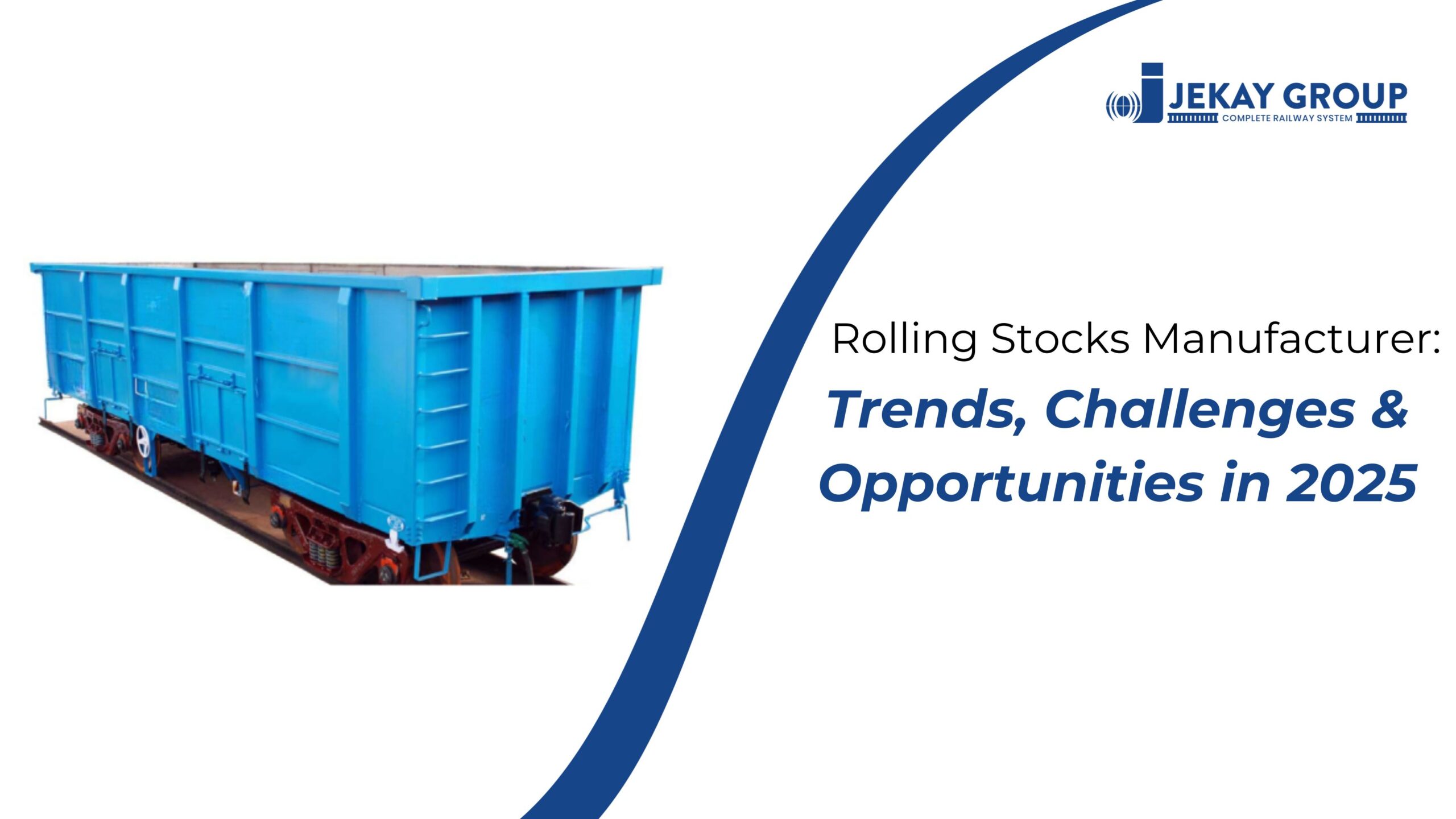
Three segments dominate the market. Wagons hold 36.8% market share due to their 50-60 ton load capacity and cost efficiency for bulk freight movement. Electric propulsion accounts for 56.9% of the market, favored for reliability, energy savings, and performance in long-distance heavy hauls. Freight transportation commands 63.2% of applications as industrial activity and cross-border trade intensify demand for rail logistics.
North America leads with 38.6% market share, driven by fleet modernization, freight efficiency investments, and expanding commuter networks. Asia-Pacific follows closely, fueled by China and India’s aggressive infrastructure programs.
Trends Shaping the Rolling Stock Industry
Electrification Dominates Propulsion Choices
Electric locomotives now represent the majority of new orders because they deliver superior acceleration, hauling capacity, and energy recovery compared to diesel alternatives. China, India, Japan, and European nations are expanding electrified rail networks at unprecedented scale. India inaugurated its first 9000-hp D9 series electric locomotives in May 2025, launching production of 1,200 high-power units.
Automation and Digital Integration Accelerate
Hitachi Rail launched Europe’s first automated freight locomotive in July 2025, equipped with ATO and RTO technology for fully autonomous operation. This shift reduces labor costs and improves scheduling precision. Predictive maintenance systems using IoT and big data analytics are becoming standard, allowing operators to prevent failures before they occur.
Urbanization Drives Transit Demand
Urban rail systems globally are expected to grow from 182 in 2019 to over 250 by 2030. Cities facing traffic congestion and air pollution are investing heavily in metro, light rail, and commuter networks. This urban transit boom represents the primary growth driver for new vehicle orders through the next decade.
After-Sales Services Gain Strategic Importance
Suppliers are pursuing data management solutions and comprehensive service contracts, increasing their value chain share. Some have entered the market with automated diagnostics, vehicle control systems, and fleet management platforms by 2025. This puts pressure on OEMs to expand their own service capabilities or risk losing lifetime value.
Challenges Facing Rolling Stock Manufacturers
Overcapacity Squeezes Profit Margins
The global rolling stock industry has long suffered from overcapacity issues that drive down pricing power. Large manufacturers can deliver global products at highly competitive price levels, forcing smaller players to consolidate or exit. This creates a race to the bottom on new vehicle pricing.
Customer Profile Transformation
Traditional rail operators are no longer the only buyers. Financial investors and leasing companies now dominate procurement decisions in many markets. These customers prioritize total cost of ownership (TCO) over upfront price, demanding comprehensive lifecycle solutions rather than standalone vehicles.
Supply Chain Volatility
Raw material availability and supply chain disruptions continue affecting production schedules. Manufacturers must balance standardization for cost efficiency against customization demands for regional and operational requirements.
Regulatory Compliance Complexity
Emission standards, safety certifications, and technical specifications vary widely across regions. Meeting multiple regulatory frameworks simultaneously increases engineering costs and extends development timelines.
Opportunities for Growth and Innovation
Emerging Markets Offer Volume Growth
China’s Five-Year Plans prioritize high-speed rail, metro, and light rail development, with targets to extend high-speed networks to 38,000 kilometers by 2025. India and Middle Eastern nations are making similar infrastructure investments, creating demand for thousands of new vehicles.
Battery-Electric Technology Opens New Segments
Siemens Mobility launched the Charger B+AC in June 2025—the first battery-electric passenger locomotive designed specifically for North America. This alternative propulsion technology addresses non-electrified routes without costly catenary infrastructure, expanding addressable markets.
Lightweight Materials Improve Efficiency
Advanced composites and aluminum alloys reduce vehicle weight, lowering energy consumption and track wear. This delivers measurable TCO improvements that appeal to financial investors evaluating long-term returns.
Data-Driven Service Models
Manufacturers that build comprehensive data platforms for condition monitoring, performance optimization, and predictive maintenance can capture recurring revenue streams. These service contracts often generate higher margins than new vehicle sales.
Technology-Driven Disruption
Connected Rolling Stock Enables Smart Operations
Real-time monitoring systems track component health, energy consumption, and operational parameters across entire fleets. Operators use this data to optimize schedules, reduce downtime, and improve asset utilization by 15-20%.
Digital Twins Accelerate Development
Virtual simulation models allow manufacturers to test designs, predict failures, and optimize performance before physical prototypes exist. This cuts development time by months and reduces testing costs significantly.
Autonomous Systems Reduce Operating Costs
Driverless technology is advancing from urban metros to mainline freight. Europe’s first automated freight locomotive demonstrates the technical feasibility. Labor represents 40-50% of operating costs for many rail services, making automation highly attractive to operators.
Market Segmentation and Product Diversification
Freight wagons dominate volume due to their simplicity and bulk transport economics. Their 50-60 ton capacity and specialized features like retractable roofs make them essential for coal, grain, steel, and container logistics.
High-speed passenger trains serve a premium segment with sophisticated propulsion, aerodynamics, and comfort systems. These vehicles command higher prices but require more complex engineering and certification.
Urban transit vehicles—metros, trams, light rail—represent the fastest-growing segment. Standardization efforts in this category help manufacturers achieve economies of scale while meeting diverse city requirements.
Refurbishment and life extension services are gaining traction as operators seek to maximize existing asset value. Upgrading propulsion systems, control electronics, and passenger amenities extends vehicle life by 15-20 years at a fraction of new vehicle cost.
Strategic Recommendations for Manufacturers
Focus on localization to meet regional content requirements and reduce logistics costs. Establishing assembly facilities near major markets improves competitiveness on large tenders.
Expand after-sales capabilities through service contracts, spare parts supply, and training programs. These offerings build recurring revenue and strengthen customer relationships.
Invest in digital tools for design, manufacturing, and fleet management. Data analytics capabilities differentiate premium offerings and justify higher pricing.
Pursue strategic partnerships with technology providers, component suppliers, and financial institutions. Ecosystem collaboration enables comprehensive solutions that single companies cannot deliver alone.
FAQs
What drives the shift toward electric rolling stock?
Electric locomotives offer 15-25% lower operating costs than diesel equivalents due to energy efficiency and reduced maintenance. They deliver superior performance in acceleration, hauling capacity, and energy recovery. Government electrification programs in China, India, and Europe make electric traction the default choice for new infrastructure.
How is urbanization changing rolling stock demand?
Urban rail systems are expanding from 182 to over 250 by 2030, creating massive demand for metro and light rail vehicles. Cities prioritize public transportation to address congestion and pollution. This urban transit segment is growing faster than traditional mainline rail.
Why are financial investors entering the rolling stock market?
Leasing companies and investment funds see rail assets as stable, long-term investments with predictable returns. They bring different purchasing criteria than traditional operators, focusing on TCO and lifecycle value. This shift requires manufacturers to offer comprehensive service packages beyond vehicle sales.
What role does predictive maintenance play?
IoT sensors and big data analytics enable condition-based maintenance that prevents failures before they occur. This reduces unplanned downtime by 30-40% and extends component life significantly. Operators achieve better asset availability while lowering maintenance costs.
Conclusion
Rolling stock manufacturers in 2025 face a market rich with growth opportunities but demanding strategic adaptation. Electrification, automation, and urbanization create volume. Those who master TCO solutions, digital services, and localized production will capture disproportionate value in this expanding market.
Jekay International Track Pvt. Ltd. manufactures railway components and track systems that meet global quality standards for modern rail infrastructure. Our engineering supports reliable, long-lasting railway operations across diverse applications and operating environments.
Ready to discuss railway component solutions for your infrastructure projects? Contact Jekay today to explore how our manufacturing capabilities align with your technical requirements and delivery schedules.