
Introduction
A single miscalculated decision about manufacturing process can cost rail component manufacturers thousands in material waste, production delays, and premature failures in the field. Rolled sections and forged sections differ dramatically in strength, cost, and application suitability—yet many manufacturers default to one method without analyzing load requirements, production volumes, or lifecycle economics. This guide breaks down the mechanical properties, manufacturing efficiencies, and application contexts for both processes. You’ll learn when rolling delivers better economics, when forging becomes non-negotiable for safety-critical parts, and how to match manufacturing methods to your specific component specifications and operational demands.
What Are Rolled Sections?
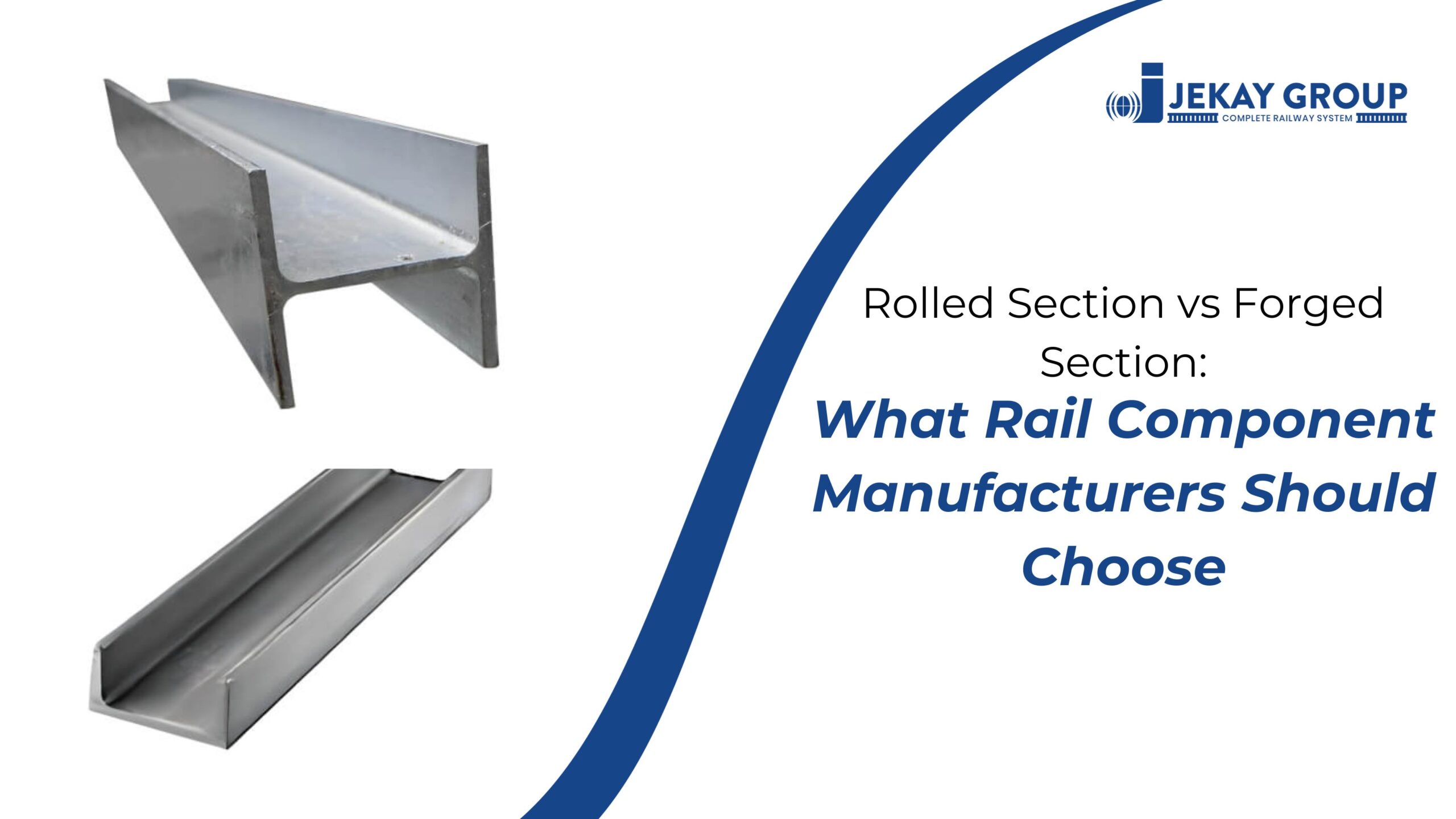
Rolling shapes steel by passing heated billets through precision rollers at temperatures exceeding 1,700°F (927°C). The process flattens, stretches, and forms the material into rails, beams, channels, and custom profiles.
Hot rolling happens above the steel’s recrystallization temperature, allowing grains to reform continuously during shaping. This creates uniform structure throughout the cross-section and maintains ductility.
Modern rolling mills produce sections up to 120 meters long in single passes, minimizing field joints and reducing installation time. Tolerances stay within millimeters across entire production runs.
Typical rolled rail components include track rails, guide rails, structural beams, and channels. These parts benefit from consistent cross-sections, smooth surfaces, and predictable mechanical properties.

What Are Forged Sections?
Forging reshapes steel through localized compressive forces—hammering or pressing heated material into dies. The process refines grain structure by forcing metal flow to follow the component’s contours.
Three main forging types serve rail manufacturing. Open-die forging hammers material between flat dies for simple shapes. Closed-die forging uses shaped dies for complex geometries. Ring rolling expands pierced billets into seamless rings.
Forging can happen hot (above recrystallization), warm (near recrystallization), or cold (below recrystallization). Hot forging suits large rail components requiring extensive deformation.
Typical forged rail components include axles, wheel hubs, couplers, bearing housings, and high-strength fasteners. These parts demand superior impact resistance and fatigue life under cyclic loading.
Comparing Rolled vs Forged Sections
Strength and Grain Structure
Forged steel delivers 25-30% higher strength than equivalent rolled parts. A University of Toledo study found forged components exhibited 26% higher tensile strength than cast-iron and showed superior performance versus rolled alternatives.
Forging’s compressive forces align grain structure along load paths, creating directional strength. Rolling produces more uniform but less refined grain patterns.
Rolled sections achieve tensile strength exceeding 400 MPa with higher ductility than forgings. This makes rolled steel more malleable and easier to work with for structural applications.

Fatigue Resistance and Durability
Forged components demonstrate significantly higher fatigue strength under repeated loading cycles. When observed under identical heavy-duty conditions, forged parts outlast rolled alternatives by substantial margins.
The refined grain structure in forgings eliminates internal voids and weak points that propagate cracks. Rolled sections, while tough, contain more residual stress from cooling processes.
Dimensional Precision
Rolling maintains tighter tolerances for standard cross-sections. Automated systems verify straightness, geometry, and surface quality throughout production runs.
Forging produces near-net shapes with higher dimensional consistency for complex geometries. Closed-die forging especially suits parts requiring intricate features.
Manufacturing Efficiency and Cost Considerations
Rolling wins on production speed and volume capacity. Mills process continuous billets into hundreds of meters per hour, making rolling economical for structural shapes and rails.
Energy consumption favors rolling for simple profiles. High-temperature forming requires less total energy input than repeated forging strikes.
Material utilization differs significantly. Rolling generates minimal waste on standard sections but struggles with complex shapes. Forging wastes more material on simple profiles but efficiently produces intricate geometries.
Cost comparison reveals a 30-50% premium for forged components versus rolled equivalents in similar sizes. This gap narrows for high-strength alloy grades where forging’s mechanical advantages justify higher processing costs.
Application Suitability for Rail Components
When to Choose Rolled Sections
Rail tracks, guide rails, and structural beams suit rolling perfectly. These components need consistent cross-sections across long lengths with predictable strength properties.
Standard fastening components like fish plates, base plates, and clips benefit from rolling’s cost efficiency and dimensional accuracy. High production volumes make tooling investments worthwhile.
When to Choose Forged Sections
Safety-critical components under cyclic loading demand forging. Axles, wheel hubs, couplers, and bolts experience repeated stress that exploits any internal weakness.
High-stress contact areas—bearing housings, journal boxes, and wear plates—require forging’s superior toughness and impact resistance. Premature failure in these parts causes catastrophic operational disruptions.
Custom geometries with complex features often justify forging despite higher costs. When parts integrate multiple functions or non-standard profiles, forging’s flexibility outweighs rolling’s simplicity.

Quality Control and Industry Standards
Rolled sections undergo continuous inline inspection. Automated systems check dimensional accuracy, surface defects, and straightness before material leaves the mill.
Forged components require batch testing. Each production lot gets sampled for hardness, tensile strength, and internal soundness through ultrasonic or magnetic particle inspection.
Indian Railways specify RDSO standards and IRS codes for both rolled and forged components. International projects reference AREMA, UIC, or EN standards depending on regional requirements.
Traceability differs between methods. Rolling marks stamped on rail webs identify producer, profile, and production date. Forged parts carry die stamps or laser engravings linking to batch records and material certificates.
Common Challenges and Mistakes
Specifying rolled sections for high-fatigue applications causes premature cracking. Components like bolts and pins subjected to repeated load reversals need forging’s refined grain structure.
Overlooking forging’s benefits in critical load paths creates risk. A 26% strength advantage prevents failures that shut down operations and damage equipment.
Balancing cost versus performance requires lifecycle analysis. A forged axle costing 40% more than a rolled alternative but lasting three times longer delivers better economics.
How to Choose the Right Supplier
Experience with both processes signals manufacturing depth. Suppliers who understand when to recommend rolling versus forging add value beyond basic fulfillment.
Customization capability matters for non-standard profiles. In-house engineering teams can modify dies or rolling sequences to meet unique specifications.
Quality certifications verify process controls. ISO 9001 for quality management plus rail-specific credentials (RDSO, IRIS) demonstrate consistent adherence to standards.
Supply chain reliability includes material sourcing, production capacity, and logistics networks. Manufacturers with multiple facilities reduce lead times and delivery risks.
Frequently Asked Questions
Can rolled sections match forged components in strength?
Rolled sections achieve good strength for structural applications but cannot match forging’s 25-30% advantage in tensile strength and fatigue resistance. For high-stress parts like axles and couplers, forging remains the superior choice.
Why do forged components cost more than rolled sections?
Forging requires intensive labor, specialized dies, and multiple heating-and-forming cycles. Rolling processes continuous material at higher speeds with less tooling cost. However, forging’s superior properties often justify the premium for critical components.
Which process offers better dimensional accuracy?
Both achieve tight tolerances for their respective applications. Rolling excels at consistent cross-sections over long lengths (within millimeters). Forging produces near-net complex shapes with high repeatability in closed-die operations.
Are there rail components that combine both processes?
Yes. Some manufacturers roll basic profiles, then forge critical features like bolt heads or bearing surfaces onto the same component. This hybrid approach balances cost with performance.
How do I verify if a component needs forging instead of rolling?
Analyze load conditions, stress cycles, and failure consequences. Components experiencing repeated impact, high cyclic loading, or safety-critical functions typically require forging’s enhanced fatigue resistance and toughness.

Conclusion
Selecting between rolled and forged sections isn’t about choosing the “better” process—it’s about matching manufacturing methods to mechanical demands, production volumes, and economic constraints. Rolled sections deliver cost-effective solutions for structural components and standard profiles. Forged sections provide the strength and fatigue resistance that safety-critical parts require. Analyze your component specifications, consult experienced manufacturers, and let application requirements drive your decision.
Contact our engineering team today to discuss your rail component specifications and determine the optimal manufacturing process for your project.
Why Choose Jekay International for Rolled and Forged Rail Components
Since 1980, Jekay International has combined precision rolling and forging capabilities to deliver railway track systems across 13+ countries. Our integrated manufacturing approach lets us recommend the right process for each component—rolled sections for structural efficiency, forged parts for high-stress applications—all backed by RDSO compliance and global quality standards.
We engineer custom solutions that balance performance requirements with production economics. Whether you need standard rolled profiles in 120-meter lengths or forged safety-critical components with enhanced fatigue life, our technical teams provide expert guidance throughout design, manufacturing, and quality verification.
Discuss your rail component requirements with our specialists. Visit jekay.com or request technical specifications and quotations directly through our website. Let four decades of manufacturing expertise work for your next project.