
Introduction
Fish-plated joints cause 60% of track-related speed restrictions despite covering less than 5% of mainline route length. Yet railways continue installing them alongside supposedly “continuous” welded track. The choice between fish plates and welded joints isn’t about picking one universal solution—it’s about understanding where each method succeeds and where it fails catastrophically. This guide breaks down joint mechanics, performance trade-offs, maintenance realities, and selection criteria for different track applications. You’ll learn when fish plates outperform welds, where welding becomes non-negotiable, and why hybrid strategies dominate modern railway infrastructure despite the industry’s push toward continuous rail.
Basics of Railway Track Joints
A track joint connects two rail ends while maintaining vertical alignment, lateral gauge, and electrical continuity. Every joint creates a discontinuity—either a physical gap (fish-plated) or a metallurgical transition zone (welded).
Joints remain essential in yards, turnouts, expansion joints on bridges, insulated blocks for signaling, and transition zones between different rail sections. Even “continuously welded” mainlines contain fish-plated joints every 200-400 meters at buffer rails and stress-relief points.
Performance terminology matters for buyers. Impact load refers to dynamic forces when wheels cross joint gaps. Rail end batter describes mushrooming deformation from repeated impacts. Gauge widening happens when lateral forces overcome joint restraint.
Fish Plate Joints Explained
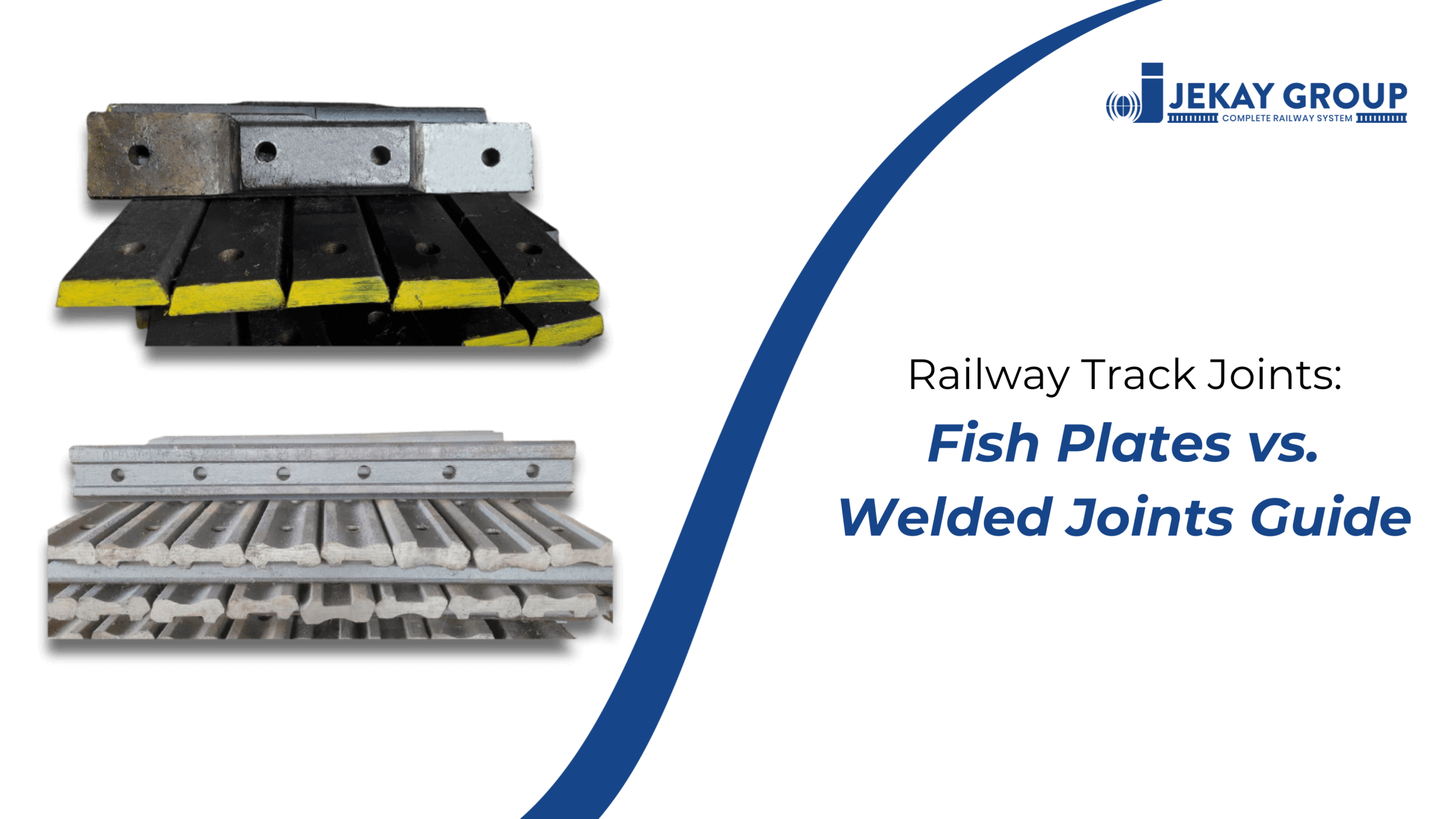
Fish plates (also called joint bars or splice bars) bolt to both sides of two rail ends, transferring loads through mechanical clamping. A typical assembly includes two fish plates, four to six bolts with nuts and spring washers, and sometimes a liner plate for height adjustment.
The fish plates grip the rail web and provide bearing surfaces that resist vertical deflection and lateral movement. Bolt tension creates friction that transfers loads between rail sections.
Common Fish Plate Types
- Standard fish plates join identical rail sections in straight track. They’re symmetric and provide uniform load distribution across all bolt holes.
- Joggled fish plates feature offset sections that clear weld bead remnants or accommodate minor height differences between adjoining rails. They’re common near thermite welds where grinding doesn’t fully remove excess material.
- Compromise fish plates connect different rail weights—for example, transitioning from 52kg to 60kg rail. These asymmetric plates have different bolt hole patterns on each end.
- Insulated fish plates prevent electrical current flow between rail sections. They’re essential for track circuits and signaling systems. The insulating layer reduces mechanical strength by 15-25% compared to solid steel plates.
- 4-hole vs 6-hole patterns: Light rail and sidings use 4-hole plates. Mainline and heavy-haul applications require 6-hole configurations to distribute higher loads and resist fatigue.
Welded Joints Explained
Welded track eliminates mechanical joints by fusing rail ends into continuous ribbons. Short Welded Rails (SWR) extend 120-260 meters, Long Welded Rails (LWR) reach 260-500 meters, and Continuously Welded Rail (CWR) exceeds 500 meters without joints.
Rail Welding Methods
- Flash butt welding heats rail ends through electrical resistance until molten, then forces them together under hydraulic pressure. Plant welding produces factory rails up to 260m long. Mobile welding machines join these sections in the field.
- Thermite welding uses an exothermic chemical reaction (aluminum powder + iron oxide) to melt steel that fills a mold around rail ends. It’s the standard field closure method and emergency repair technique, requiring only portable equipment.
- Gas pressure welding heats rail ends with oxy-acetylene flames and forges them together under mechanical pressure. It’s less common but useful where electricity isn’t available for flash butt equipment.
Post-weld treatment includes grinding the joint profile smooth, ultrasonic testing for internal defects, and managing longitudinal stress through rail adjustment or stress-free temperature procedures.
Performance Comparison
Ride Quality and Noise
Fish-plated joints create 6-12mm gaps (expansion clearance) that generate impact noise and vertical shock as wheels drop into and climb out of the depression. Noise levels spike 15-20 dB at joint locations.
The welded track provides continuous running surfaces with no gap. Ride quality improves dramatically—passengers report 40-50% reduction in perceived roughness on welded versus jointed track at equivalent speeds.
Load and Fatigue
Bolt holes in fish-plated rails create stress concentrations. Cracks initiate at hole edges and propagate through the rail web—40% of rail fractures on jointed track originate at bolt holes rather than in the rail body.
Welded joints shift failure modes to the Heat-Affected Zone (HAZ) where metallurgical changes occur during welding. Properly executed welds match or exceed parent rail strength, but defective welds (inclusions, poor fusion, quench cracks) fail without warning.
Track Geometry
Fish-plated joints loosen over time. Bolt preload drops 50-70% within the first year under heavy traffic as vibration works nuts loose and rail end batter enlarges holes. Gauge widens by 3-8mm at joints versus mid-rail locations.
The welded track maintains gauge precisely because there’s no mechanical connection to loosen. However, thermal stress becomes critical—unrestrained expansion can buckle track in summer or fracture rails in winter.
Maintenance and Lifecycle Differences
Fish Plate Joint Maintenance
Track crews check bolt torque every 3-6 months on heavy corridors. Recommended torque ranges 400-600 Nm—under-torqued bolts allow movement, over-torqued bolts strip threads or crack plates.
Lubrication of joint surfaces reduces friction wear but attracts dust contamination. Most operators now avoid lubrication except in specific curved track applications.
Typical failures include rail end batter (requiring cropping and new holes), bolt-hole elongation (necessitating oversize bolts or rail replacement), fish plate cracking at high-stress points, and corrosion weakening bolt shanks.
Welded Track Maintenance
Weld inspection cycles run 1-2 years using ultrasonic testing to detect internal flaws before they propagate. Surface cracks get ground out if shallow (under 2mm depth) or require weld cutting and re-welding if deeper.
Rail grinding addresses corrugation and profile irregularities that develop from wheel-rail interaction. Welded track typically needs grinding every 3-5 years on heavy lines versus 5-8 years for jointed track (which wears differently due to impact dynamics).
Heat-affected zones fail through fatigue after 20-40 million gross tonnes on heavy-haul lines. Failure rates run 0.5-2 per 100 kilometers annually—low absolute numbers but catastrophic consequences when fractures occur under loaded trains.
Where Each Option Fits Best
When Fish Plates Work Better
Temporary track installations during construction use fish plates exclusively. Dismantling welded track wastes material and labor—fish-plated rails simply unbolt and relocate.
Emergency repairs favor fish plates. A fractured rail gets cropped, a spare section inserted, and fish plates bolted within 1-2 hours. Thermite welding the same repair takes 4-6 hours including preheat, pour, cooling, and grinding.
Yards and sidings with frequent track modifications need fish plates. Track geometry changes every few years as operational patterns evolve—welded track locks configurations permanently.
When Welding Works Better
High-speed passenger lines demand welded track above 130 km/h. Joint impact loads at those speeds cause rail end damage within months and create unacceptable ride discomfort.
Heavy-haul freight corridors (25+ tonne axle loads) destroy fish-plated joints rapidly. Bolt holes crack, plates fracture, and rail ends batter beyond serviceable limits within 5-10 years versus 20-30 years for welded sections.
Hybrid Reality
Even “continuously welded” routes contain fish plates at strategic locations. Buffer rails (short sections near fixed structures) use fish plates at one end to accommodate thermal expansion. Special Expansion Joints (SEJs) incorporate sliding mechanisms within fish-plated assemblies.
Insulated joints require fish plates because welding would create electrical continuity. Track circuit boundaries and traction power section breaks maintain mechanical fish-plated connections despite surrounding welded track.
Selection Checklist for Buyers
Step 1: Define your operating parameters—rail section (52kg, 60kg, etc.), axle load range, maximum speed, and annual tonnage. These numbers determine whether joints can tolerate mechanical connections.
Step 2: Map every joint location and its constraints. Bridge approaches need expansion capability. Turnout heels require adjustability. Stations benefit from smooth ride quality.
Step 3: Categorize joints by failure consequence. Mainline running track failures shut down operations—specify welded joints. Siding failures inconvenience local shunting—fish plates suffice.
Step 4: Specify materials precisely. Fish plates need minimum tensile strength (880+ MPa for heavy-haul), bolt grades (typically 8.8 or 10.9), and corrosion protection (hot-dip galvanizing for 25+ year life).
Step 5: Align installation methods with joint types. Welding requires skilled operators and quality control. Fish plating needs calibrated torque wrenches and proper bolt sequencing but tolerates lower skill levels.
Choosing the Right Manufacturer
Look for suppliers offering complete joint assemblies—fish plates, bolts, washers, and liners—rather than piecemeal components. Integrated sourcing ensures compatibility and simplifies quality verification.
Manufacturing precision matters critically. Fish plate bolt holes must align within ±0.5mm to distribute clamping forces evenly. Fishing surfaces (rail contact areas) require machining to precise flatness tolerances.
Request test documentation showing dimensional verification across production batches, hardness testing confirming heat treatment quality, and material certificates tracing steel chemistry to mill sources.
Project support should include customization for non-standard rail profiles, rapid delivery for urgent repairs, and technical consultation on joint selection for mixed-use scenarios.
Frequently Asked Questions
Q: Can I convert fish-plated track to welded track incrementally?
A: Yes. Replace sections during regular maintenance cycles by welding new long rails and removing fish-plated joints progressively. This staged approach spreads costs over 5-10 years and minimizes traffic disruption compared to wholesale replacement.
Q: Why do “continuously welded” tracks still have fish-plated joints every few hundred meters?
A: Thermal stress management requires periodic stress-relief points called buffer rails. These short sections (10-20m) use fish plates at one end to break longitudinal continuity while maintaining track usability. SEJs and insulated joints also necessitate mechanical connections.
Q: How long do fish-plated joints last before complete replacement?
A: Service life varies by traffic intensity. Light-traffic sidings reach 20-30 years. Mainline freight joints need replacement every 8-12 years as bolt holes enlarge and rail ends batter. Welded joints typically outlast fish-plated equivalents by 2-3× under identical traffic.
Q: What causes fish plates to crack even when bolts stay tight?
A: Fatigue from cyclic loading concentrates stress at bolt hole edges and the curved transition from web to shoulder area. Microscopic cracks propagate through millions of load cycles until visible fractures appear. Material quality and proper heat treatment significantly influence fatigue resistance.
Q: Is thermite welding as strong as flash butt welding?
A: When executed properly, thermite welds achieve 90-95% of parent rail strength—adequate for all standard applications. Flash butt welds reach 95-100% strength with better fatigue resistance. The practical difference matters mainly on extreme heavy-haul (30+ tonne axles) or very high-speed (200+ km/h) applications.
Conclusion
Fish plates and welded joints serve different purposes in modern railways. Fish plates deliver flexibility, repairability, and electrical isolation where operational needs demand them. Welds provide superior ride quality, reduced maintenance, and extended service life where traffic justifies the investment. Most projects need both—welded running rails with strategic fish-plated joints at expansion points, insulated blocks, and turnout connections. Match each joint location to its specific mechanical, electrical, and operational requirements rather than defaulting to one universal solution.
Ready to specify joints for your track project? Contact our engineering team with your rail sections, traffic parameters, and project constraints for a detailed joint selection recommendation.
Why Choose Jekay International for Railway Track Joints and Fish Plates?
Since 1980, Jekay International has manufactured precision fish plates, rail joints, and complete fastening assemblies for railway projects across 13+ countries. Our production covers standard fish plates (4-hole and 6-hole), joggled plates, compromise plates, and insulated joint systems—all meeting RDSO IRS specifications and international standards for rail weights from 30kg to 60kg per meter.
We provide complete joint solutions including matched bolts, spring washers, and liners machined to exact tolerances ensuring proper load distribution and long service life. Our engineering team helps buyers navigate the fish-plate-versus-weld decision, recommending optimal joint types based on traffic density, speed requirements, and maintenance capabilities.
Discuss your track joint requirements with our specialists today. Visit jekay.com or request technical specifications, joint assembly drawings, and project quotations directly through our website. Let four decades of railway component expertise ensure your track joints deliver safety, reliability, and optimal lifecycle performance.