
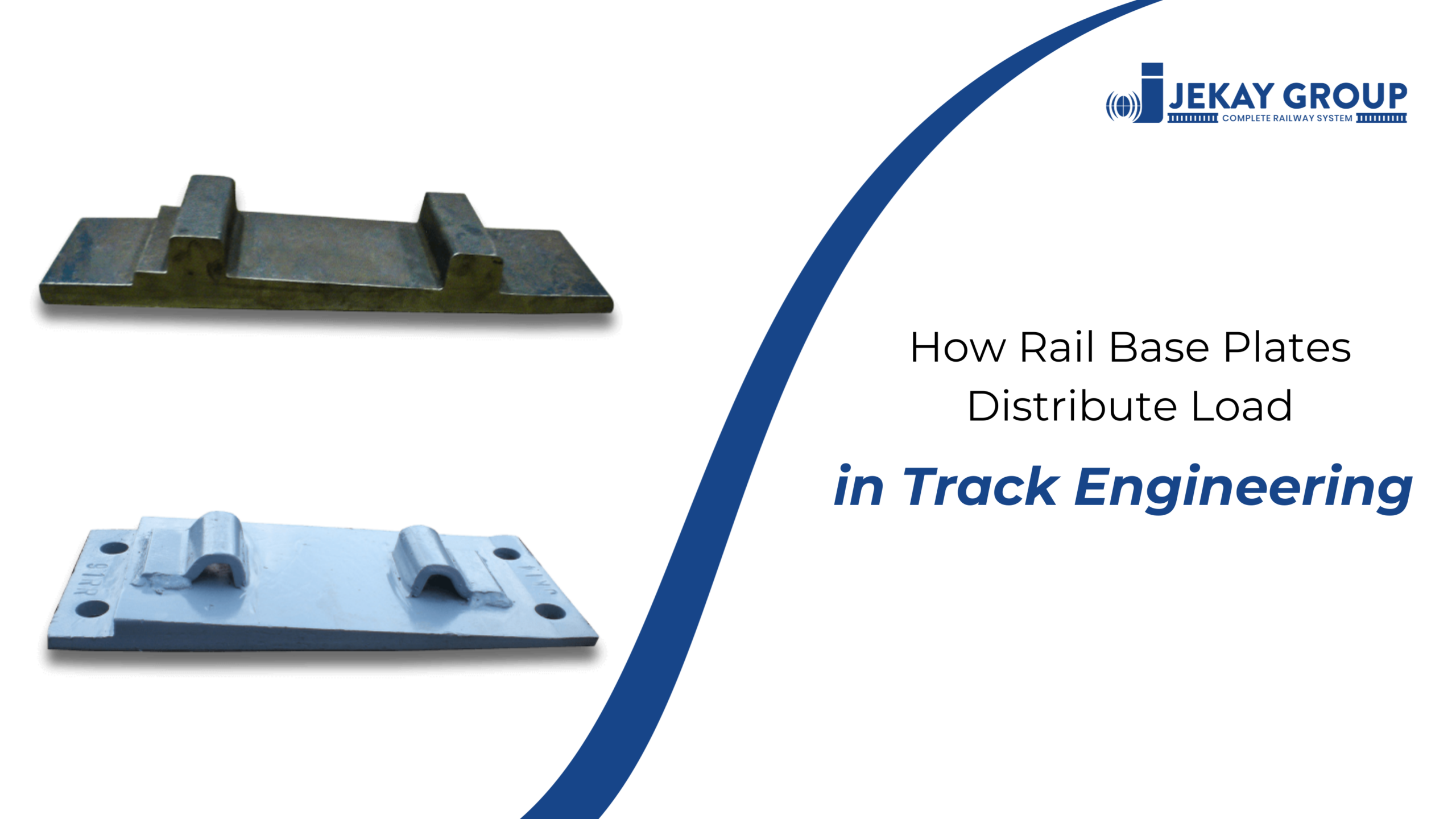
Introduction
Most sleeper failures start the same way: localized crushing under rail seats where contact pressure exceeds material capacity. Buyers often think base plates just “hold the rail in place,” missing their real function—transforming concentrated wheel loads into distributed pressure that sleepers can handle without cracking. A 25-ton axle generates roughly 125 kN of vertical force at the rail base, which without proper distribution would create contact stresses exceeding 10 MPa on wooden sleepers or 20 MPa on concrete. Base plates engineered for load distribution prevent this crushing, maintain gauge stability, and extend sleeper life by 40-60%.
This guide explains the load path from wheel to ballast, how plate design features control stress distribution, and what procurement criteria ensure plates actually perform their structural role.
Rail Load Path in Track Engineering
From Wheel to Rail Base
A wheel contacting rail head creates stress up to 1500 MPa at the contact patch—one of the highest stresses in any engineering structure. This concentrated force transfers through the rail web to the rail base, where it must spread across a wider area before reaching the sleeper.
Without a base plate, the rail base (typically 125-150mm wide) contacts the sleeper directly, creating bearing pressures that crush wood fibers or crack concrete at rail seats.
Complete Load Transfer Chain
The load path follows: wheel → rail head → rail web → rail base → base plate → elastic pad (if present) → sleeper top surface → sleeper body → ballast or slab foundation. Each interface transforms the stress distribution—narrower and higher pressure upstream, wider and lower pressure downstream.
Base plates increase bearing area by 2-3 times compared to direct rail-sleeper contact. A typical plate provides 150-200 square centimeters of contact area, reducing peak pressure to levels sleeper materials can sustain through millions of load cycles.
Dynamic vs Static Loading
Static wheel loads represent steady-state conditions at rest or constant speed. Dynamic loads from train passage include impact factors (1.3-2.0x static), vibration, and lateral forces from cornering. Base plates must distribute both vertical and lateral components without yielding or allowing permanent rail displacement.
How Base Plates Spread the Load
Base plates function as structural distributors that transform point loads into area loads. The plate acts as a stiff beam spanning across the sleeper width, bending slightly under load to activate the full bearing surface rather than creating point contacts.
Plate dimensions directly determine bearing area. A 200mm x 180mm plate provides 36,000 mm² of contact area compared to 12,000-15,000 mm² for direct rail base contact. This 2.5-3x increase cuts bearing stress proportionally, keeping pressures within safe limits.
The plate also positions stress away from sleeper edges where crack initiation is most likely. By centering the load distribution and providing shoulders that resist lateral spreading, base plates keep rails stable even when sleepers settle unevenly.
Design Features That Control Load Distribution
Plate Thickness and Stiffness
Thicker plates (12-16mm) resist bending better than thin plates (8-10mm), maintaining more uniform contact pressure distribution. However, excessive stiffness creates inflexibility that concentrates loads at plate edges rather than distributing across the surface. Optimal thickness balances these effects based on sleeper stiffness and fastening arrangement.
Ribs and Reinforcing Geometry
Ribbed base plates feature longitudinal raised sections on the underside that increase bending resistance without adding thickness everywhere. These ribs function like I-beam flanges, providing structural depth where bending moments peak while keeping overall weight manageable.
Ribs also prevent the plate from settling into concrete sleepers under repeated loading—a common failure mode where flat plates gradually embed into the contact surface.
Rail Cant and Inclination
Base plates incorporate 1:20 or 1:40 inclination that tilts the rail inward. This cant affects load distribution by ensuring wheel-rail contact occurs at the intended point on the rail head profile, which controls lateral force components and rail-seat loading patterns.
Incorrect cant (using flat plates where inclined ones are specified) changes wheel contact geometry and increases lateral forces that accelerate both rail and sleeper wear.
Shoulders and Lateral Restraint
Raised shoulders on one or both sides of the rail prevent lateral displacement under cornering forces and thermal expansion. These shoulders don’t directly spread vertical load, but they keep the rail centered on the bearing area. Without shoulders, rails shift laterally under service, creating asymmetric loading that overloads one sleeper edge.
Double-shoulder plates provide bilateral restraint suited to heavy freight and high-speed applications where lateral forces are significant.
Base Plates by Sleeper Type
Wooden Sleepers
Wood’s lower compressive strength (8-12 MPa for hardwoods) makes load distribution critical. Base plates for wooden sleepers need larger bearing areas—often 180-220mm length—and built-in inclination since wood can’t provide this geometry through inserts.
Plate thickness matters more on wood because sleepers deflect under load, and thin plates bend excessively with the wood, creating uneven stress.
Concrete Sleepers
Concrete’s higher strength (30-50 MPa) tolerates smaller bearing areas, but brittleness makes stress concentration dangerous. Ribbed plates distribute load and prevent embedment into the concrete surface under repeated cycling.
Many concrete sleepers have molded inclination and cast-in shoulders, making the base plate’s role purely load spreading rather than geometry provision.
Steel Sleepers
Steel’s high strength and stiffness change base plate requirements entirely. Plates interface with bolt clamps rather than spikes, and corrosion resistance becomes a primary concern since dissimilar metals in contact accelerate degradation.
Slab Track Systems
In ballastless track, base plates and elastic pads form a tuned system that controls deflection and vibration. Pad stiffness combines with plate flexibility to achieve target vertical stiffness values—typically 50-100 kN/mm for urban rail applications. This combined stiffness determines ride quality, noise transmission, and long-term settlement.
Use Cases Where Load Distribution Is Critical
Heavy haul corridors with 30-32.5 ton axle loads generate bearing pressures near material limits even with proper plates. Using undersized or thin plates causes rapid sleeper deterioration—wooden sleepers split at rail seats, concrete sleepers develop cracks radiating from plate edges.
Curves impose lateral loads that add to vertical loads through vectored combination. A train negotiating a curve experiences centrifugal force pushing outward, which the outer rail must resist. Base plates with substantial shoulders and adequate thickness prevent rail rollover and gauge widening.
Turnouts and crossings create impact loads 2-3x higher than straight track due to interrupted wheel guidance at frogs. Base plates in these locations need enhanced load capacity—often achieved through thicker sections or higher-grade materials.
Urban rail and metro systems accumulate load cycles rapidly—millions per year—making fatigue performance essential. Plates must maintain geometric stability and load distribution characteristics through these cycles without permanent deformation.
Coastal and industrial environments accelerate corrosion that reduces plate cross-section. A plate losing 2mm thickness to rust loses significant bending resistance, degrading its load distribution capability even though it still “holds the rail.”
Procurement Checklist for Buyers
Specify complete requirements:
- Rail section (52 kg, 60 kg, 90 UTS, etc.)
- Sleeper type (wooden, concrete, steel)
- Required cant (1:20, 1:40, or flat)
- Fastening system compatibility (spike holes, clip shoulders)
- Service conditions (axle loads, curve radius, corrosive environment)
Request material certifications and process documentation showing rolling, casting, or forging route with mechanical properties verified.
Verify dimensional tolerances on critical features: overall flatness (typically ±1.5mm), hole position accuracy (±2mm), shoulder height uniformity, and rib geometry consistency.
Check for proper packaging that prevents bending during transport. Bent plates create point loads on sleepers regardless of design intent.
How Suppliers Differentiate Performance
Advanced suppliers engineer plate stiffness to match pad stiffness and track form. This system approach recognizes that plate flexibility interacts with pad compression to control load distribution—optimizing one without considering the other misses the real performance target.
Manufacturing process control determines whether geometric features actually perform as designed. Ribbed plates need consistent rib height and positioning; shouldered plates require controlled welding that doesn’t create stress concentrations.
Field outcomes tell the real story: reduced sleeper cracking frequency, longer fastener service life, and extended maintenance intervals all indicate proper load distribution. Suppliers who track these metrics and adjust designs accordingly separate themselves from those selling catalog items.
FAQs
Q: Why do concrete sleepers crack at rail seats if they’re stronger than wood?
A: Concrete’s brittleness makes it vulnerable to stress concentrations despite high compressive strength. A poorly designed base plate or one that settles unevenly creates localized bearing pressure that exceeds concrete’s tensile capacity on the underside of the contact zone, initiating cracks that propagate through repeated loading. Wooden sleepers crush gradually rather than cracking suddenly, giving more warning before failure.
Q: Can you use the same base plate on different sleeper types?
A: No. Wooden sleepers require larger bearing areas and integrated inclination because wood can’t provide geometric features. Concrete sleeper plates need ribs to prevent embedment and often interface with cast-in shoulders. Steel sleeper plates serve entirely different bolt clamp geometries. Using a wooden sleeper plate on concrete creates inadequate bearing area and poor load distribution.
Q: How does base plate thickness affect load distribution?
A: Thicker plates resist bending better, maintaining more uniform pressure distribution across the bearing surface. Thin plates flex excessively, creating higher pressure at plate edges and lower pressure in the middle—essentially converting the distributed load back toward a point load. However, overly thick plates become inflexible and can’t accommodate minor sleeper surface irregularities, again creating contact pressure variations. Optimal thickness ranges from 10-16mm depending on sleeper stiffness and load conditions.
Q: What causes base plates to lose load distribution capability over time?
A: Corrosion reduces cross-sectional thickness, cutting bending resistance and allowing excessive flex. Plastic deformation from overload permanently bends the plate, creating curved geometry that no longer contacts sleepers uniformly. Cracking near holes or shoulders (common in poorly heat-treated plates) compromises structural integrity. Accumulated dirt or ballast fragments under the plate creates uneven support that concentrates loads. Regular inspection and cleaning prevent these degradation modes.
Q: Why specify ribbed base plates instead of flat ones?
A: Ribs increase bending resistance by 40-60% without proportional weight increase. They prevent plate embedment into concrete sleepers under repeated loading, a failure mode where flat plates gradually settle into the contact surface. Ribs also improve drainage by creating clearance under the plate center. The cost premium (typically 15-25%) justifies itself through extended service life and reduced sleeper damage on concrete sleeper installations.
Conclusion
Base plates distribute load by increasing bearing area, controlling stiffness, and maintaining rail geometry under dynamic forces. Procurement based on matching plate characteristics to sleeper type, service loads, and fastening systems prevents the sleeper failures, gauge problems, and accelerated maintenance that come from treating plates as generic commodity items. Engineering matters more than catalog selection.
Jekay International Track Pvt. Ltd. manufactures rail base plates engineered for load distribution across wooden, concrete, and steel sleeper applications. Our designs match plate geometry, thickness, and stiffness to specific rail sections, fastening systems, and service conditions. Manufacturing controls ensure dimensional accuracy, material properties, and surface quality that maintain load distribution performance throughout the plate’s service life.
Ready to specify base plates designed for controlled load distribution in your track system? Contact Jekay today to discuss rail sections, sleeper types, service loads, and fastening compatibility for base plates that protect sleepers and maintain track geometry.