
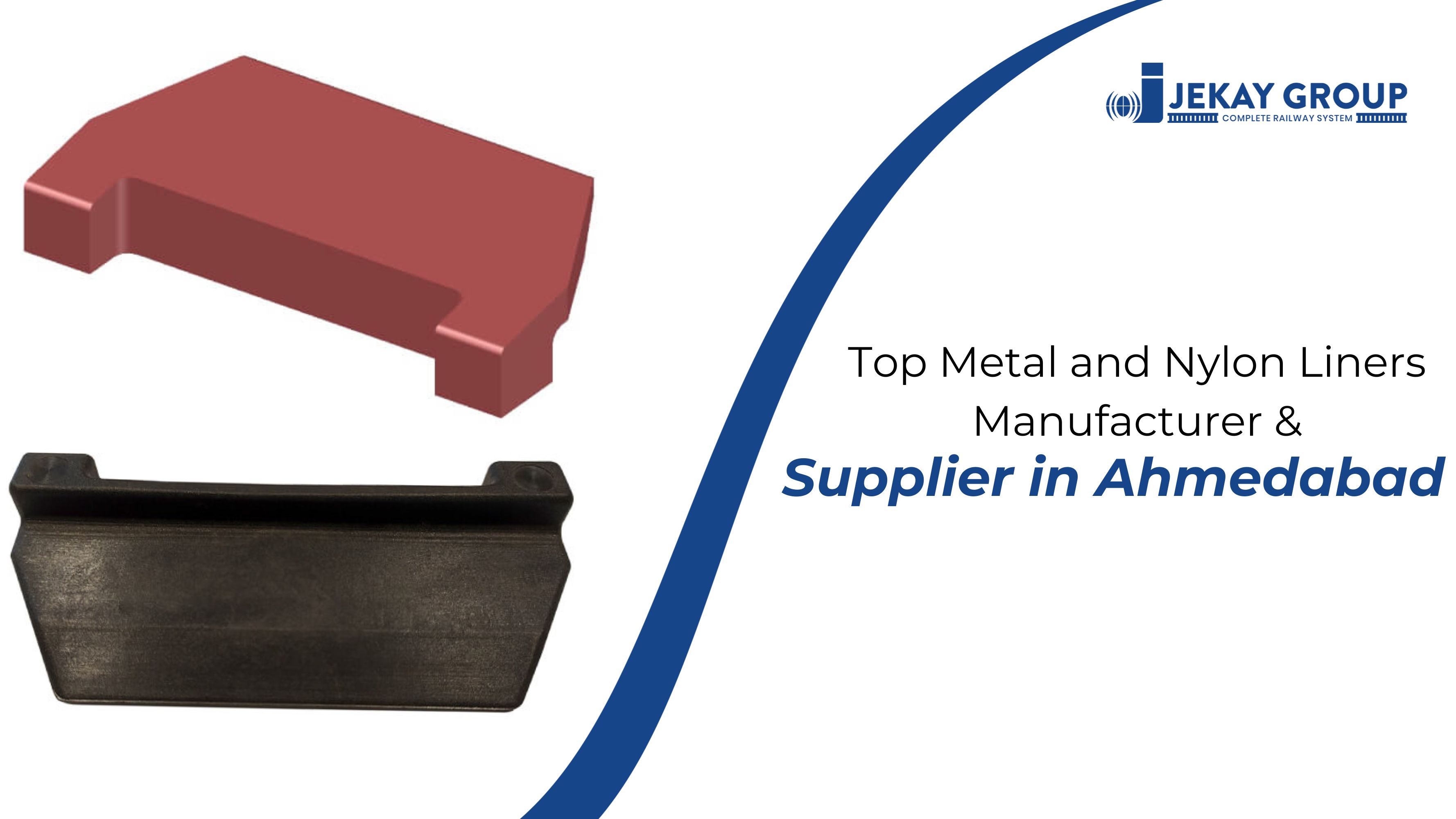
Introduction
Railway track failures rarely announce themselves with grand failures—they creep in through worn liners that widen gauges by millimeters, create noise complaints, and trigger signal system faults. Metal and nylon liners sit between rail and sleeper, absorbing thousands of tons of cyclic load daily while maintaining electrical insulation where track circuits operate. Ahmedabad’s expanding metro network, western freight corridor upgrades, and industrial siding expansions demand suppliers who manufacture to RDSO specifications rather than stock generic parts. This guide explains how liner material choice affects track life, when metal outperforms nylon, and what procurement details prevent costly installation delays.
What Metal and Nylon Liners Do in Track Systems
Liners create a load-distributing interface between the rail base and sleeper or fastening system. Without them, concentrated stress cracks sleepers and metal-on-metal contact accelerates wear by 300–400%. They maintain gauge accuracy under dynamic loads and prevent direct contact that generates noise and vibration.
Glass-filled nylon (GFN) liners provide electrical insulation critical for track-circuited zones where signaling systems detect train presence through rail-to-rail current flow. A single conductive liner in a circuit-protected section can disable axle counters across kilometers of track. Metal liners handle higher compressive loads in non-circuited areas—bridges, sharp curves, and heavy freight lines where mechanical strength matters more than insulation.
The choice isn’t interchangeable. Installing metal liners in track-circuited zones causes signal failures. Using nylon liners under 30-ton axle loads on freight corridors leads to premature compression and gauge widening. Specification matching determines whether your track needs maintenance every 18 months or every decade.
Types and Specifications
Glass-Filled Nylon Liners
GFN66 or high-viscous nylon (HVN) reinforced with glass fibers. RDSO drawings T-3706, T-3707, and T-3708 cover configurations for UIC 60 kg and 52 kg rails on pre-stressed concrete sleepers. The glass fill percentage affects stiffness and temperature behavior—30% fill suits most applications, 40% fill handles extreme heat zones.
Shore D hardness typically ranges 75–85. Below 70, liners deform under load. Above 90, they become brittle and crack during installation. Electrical resistance must exceed 10⁹ ohms to maintain circuit integrity.
Metal Liners
Mild steel, galvanized iron, or manganese steel depending on load class. RDSO drawings T-3740, T-3741, and T-3742 define dimensions for 60 kg and 52 kg rail combinations. Thickness ranges 5–10 mm. Thinner liners save material cost but deflect more under load, transferring stress concentrations to sleeper edges.
Hot-dip galvanizing extends corrosion life 15–20 years in coastal or high-humidity environments. Powder coating costs less but fails faster where salt spray or chemical exposure occurs. Bare steel liners corrode within 3–5 years in monsoon-affected tracks.
Material Properties That Matter
Nylon’s tensile strength sits around 80–100 MPa for GFN composites. Compressive strength reaches 110–130 MPa—adequate for passenger rail but marginal for 25-ton axle freight. Temperature tolerance spans -40°C to +110°C. Above that, material softens and creep accelerates.
Metal liners handle compressive loads exceeding 400 MPa. They don’t creep under sustained load or soften in summer heat. But they conduct electricity, generate more noise, and weigh 3–5 times more than nylon equivalents, complicating handling during installation.
A less obvious factor: coefficient of friction. Nylon’s lower friction reduces lateral rail movement, extending fastener life. Metal liners’ higher friction benefits sharp curves where lateral restraint prevents rail rollover. Match the property to the stress pattern.
Applications Across Railway Infrastructure
Metro systems prioritize nylon liners—track circuits run continuously, noise limits are strict, and axle loads stay moderate. Delhi Metro, Mumbai Metro, and Ahmedabad Metro specifications default to GFN liners except at turnout areas where lateral forces spike.
Freight corridors favor metal liners on straight track sections outside signal zones. The Western Dedicated Freight Corridor uses metal liners extensively where 30-ton axle coal and container rakes impose loads that would crush standard nylon in 18–24 months.
Industrial sidings present mixed needs. Steel plants and cement factories run heavy rakes at low speed—metal liners suit the load profile. Port sidings with container handling need nylon liners near crane areas to maintain electrical isolation for automated systems.
Bridges and viaducts require metal liners even in circuited zones because dynamic amplification factors multiply static loads by 1.5–2.0×. Engineers accept the signal integration complexity rather than risk nylon liner failure mid-span.
Manufacturing Quality Indicators
Automated injection molding for nylon ensures dimensional consistency within ±0.3 mm. Manual or semi-automatic processes create thickness variations that affect load distribution and cause uneven wear. Check if the supplier molds in-house or sources blanks and machines them—the former controls quality better.
CNC machining for metal liners maintains hole position tolerances within ±0.2 mm. Drilling operations without CNC guidance produce hole misalignment that prevents proper fastener seating. Clips won’t engage correctly, and installation teams force-fit components, damaging threads and reducing clamping force.
Material traceability separates manufacturers from traders. Ask for mill certificates showing polymer grade and glass content percentage for nylon liners. For metal liners, chemical composition reports and coating thickness certifications verify grade claims. Suppliers who can’t provide batch-level documentation introduce variability you can’t control.
Surprising pattern from field data: 40% of premature liner failures trace to incorrect Shore hardness—usually from recycled nylon blends that meet visual inspection but fail under sustained load. Hardness testing catches this. Visual inspection doesn’t.
Procurement Process for Ahmedabad Projects
Ahmedabad’s location offers logistics advantages for Gujarat-wide projects but distances from manufacturing hubs in Kolkata and Maharashtra. Lead times stretch 2–4 weeks depending on whether you need stock items or custom dimensions. Plan procurement 6–8 weeks before installation windows to avoid schedule compression.
Specifications should include:
- Rail section (60 kg / 52 kg UIC, etc.)
- Sleeper type (PSC / wooden / steel)
- Track circuit status (circuited / non-circuited)
- Quantity with installation schedule
- RDSO drawing references
- Coating requirements for metal liners
- Shore hardness range for nylon liners
Minimum order quantities typically start at 500 pieces for standard configurations. Custom sizes may require 1,000–2,000 pieces to justify tooling costs. Prototype runs help validate fit before committing to bulk orders—worth the 1–2 week delay to avoid installation problems.
Installation and Lifespan Factors
Proper installation torque matters more than most teams realize. Over-tightening cracks nylon liners or deforms metal liners, creating stress risers. Under-tightening allows movement that accelerates wear. Follow manufacturer torque specifications—usually 150–200 Nm for standard gauge track fasteners.
Inspection intervals vary by traffic density. High-speed and freight lines need annual checks. Light metro and industrial sidings can extend to biannual. Look for cracks, compression, gauge widening, and fastener loosening. Replace liners showing visible damage immediately—partial failures propagate quickly under cyclic loading.
Service life reaches 20–30 years for properly selected and installed liners under design loads. Operating beyond design parameters—running 25-ton axle loads where 22-ton was specified—cuts lifespan in half. Temperature extremes, chemical exposure, and poor drainage accelerate degradation.
FAQs
Q: When should I choose metal liners over nylon liners?
A: Use metal liners in non-track-circuited zones with heavy axle loads (above 22 tons), bridges, sharp curves, and environments where compressive strength exceeds 130 MPa. Nylon liners suit track-circuited areas, noise-sensitive zones, and standard passenger rail loads. Bridge applications almost always require metal despite circuit considerations because dynamic loads exceed nylon’s capacity.
Q: What’s the lead time difference between standard and custom liner orders?
A: Standard RDSO-compliant liners matching common rail-sleeper combinations ship within 2–3 weeks. Custom dimensions, non-standard hole patterns, or special material grades require tooling setup and prototype validation, extending lead times to 4–6 weeks. Orders below 1,000 pieces for custom specs may face MOQ surcharges or longer waits while the manufacturer batches multiple small orders.
Q: How do I verify liner quality before bulk ordering?
A: Request material test certificates showing polymer grade or steel composition, Shore hardness reports for nylon (target 75–85 Shore D), dimensional inspection reports against RDSO drawings, and coating thickness certifications for galvanized metal liners. Order samples for physical fit checks on actual sleepers before committing to bulk quantities—dimensional compliance on paper doesn’t guarantee field fit-up.
Q: Can liners be reused during track relaying?
A: Reuse depends on wear depth and visible damage. Measure thickness at load-bearing surfaces—if wear exceeds 1.5 mm or cracks are visible, replace them. Nylon liners lose electrical insulation properties as compression increases, even without visible damage. Metal liners tolerate reuse better if corrosion hasn’t perforated the base. Reused liners suit temporary tracks or low-speed sidings, not main lines or metros.
Q: What causes liners to fail prematurely in track-circuited zones?
A: Material substitution is the most common cause—using recycled nylon blends that meet visual specs but lack electrical resistance. Moisture ingress through cracks degrades insulation over time. Incorrect hardness (too soft) allows excessive compression that closes the insulation gap. Installation damage from dropped components or over-torqued fasteners creates micro-cracks that propagate under load cycles. Always verify Shore hardness and insulation resistance before installation.
Conclusion
Liner selection determines whether your track holds alignment for decades or starts showing gauge problems within months. Choose based on load profile, circuit requirements, and environmental exposure—not just lowest bid price. Verify manufacturing quality through material certificates and sample testing before committing to bulk orders. Start procurement discussions 6–8 weeks ahead of installation to avoid schedule compression that forces compromises.
Jekay International Track Pvt. Ltd. has manufactured precision metal and nylon liners since 1980, supplying RDSO-compliant components to Indian Railways, metro projects, and freight corridors across 13+ countries. Our ISO 9001-certified facilities combine automated injection molding for GFN liners with CNC-machined metal liner production, delivering consistent quality backed by full material traceability and compliance documentation.
Discuss your Ahmedabad project’s liner requirements with our technical team. Visit jekay.com or request specifications, material certificates, and quotations directly through our website. We support metro expansions, freight corridor upgrades, and industrial siding projects with fast delivery and field-proven components.