
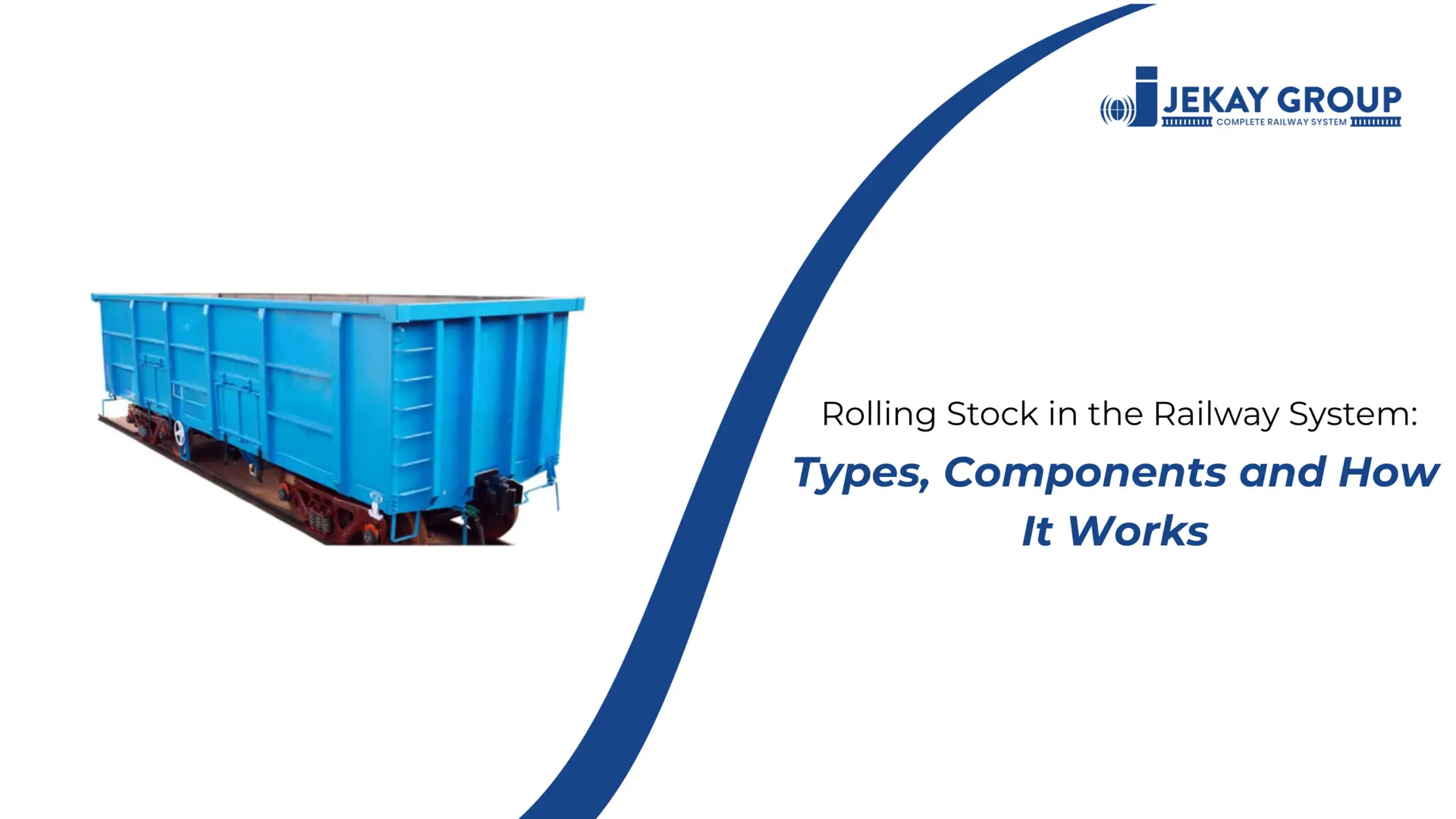
Every freight train you see is a chain of decisions made years earlier on a drawing board. The wagon type, the bogie, the coupler and the brake system decide how much it carries, how fast it runs and how often it sits in a workshop. Freight brings in nearly 65% of Indian Railways’ earnings, so these choices are not academic.
This guide breaks rolling stock down into plain parts. We cover the main types, the components that hold a vehicle together, how those parts work as one system, and what to check before you pick a supplier. It is written from the shop floor of a manufacturer that builds wagons, bogies and couplers under one roof.
What Is Rolling Stock
Rolling stock is the collective name for every vehicle that runs on rails. That includes locomotives, passenger coaches, freight wagons and track machines.
The term separates the moving fleet from fixed infrastructure such as track, bridges, signals and stations. A railway needs both to work, but they are bought, built and maintained very differently.
In practice, rolling stock is managed over a full life cycle:
- Specification and design approval
- Procurement and manufacturing
- Inspection and commissioning
- Operation and periodic maintenance
- Refurbishment and condemnation
Types of Rolling Stock
Rolling stock splits into powered and unpowered vehicles. Powered units pull or push. Unpowered units carry people or goods.
Locomotives
Locomotives supply traction. Indian Railways runs mostly electric locomotives today, with diesel units kept for non-electrified routes and shunting. A locomotive carries the traction motors, power electronics and the main brake control for the train.
Passenger Coaches and Multiple Units
Passenger coaches are hauled by a locomotive. Multiple units, such as EMUs and MEMUs, spread traction motors across several cars, so the train has no separate engine. Coaches are built for ride comfort, fire safety and crash performance.
Freight Wagons
Wagons carry goods. Each design is tuned to one family of cargo:
- Open wagons for coal, iron ore and other bulk minerals
- Covered wagons for cement, food grains and bagged goods
- Flat wagons for rails, steel coils and containers
- Hopper wagons with bottom or side doors for fast unloading of coal and ballast
- Well wagons for heavy steel coils and tall loads
- Tank wagons for petroleum, chemicals, alumina and milk
- Brake vans for the train guard and emergency braking
Departmental and Special Vehicles
These include track recording cars, ballast cleaners, cranes and inspection vehicles. They rarely earn revenue but keep the network running.
Main Components of Rolling Stock
Strip away the paint and every rail vehicle comes down to the same building blocks.
Car Body and Underframe
The underframe is the steel backbone. It takes the load from the body and passes it to the bogies. The car body sits on top and is shaped for the cargo, from an open tub to a sealed tank. Indian freight wagons use mild steel, corrosion-resistant steel to IRS:M44, or a mix of both.
Bogie
The bogie is the wheeled frame under each end of the vehicle. It carries the weight, steers through curves and isolates the body from track shocks. Indian freight wagons largely use three-piece cast steel bogies, built as two side frames and a bolster.
Wheelsets and Axle Boxes
A wheelset is two wheels pressed onto one axle. Axle boxes hold the bearings and connect the wheelset to the bogie frame. Here is a detail most buyers never think about: the contact patch between one wheel and the rail is roughly the size of a small coin. Every tonne of cargo passes through that tiny area.
Suspension
Springs and dampers absorb vertical and lateral shocks. Freight bogies usually carry nested coil springs with friction snubbers. Passenger stock adds secondary suspension, often air springs, for ride comfort.
Draw Gear, Buffing Gear and Couplers
Draw gear pulls. Buffing gear absorbs push. Older stock kept them separate with screw couplings and side buffers. Modern freight wagons combine both functions in a Centre Buffer Coupler with a draft gear behind it.
Brake System
Most Indian rolling stock runs on air brakes. Compressed air from the locomotive charges a brake pipe along the train. A drop in pipe pressure tells every vehicle to apply its brakes through a distributor valve, brake cylinder and rigging.
How Rolling Stock Works
All these parts function as one load path. Think of it as four jobs happening at the same time.
Carrying the Load
Cargo weight flows from the body to the underframe, through the centre pivot into the bogie bolster, down the springs and side frames, into the axle boxes, and finally through the wheels into the rail. A weak casting anywhere in that chain becomes the weak point of the whole wagon.
Transmitting Traction and Buffing Forces
When the locomotive pulls, the force travels coupler to coupler down the train. When the train brakes or bunches, the same couplers take compression. On a long, heavy freight rake, the couplers near the locomotive carry the highest tensile load.
Guiding on the Track
Wheels are coned, not flat. As a wheelset drifts sideways, one wheel rides on a larger diameter than the other and steers the axle back to centre. Flanges act only as a last line of guidance on sharp curves and turnouts.
Stopping the Train
Brakes convert motion into heat at the wheel tread or brake disc. Braking distance depends on load, speed, gradient and the condition of brake blocks, so a fully loaded wagon behaves very differently from an empty one.
Maintenance of Rolling Stock
Rolling stock is maintained on a fixed schedule rather than only after failures. Around 90,000 wagons, coaches and locomotives come up for periodic overhaul at about 44 railway workshops across India every year.
A typical regime includes:
- Daily or trip examination in yards for brakes, couplers and running gear
- Routine overhaul at set intervals for wheels, springs and brake parts
- Periodic overhaul in workshops, where the vehicle is stripped down and rebuilt
- Condition monitoring using wheel impact load detectors and hot box detectors
The quality of original castings shows up here. Bogies and couplers with clean metallurgy and correct heat treatment come back for fewer unplanned repairs.
Standards and Approvals
In India, designs and specifications for rolling stock and its components are set by RDSO, the research and standards arm of the Ministry of Railways. Wagons are built to Indian Railway Standard (IRS) specifications, and inspection agencies check products before dispatch.
For export orders, buyers often ask for AAR, UIC or project-specific standards. A supplier should be able to show compliance documents for the exact standard on your tender, not a general claim.
How to Choose a Rolling Stock Supplier
Price is only one line on the evaluation sheet. Use this checklist:
- In-house capability: Does the supplier cast bogies and couplers, or buy them in? In-house foundries give tighter control over metallurgy and lead time.
- Approved designs: Ask for approvals against the wagon or component codes you need.
- Production capacity: Match annual output to your delivery schedule, with headroom.
- Testing facilities: Look for in-house chemical, mechanical and metallurgical labs.
- Track record: Request delivery history and references from rail operators.
- After-sales support: Check spares availability and response time.
Frequently Asked Questions
What is the difference between rolling stock and locomotives?
A locomotive is one type of rolling stock. Rolling stock is the umbrella term for every rail vehicle, powered or unpowered, including coaches and wagons.
Why do Indian freight wagons use three-piece bogies?
Three-piece cast steel bogies are rugged, easy to repair and tolerant of track irregularities. They also let workshops replace one side frame or bolster without scrapping the full bogie.
What does IRS:M44 mean on a wagon specification?
It refers to an Indian Railway Standard for corrosion-resistant steel. Using it on the body extends wagon life, especially for coal and mineral traffic.
How long does a freight wagon last?
Codal life for Indian freight wagons typically runs around 30 to 35 years, depending on type and service. Good maintenance and quality components help a wagon reach that life without major rebuilds.
Conclusion
Rolling stock is a system, not a list of parts. The car body, bogie, wheelset, coupler and brakes share one load path, and the weakest component sets the limit for the whole vehicle. When you assess a supplier, look at how much of that chain they control directly.
If you are planning a wagon or component purchase, send us your specification and we will map it against our approved range.
Build Your Fleet with Jekay International
Jekay International Track Pvt. Ltd. has supplied railway developers, governments and private operators since 1980. Our wagon plant, spread over 250,000 sq ft, can build up to 4,800 wagons a year across open, covered, flat, hopper, well, tank and brake van types. Our flaskless foundry produces cast steel bogies and high tensile CBC couplers in-house, and our spring plant makes bogie springs under the same roof.
Our promise is simple: one partner for the wagon, the bogie and the coupler, built to specification and tested in our own labs.
Contact Jekay International to discuss your rolling stock requirement today.