
Introduction
Metro and high-speed rail projects adopting ballastless track systems face specification challenges when base plates lack adequate adjustment range, fail dynamic stiffness tests, or complicate installation schedules. The wrong base plate design forces costly slab rework when alignment tolerances can’t be achieved or creates long-term maintenance problems through inadequate load distribution. Purpose-engineered base plates for ballastless applications provide vertical and lateral adjustment capabilities, integrate elastic fastening components seamlessly, and distribute wheel loads across concrete slabs without stress concentrations. This guide explains design requirements, fastening system integration, adjustment mechanisms, and compliance standards—so you can specify base plates that enable precise track geometry while simplifying installation and ensuring 50+ year service life.
Understanding Ballastless Track Requirements
Ballastless tracks replace traditional ballast and sleepers with continuous concrete slabs that support rails directly through base plate assemblies. This construction delivers superior geometry stability, eliminates ballast maintenance, and enables operation at speeds exceeding 300 km/h. The concrete slab provides a rigid foundation that fundamentally changes base plate design requirements.
In ballasted track, sleepers distribute loads across ballast particles that compress and shift over time. Ballastless systems eliminate this flexibility, creating a 10-15 times stiffer foundation that concentrates dynamic forces. Base plates must compensate through enhanced resilience and precise load distribution.
Construction Methods Impact Design
Precast concrete slabs arrive at sites with embedded inserts or anchor sockets positioned during manufacturing. Base plates must accommodate positioning tolerances inherent in precast production—typically ±5mm in each direction. Cast-in-place slabs allow more precise anchor placement but create longer construction timelines that increase project costs.
The base plate design must work with the chosen construction method rather than forcing contractors to adopt unfamiliar techniques.
Critical Design Principles
Ribbed Base Plate Geometry
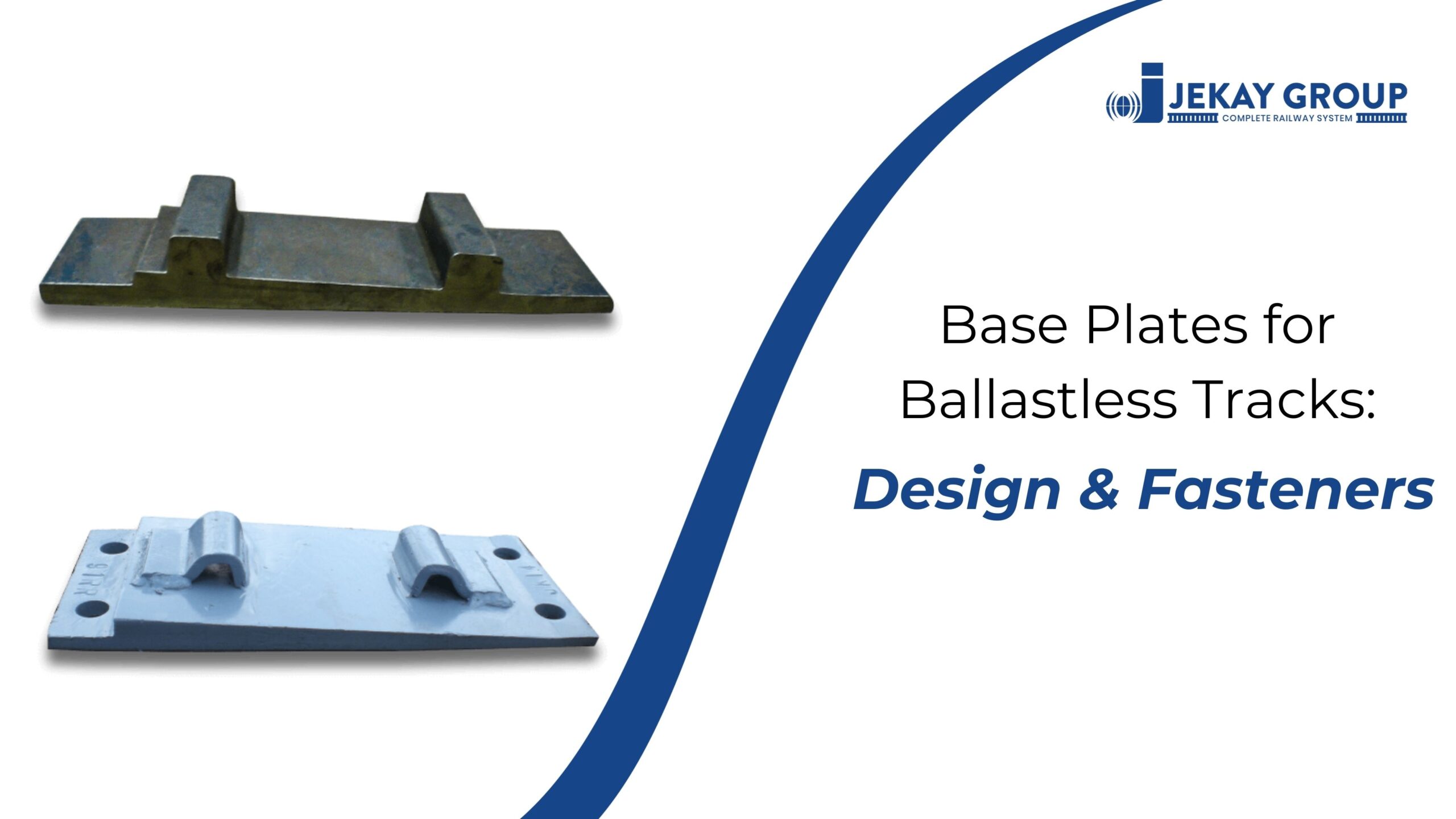
Ribbed designs create multiple load paths that distribute wheel forces across larger slab areas, reducing peak stresses by 30-40% compared to flat plates. The ribs also provide structural stiffness that prevents plate flexing under dynamic loads while maintaining overall system resilience through proper elastic component selection.
Ductile cast iron provides the optimal balance of strength, vibration damping, and manufacturing precision for complex ribbed geometries. Steel fabricated base plates work for simpler designs but require welding that introduces potential weak points.
Electrical Insulation Integration
Base plates for electrified railways must prevent current leakage from rail to concrete slab while maintaining mechanical integrity. Insulating layers between plate and slab, plus insulated anchor bolt sleeves, create the required electrical isolation. These insulation components must withstand compression loads exceeding 200 kN per base plate without breakdown or creep deformation.
A surprising reality: approximately 25% of ballastless track electrical faults trace to improperly specified or installed base plate insulation rather than rail-to-rail insulation failures.
Adjustment Range Capabilities
Vertical Adjustment Mechanisms
Ballastless tracks demand ±30mm vertical adjustment to compensate for slab level variations and achieve precise rail elevation. This adjustment typically occurs through shimming systems using calibrated steel shims in 1mm increments, or grub screw mechanisms that provide continuous adjustment within the design range.
Shim-based systems prove more reliable long-term because they can’t back off from vibration like threaded adjusters. However, shims complicate field adjustments after initial installation and grouting.
Lateral and Longitudinal Control
Base plates provide ±10mm lateral adjustment to achieve correct track gauge and alignment despite anchor bolt position tolerances. Slotted holes in the base plate allow this movement before final locking. Some advanced designs incorporate spring-loaded lateral restraints that maintain centerline positioning while allowing thermal expansion.
Zero longitudinal restraint (ZLR) base plates allow rails to expand freely without transferring forces into concrete slabs. This prevents thermal buckling in continuous welded rail applications where temperature swings create significant expansion forces.
Fastening System Integration
Elastic Clip Selection
Ballastless track base plates integrate with elastic rail clips that provide controlled toe load while absorbing dynamic impacts. E-clip designs create vertical clamping through spring action, while tension clamp systems generate force through bolt tightening against elastic elements. Toe load requirements typically range from 10-14 kN depending on traffic loads and operating speeds.
The base plate must provide properly designed shoulders or anchor points that maintain clip geometry throughout the adjustment range. Poor shoulder design allows clips to shift position during adjustment, compromising toe load consistency.
Rail Pad Specifications
Rail pads between base plate and rail foot provide the primary source of vertical resilience in ballastless systems. Static stiffness typically ranges from 80-150 kN/mm—significantly higher than ballasted track pads at 40-80 kN/mm. This increased stiffness compensates for the rigid concrete foundation while still providing adequate vibration isolation.
Dynamic stiffness under cyclic loading must remain within 20% of static values to prevent resonance conditions that amplify vibration transmission.
Performance Requirements
Load Distribution Verification
Base plates must distribute wheel loads across minimum 600cm² slab contact area to prevent concrete stress concentrations exceeding 15 MPa. Finite element analysis during design validates load distribution patterns, while prototype testing confirms analytical predictions. Undersized bearing areas create localized crushing that compromises long-term slab integrity.
Fatigue Resistance Standards
Railway base plates undergo 3-5 million load cycles annually in high-traffic corridors. RDSO specifications demand fatigue testing to 5 million cycles at maximum design loads without crack initiation or permanent deformation. This requirement eliminates marginal designs that might survive initial acceptance testing but fail after several years of service.
Testing at 1.5 times service loads provides safety margins accounting for overload conditions and material property variations.
Installation Considerations
Pre-Assembly Advantages
Factory pre-assembly of base plates with fastening components reduces field installation time by 40-50% compared to component-by-component installation. Pre-assembled units arrive at sites with clips, insulators, and rail pads already positioned and verified, eliminating field handling errors that compromise performance.
This approach demands precise manufacturing tolerances because adjustment after assembly becomes difficult.
Grouting and Locking Procedures
- Position base plate and achieve preliminary alignment using adjustment mechanisms
- Verify rail elevation, gauge, and alignment meet specification tolerances
- Inject non-shrink grout beneath base plate to fill voids and lock position
- Allow grout cure (typically 24-48 hours) before applying full rail tension
- Final torque check all anchor bolts after grout achieves design strength
Inadequate grouting creates voids that allow base plate movement and accelerate fatigue damage. Quality control must verify complete grout fill before accepting installation.
Compliance Standards
RDSO Annexure-III defines performance criteria for fastening systems in ballastless track applications including toe load ranges, dynamic stiffness values, electrical resistance requirements, and adjustment capabilities. Suppliers must demonstrate compliance through type testing at RDSO-approved laboratories before project deployment.
International references including UIC 864 and EN 13481 provide additional guidance for metro and high-speed applications. Buyers should specify applicable standards in procurement documents rather than accepting generic “railway quality” claims.
Documentation Requirements
Each base plate delivery must include material certificates for cast iron or steel, dimensional inspection reports covering critical features, electrical insulation test results, and assembly procedures when pre-assembled units are supplied. This documentation enables traceability and supports warranty claims if performance issues emerge.
FAQs
Q: What vertical adjustment range is standard for ballastless track base plates?
A: Standard designs provide ±30mm vertical adjustment through shim stacks or threaded mechanisms. Metro applications may require ±40mm to accommodate larger slab tolerance variations. Verify your concrete slab construction tolerance specifications before finalizing base plate selection. Insufficient adjustment range forces expensive slab grinding or overlay work to achieve rail elevation targets.
Q: How do ribbed base plates differ from flat designs?
A: Ribbed base plates distribute loads across larger slab contact areas through multiple load paths, reducing peak concrete stresses by 30-40%. They provide greater structural stiffness that prevents plate flexing while weighing less than equivalent flat plates. Specify ribbed designs for high-speed or heavy-haul applications where load distribution is critical to long-term slab integrity.
Q: Can base plate fastening systems be adjusted after grouting?
A: Limited adjustment remains possible through shim addition/removal or grub screw rotation depending on design type. However, major adjustments require grout removal and reinstallation. Plan comprehensive geometry surveys before final grouting to minimize post-installation adjustments. Quality control during initial installation prevents 95% of adjustment needs later.
Q: What toe load should be specified for metro ballastless tracks?
A: Metro applications typically require 10-12 kN toe load at installation for axle loads up to 17 tons. Heavy metro or light rail systems may need 12-14 kN. Specify toe load ranges rather than single values to accommodate manufacturing tolerances. Verify that proposed elastic clips maintain minimum toe load throughout the vertical adjustment range.
Q: How often do ballastless track base plates require inspection?
A: Initial inspection occurs 6 months after commissioning to verify grout integrity and fastener torque. Subsequent inspections follow 2-year intervals for standard traffic or annually for high-speed/heavy-haul. Check for anchor bolt loosening, clip condition, rail pad wear, and base plate cracking. The rigid slab foundation eliminates geometry degradation common in ballasted track, reducing maintenance frequency by 60-70%.
Conclusion
Base plate specification determines whether ballastless track projects achieve design geometry efficiently or struggle with costly alignment problems and premature maintenance needs. Focus on adequate adjustment range, proven load distribution capability, and documented compliance rather than accepting lowest-cost alternatives that compromise long-term performance. Visit jekay.com now to source precision-engineered base plates for ballastless track applications featuring ±30mm vertical adjustment, ribbed load distribution geometry, integrated elastic fastening compatibility, and complete RDSO compliance documentation—contact our technical team today to discuss your metro or high-speed rail project requirements and discover why leading infrastructure developers trust our 40+ years of track component expertise to deliver reliable ballastless track solutions that simplify installation while ensuring 50+ years of maintenance-free service.