
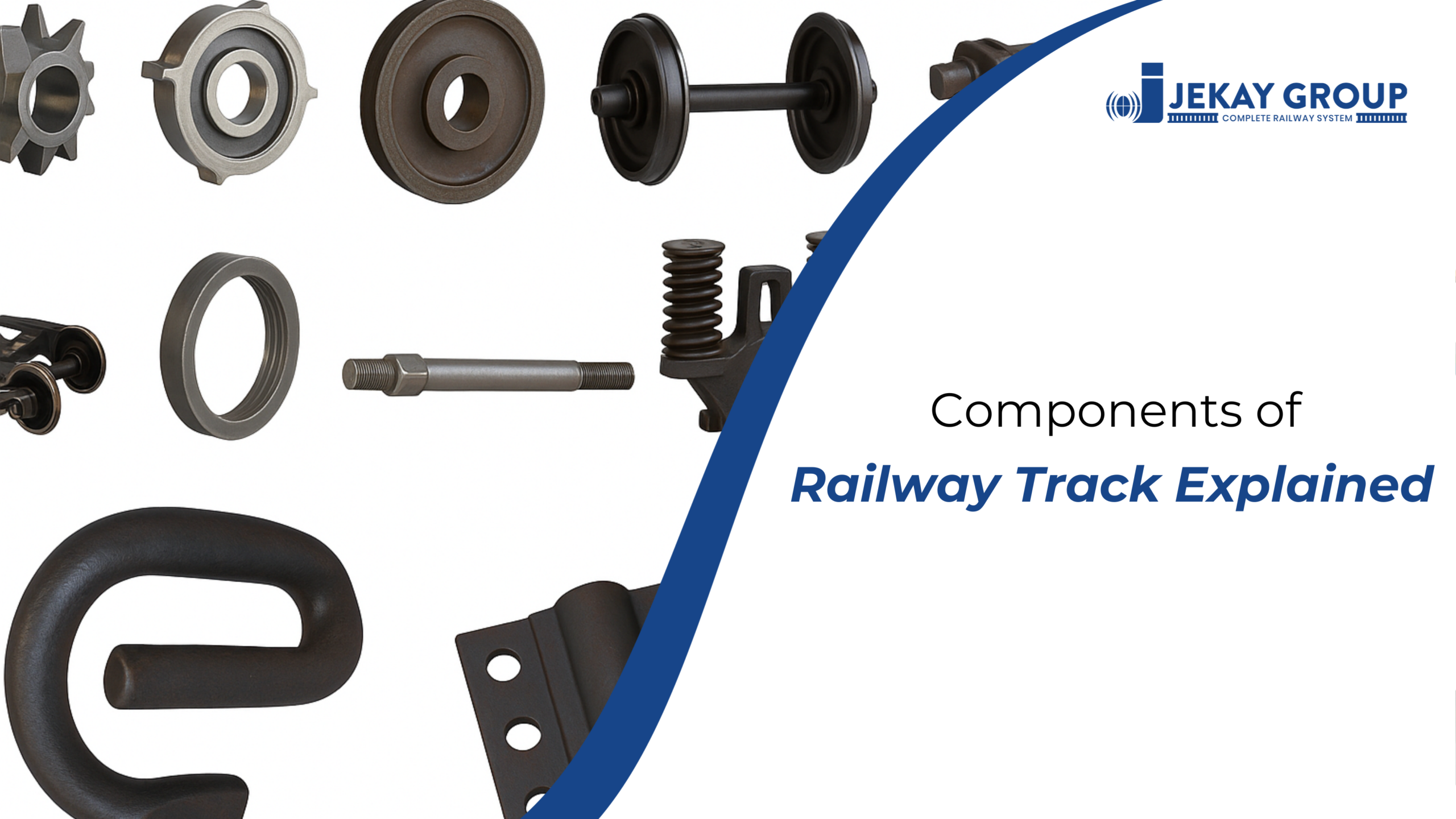
A railway track looks like a simple pair of steel rails, but it’s really a stack of interdependent components, and a weakness in any single one shortens the life of the whole system. Buyers who only think about rail quality often miss that sleepers, fasteners, ballast, and subgrade all carry equal weight in determining how long a track holds its geometry. This post breaks the track structure down piece by piece — what each component does, how it fails, and what to check before you specify or purchase one. By the end, you’ll know exactly where to focus your sourcing attention and why.
What Is a Railway Track
A railway track — also called the permanent way — is the structure that lets trains roll on a dependable, low-friction surface. It’s built in two parts: the superstructure, which includes rails, sleepers, fasteners, and ballast, and the subgrade, the compacted foundation underneath everything else.
Ballasted vs. Ballastless Track
Ballasted track uses crushed stone beneath the sleepers and remains the dominant structure worldwide because it’s flexible, affordable, and easy to maintain. Ballastless track replaces that loose stone bed with a concrete or asphalt slab, trading higher upfront cost for lower long-term maintenance and slower deformation over time.
Jointed vs. Welded Rail
Jointed track connects rail sections with bolted fish plates, which creates small gaps that concentrate stress every time a wheel crosses them. Continuously welded rail removes almost all of these gaps, which is why most heavy-traffic modern lines have shifted to welded construction wherever budget allows.
Rails
Rails form the primary rolling surface and take the brunt of every mechanical force a train generates.
What Rails Actually Do
- Provide a continuous, level surface for train wheels with minimal friction
- Deliver strength, durability, and lateral guidance to keep trains on course
- Transmit axle load down to the sleepers below
- Absorb stress from vertical loads, braking forces, and temperature swings
Rails are manufactured from high-carbon steel specifically because plain steel doesn’t hold up under repeated heavy axle loads. The flat-footed rail profile dominates modern track, though older bullhead designs still run on some legacy lines in Britain and Ireland.
Sleepers
Sleepers, also called ties, sit perpendicular to the rails and do more structural work than most buyers assume.
Core Functions
- Hold the rails at the correct gauge
- Distribute axle load evenly across the ballast bed
- Absorb vibration as an elastic buffer between rail and ballast
- Maintain rail alignment through turnouts and crossings
Material Choice Changes the Equation
Wooden sleepers were the original standard and remain in use on lower-speed lines, partly because wood offers natural electrical insulation. Concrete has become the dominant choice on modern track because it costs less over its service life and needs far less maintenance, while steel sleepers handle the heaviest loads in specialized freight applications.
Fasteners
Fasteners are the connective tissue between rail and sleeper, and they’re also where a surprising share of track problems actually originate. Loosened or degraded fasteners are cited more often than rail defects in investigations of gradual geometry drift — a detail that runs against the instinct to focus procurement attention on rails first.
Common Fastener Types
- Spikes and screws
- Rail anchors
- Tie plates and chairs
- Elastic rail clips
- Rail clamps
Elastic clips have largely replaced rigid spikes on modern lines because they apply consistent clamping force while flexing under load, which cuts both maintenance frequency and vibration transmitted into the sleeper.
Rail Joints
Rail joints — commonly called fish plates or joint bars — connect the ends of two rail sections into a continuous rolling surface.
Why Joints Matter More Than Their Size Suggests
Every wheel passage across a joint creates a small impact, and that repeated impact is why joints wear out faster than open rail. Several joint variants exist for different situations:
- Common joints — standard connections on matching rail sections
- Compromise joints — for joining different rail profiles
- Insulated joints — maintain electrical isolation for signaling circuits
- Glued insulated joints — combine mechanical strength with electrical isolation for higher-load applications
Continuously welded rail reduces the number of joints on a line dramatically, but joints never disappear entirely — they remain necessary at insulated sections, expansion points, and turnouts.
Ballast
Ballast is the crushed stone layer beneath the sleepers, and it does far more than just hold everything in place.
What Ballast Actually Accomplishes
- Distributes sleeper load evenly onto the subgrade below
- Provides drainage so water doesn’t pool under the track
- Holds sleepers in the correct lateral and longitudinal position
- Allows some flexibility for periodic realignment (tamping)
Ballast isn’t a set-once-and-forget layer. Over time, train weight crushes and shifts individual stones, which is why periodic tamping and eventual ballast replacement are standard line items in every maintenance budget.
Subgrade
The subgrade is the compacted foundation everything else in the track structure rests on, and it’s the component buyers think about least despite carrying the most consequence when it fails.
Why Subgrade Quality Is Non-Negotiable
A poorly compacted or poorly drained subgrade transmits its weaknesses upward through every layer above it — ballast shifts faster, sleepers settle unevenly, and rail geometry drifts out of tolerance. Fixing a subgrade problem after the fact means tearing up ballast, sleepers, and sometimes rail just to correct a foundation issue that should have been solved before construction began.
Turnouts and Switches
Turnouts — also called switches or points — let trains move from one track to another, and they carry a disproportionate share of the system’s stress and failure risk.
Why Turnouts Deserve Separate Attention
Turnouts occupy a small fraction of total track length but concentrate switch point impacts, frog loads, and geometric complexity into a short assembly. That concentration is exactly why turnout components — switches, frogs, guard rails — need specification standards distinct from plain track, not a scaled-down version of the same catalog part.
Track Maintenance
None of these components perform at their rated life without ongoing maintenance matched to actual traffic conditions.
Routine Maintenance Activities
- Rail grinding to maintain surface profile
- Sleeper replacement as individual units degrade
- Switch lubrication and adjustment
- Tamping and realigning ballast
- Tightening or replacing loosened fasteners
Mechanized track renewal trains have made large-scale sleeper and rail replacement faster and more consistent than manual methods, but the underlying inspection discipline — catching small defects before they compound — still determines whether a track hits its full design life or falls short of it.
FAQs
Which railway track component fails most often? Fasteners and joints tend to show problems earlier than rails or sleepers, largely because they experience the highest cyclic stress relative to their size. Regular inspection of clamping force and joint alignment catches most of these issues before they escalate into geometry defects.
Is ballastless track always better than ballasted track? Not necessarily — ballastless track offers lower long-term maintenance and slower deformation, but it costs significantly more to install and is harder to modify once built. Ballasted track remains the practical choice for most projects where flexibility and lower upfront cost matter more than minimal long-term upkeep.
Why does subgrade quality matter more than people assume? Every other component in the track structure sits on top of the subgrade, so any weakness there transmits upward through ballast, sleepers, and rail. Correcting a subgrade problem after construction is far more disruptive and costly than specifying it correctly from the start.
How often should ballast be replaced? Ballast doesn’t follow a fixed universal replacement schedule — it depends on traffic density, ballast quality, and drainage conditions. Tamping restores alignment between full replacements, but crushed or contaminated ballast eventually needs full renewal to maintain proper drainage and support.
Do concrete sleepers outperform wooden sleepers in every application? Concrete generally offers lower maintenance and longer service life, which is why it dominates modern high-traffic lines. Wooden sleepers still make sense on lower-speed lines or where natural electrical insulation is a specific requirement.
Build a Track System Where Every Component Pulls Its Weight
Jekay International Track Pvt. Ltd. has manufactured rail components — turnouts, fish plates, base plates, and fastening systems — since 1980, engineered to RDSO, EN, UIC, and IRS specifications for the actual load and traffic conditions each project demands. Our promise is straightforward: components specified and certified for the system they’re part of, not sold as generic catalog parts.
Share your track specifications and traffic parameters with our engineering team, and get a component-by-component sourcing recommendation for your project.