
Introduction
Track gauge widening causes 30% of speed restrictions on heavy-haul corridors, while uncontrolled vibrations accelerate ballast degradation by up to 50%. Traditional rigid fasteners can’t address both issues simultaneously—they either hold gauge or dampen shock, but rarely both effectively. Elastic rail clips solve this dual challenge through spring-loaded resilience that maintains consistent toe load while absorbing dynamic wheel forces.
This guide explains how elastic clips work, their mechanical advantages over rigid systems, and selection criteria for different track applications. You’ll learn the physics behind gauge stability, vibration damping mechanisms, and performance metrics that separate quality clips from inadequate alternatives.
What Are Elastic Rail Clips?
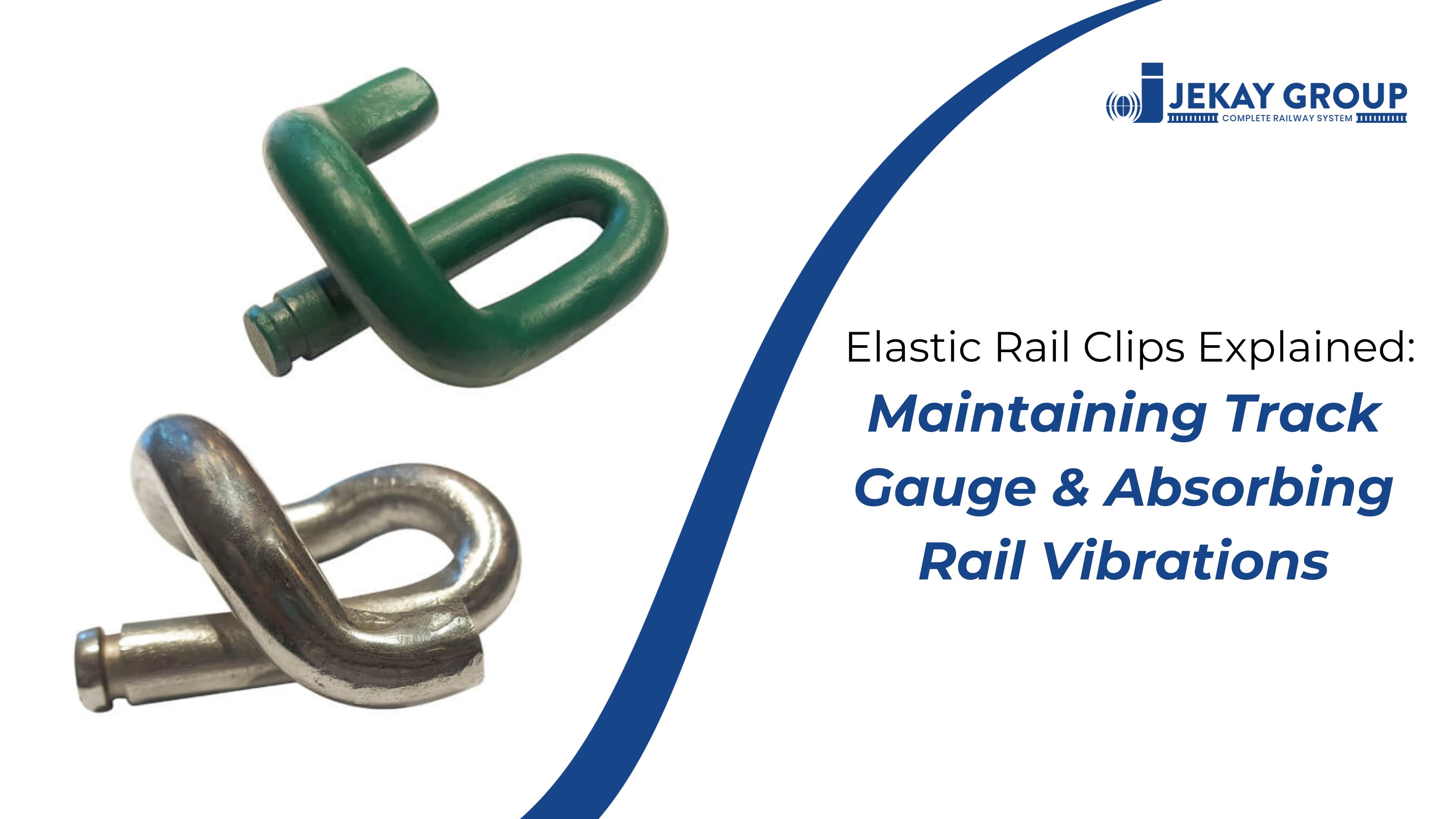
Elastic rail clips are spring steel components that secure rails to sleepers through controlled deflection and recovery. Unlike rigid spikes that rely on friction, elastic clips generate constant clamping force through material elasticity.
Common types include e-clips (single-piece designs with shoulders), SKL clips (double-coil tension systems), and fast clips (modified e-clips for quick installation). Each variant suits specific rail profiles and sleeper configurations.
Manufacturing uses high-carbon spring steel grades (typically 60Si2Mn or equivalent) heat-treated to 42-52 HRC hardness. The steel undergoes hot forming, quenching, tempering, and shot peening to achieve fatigue resistance exceeding 2 million load cycles.
Surface treatments include phosphating for corrosion protection or galvanizing for coastal environments. Untreated clips corrode within 5-8 years in aggressive atmospheres.

How Elastic Rail Clips Maintain Track Gauge?
Four-Point Contact Mechanism
Elastic clips shoulder simultaneously against the rail foot and sleeper insert, creating four distinct contact points. This geometry locks rail position laterally while allowing controlled vertical movement.
The clip’s pre-tensioned state generates 12-18 kN toe load—horizontal force pressing the rail base against the shoulder. This force resists lateral displacement from wheel flange contact and thermal expansion.
Self-Tensioning Properties
As rail head wears down (typically 1-2mm annually on heavy corridors), the clip relaxes slightly but maintains 75-80% of original toe load through elastic recovery. Rigid spikes lose 60% clamping force under identical wear.
Temperature swings cause rail expansion of 0.6mm per degree Celsius per 10-meter length. Elastic clips accommodate this movement without loosening, while screw spikes back out 2-3mm annually from thermal cycling.
Rail Creep Resistance
Longitudinal creep—rail movement along track direction—accelerates joint failures and gauge inconsistency. Elastic clips limit creep to under 1mm per million gross tonnes versus 4-6mm for spike-fastened track through superior toe load retention.
Field data from Indian Railways shows elastic-fastened sections maintain gauge within ±3mm after 20 years versus ±10mm deviation on conventionally fastened track of similar age and tonnage.
Vibration Absorption and Shock Damping
Elastic clips deflect 2-4mm under wheel impact loads, converting kinetic energy to elastic potential energy stored in the spring steel. This deflection cushions shock that would otherwise transmit directly to sleepers and ballast.
Rail pads—rubber or polymer layers between rail and base plate—add a second elastic stage. The combined system (elastic clip + resilient pad) reduces peak vibration amplitudes by 60-75% compared to rigid spike and hard metal contact.
Noise Reduction Benefits
Track noise drops 5-8 dB on lines equipped with elastic fastening systems. The vibration damping prevents resonance in rail and sleeper that generates noise frequencies audible up to 500 meters from the track.
Urban transit systems particularly benefit. Elastic clips reduce ground-borne vibration transmission into adjacent buildings by 40-50%, minimizing complaints and regulatory violations.

Mechanical Properties and Performance Metrics
Toe Load Specifications
RDSO standards specify a minimum 10 kN toe load after installation and 8 kN after 5 years service. Quality elastic clips deliver 14-16 kN initially and retain 11-13 kN after 10+ years.
Toe load measurement uses calibrated load cells inserted between clip and shoulder. Variability should stay within ±1 kN across production batches—wider spreads indicate inconsistent heat treatment or forming.
Fatigue Life Under Cyclic Loading
Premium elastic clips withstand 2.5-3 million fatigue cycles before cracking initiates at stress concentration points (typically shoulder radius or coil transitions). Budget clips fail after 800,000-1.2 million cycles.
Each passing axle constitutes one load cycle. A track carrying 100 trains daily with 60 axles per train experiences 2.2 million cycles annually—requiring clips rated for multi-year service.
Rail Profile Compatibility
Clips designed for 52kg rail won’t fit 60kg profiles—the dimensional differences in rail foot width and height alter contact geometry. Suppliers must verify clip-to-rail compatibility through dimensional analysis before specification.
Installation and Fastening System Integration
A complete elastic fastening assembly includes:
- Elastic clip: Provides toe load and lateral restraint
- Shoulder insert: Creates clip bearing surface on sleeper side
- Rail pad: Dampens vibrations between rail and base plate
- Liner: Insulates rail electrically and fine-tunes rail height
- Base plate: Distributes loads to sleeper surface
Installation sequence matters. Incorrect assembly order—particularly inserting clips before pads seat properly—reduces toe load by 20-30% and accelerates wear.
Mechanized clip applicators achieve 200-300 clips per hour with consistent toe load. Manual installation varies widely (50-150 per hour) depending on operator skill and fatigue.
Track geometry adjustment uses different liner thicknesses (2mm, 4mm, 6mm options) to raise or lower rail. This flexibility allows fine-tuning without replacing entire assemblies.
Quality Control and Testing Standards
RDSO specification IRS T-31 governs elastic rail clips for Indian Railways, defining dimensional tolerances, material composition, hardness ranges, and toe load minimums.
EN 13481 series covers European applications with similar requirements plus additional fatigue testing protocols. UIC 864-6 applies to international projects mixing regional standards.
Testing protocols include:
- Toe load measurement: Using calibrated load cells on sample clips
- Fatigue testing: 3 million cycle simulation at design load amplitudes
- Hardness verification: Rockwell C-scale testing at multiple clip locations
- Chemical analysis: Spectroscopy confirming spring steel composition
Batch certification should accompany every delivery, tracing clips to specific heat treatment runs and raw material sources.

Maintenance and Service Life Considerations
Visual inspection reveals clip degradation before failure. Warning signs include visible cracks at shoulder radius, permanent deformation (clips not springing back when removed), and corrosion pitting exceeding 0.5mm depth.
Inspection intervals depend on traffic density. Heavy-haul lines (25+ million gross tonnes annually) need annual clip checks. Passenger lines carrying under 10 million gross tonnes inspect every 2-3 years.
Replacement procedures take 1-2 minutes per clip using standard tools. Remove old clip with lever bar, verify shoulder insert condition, install new clip ensuring proper seating. No track outage required—work proceeds under traffic.
Service life expectations range 20-30 years for quality clips on standard mainlines. Extreme conditions—coastal corrosion, excessive curvature, or poorly maintained track geometry—reduce life to 12-18 years.
Choosing the Right Elastic Rail Clip Supplier
RDSO-compliant manufacturing ensures clips meet Indian Railways specifications. Verify supplier holds valid approvals and can provide recent test certificates—outdated certifications signal production gaps.
Customization capability addresses non-standard rail profiles, special sleeper spacings, and hybrid track sections. Suppliers with engineering teams modify clip geometry for project-specific requirements.
In-house testing facilities demonstrate quality commitment. Suppliers operating fatigue test rigs and load measurement equipment validate performance before delivery rather than relying on third-party labs.
Global supply networks reduce delivery risks. Multi-facility manufacturers respond faster to urgent orders and maintain buffer stock for common clip types.
Frequently Asked Questions
Q: How do I know if elastic clips have lost too much toe load?
A: Use a calibrated toe load measuring device inserted between clip and shoulder. Readings below 8 kN indicate replacement needed. Visual signs include permanent clip deformation where it no longer springs back fully when lifted, or visible cracks at stress concentration points.
Q: Can elastic clips work with wooden sleepers?
A: Yes, using adapter base plates that provide shoulder geometry and bearing surfaces. The plate bolts or screws into wood, creating a platform for elastic clip installation similar to concrete sleeper systems.
Q: What causes premature elastic clip failure?
A: Primary causes include manufacturing defects (improper heat treatment, incorrect steel grade), installation errors (clips forced into wrong positions), and aggressive environments (coastal salt exposure without adequate coating). Over-gauge track also overstresses clips beyond design limits.
Q: Do all elastic clips provide the same vibration damping?
A: No. Single-coil clips offer less deflection travel (2-3mm) than double-coil designs (4-6mm), reducing damping effectiveness. Clip design, material thickness, and complementary rail pad selection all influence total vibration reduction.
How long do elastic clips maintain their spring properties?
A: Quality clips retain 75-80% of initial toe load after 20-25 years in standard service. Spring steel properties degrade gradually through repeated stress cycling, but proper heat treatment ensures predictable, slow deterioration rather than sudden failure.
Conclusion
Elastic rail clips maintain track gauge through self-tensioning toe load that resists lateral forces and thermal movement. They simultaneously absorb vibrations by deflecting under wheel impacts, protecting track structure and reducing noise. Understanding clip mechanics, performance specifications, and maintenance requirements ensures you select components that deliver decades of reliable service. Match clip type to your rail profile, traffic loads, and environmental conditions for optimal track stability.
Need technical guidance selecting elastic rail clips for your project? Contact our engineering team for a detailed fastening system analysis.
Why Choose Jekay International for RDSO-Compliant Elastic Rail Clips?
Since 1980, Jekay International manufactures precision elastic rail clips meeting RDSO IRS T-31 specifications and international standards for railway projects across 13+ countries. Our production includes e-clips, SKL clips, and custom designs for 52kg, 60kg, and specialized rail profiles—all backed by in-house fatigue testing and toe load verification.
We combine metallurgical expertise with real-world track performance data. Our spring steel clips undergo controlled heat treatment achieving 42-52 HRC hardness, shot peening for fatigue resistance, and corrosion protection suitable for coastal and industrial environments. Every production batch includes certified toe load testing, hardness verification, and material traceability documentation.
Technical support extends beyond component supply. Our engineering teams analyze your rail profile, sleeper type, axle loads, and operating speeds to recommend clip configurations optimized for gauge stability and vibration control. From high-speed passenger corridors to heavy-haul freight lines, Jekay delivers elastic fastening solutions proven under demanding operational conditions.
Discuss your elastic rail clip requirements with our specialists. Visit jekay.com or request technical specifications, test certificates, and project quotations directly through our website. Let four decades of fastening system manufacturing expertise ensure your track stability and performance.