
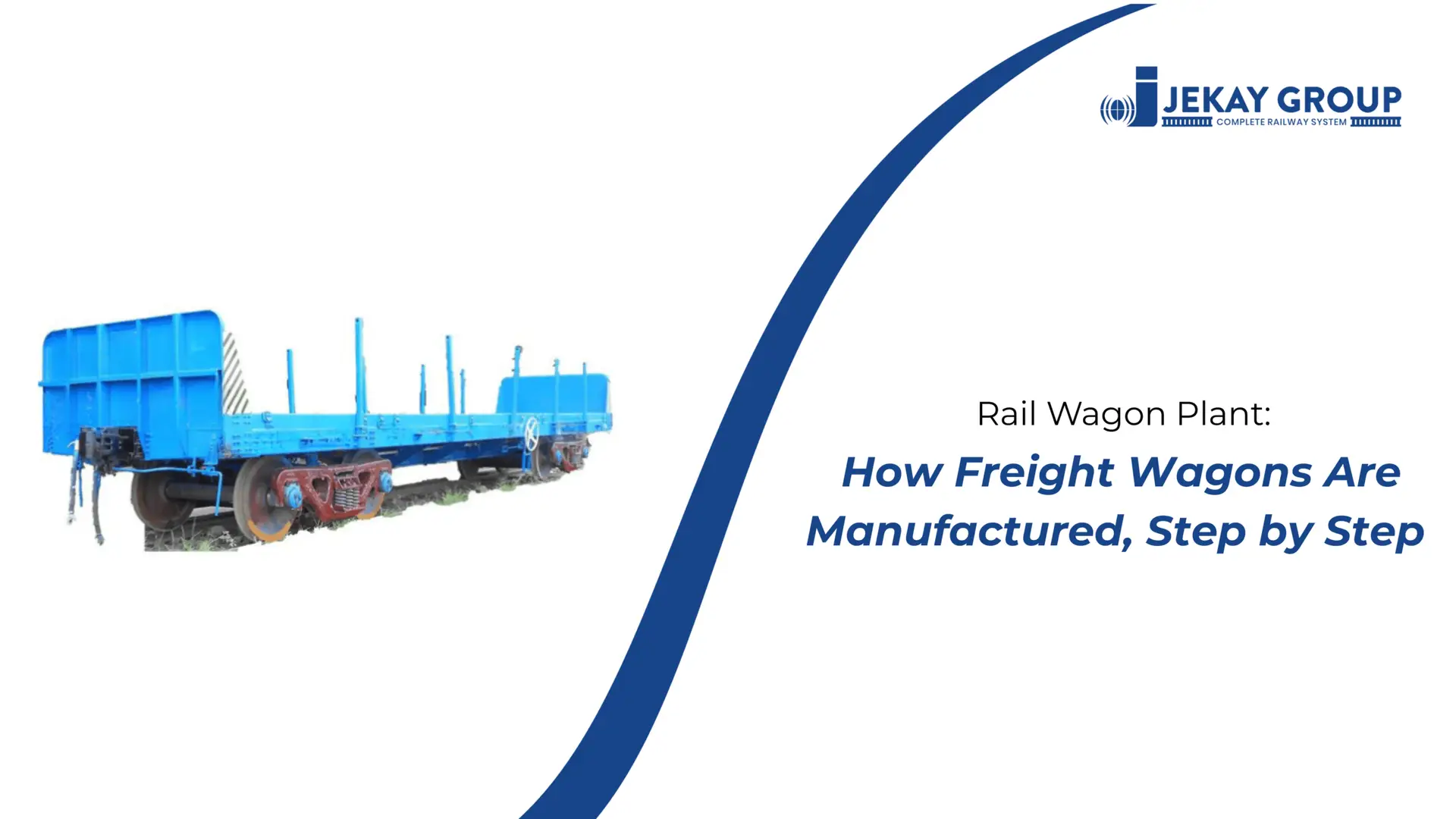
A freight wagon looks like a simple steel box on wheels. Inside the plant, it is closer to a structural bridge that has to survive 30-plus years of loading, shunting impacts and vibration. Most failures traced in service go back to a weld, a casting or a fit-up decision made on the shop floor.
This guide walks through how a freight wagon is built, from the first steel plate to the final brake test. We explain each stage, what gets checked, and what separates a well-run wagon plant from an average one. It comes from a manufacturer that runs its own wagon plant, foundry and spring plant.
What Happens Inside a Rail Wagon Plant
A wagon plant converts steel plates, rolled sections and castings into a finished, tested vehicle. It combines heavy fabrication, precision assembly and pneumatic systems work under one roof.
The plant layout usually follows the build sequence. Material enters at one end, sub-assemblies merge into the main line, and finished wagons roll out on rails at the other end.
Key Sections of a Wagon Plant
Most integrated wagon plants include:
- Raw material yard and inspection bay
- Cutting and forming shop with CNC plasma, profile cutting and press brakes
- Sub-assembly shop for sole bars, centre sills, bolsters and doors
- Main fabrication line with underframe and body jigs
- Surface treatment with shot blasting and paint booths
- Bogie shop for assembling cast steel bogies and springs
- Final assembly line for brakes, couplers and lowering the body onto bogies
- Testing area for brake, dimensional and weight checks
Plants with an attached foundry and spring plant add a big advantage. Bogies, couplers and springs never leave the company’s control.
Wagon Manufacturing Process, Step by Step
1. Design and Drawing Approval
Every wagon starts with an approved design and specification. The plant prepares shop drawings, welding procedures and jig designs for that wagon type. For Indian Railways, this follows RDSO-approved drawings and IRS specifications.
2. Raw Material Inspection
Steel plates and sections arrive with mill test certificates. The plant checks chemistry, mechanical properties and dimensions before anything gets cut. Common materials include mild steel to IS:2062 and corrosion-resistant steel to IRS:M44.
3. Cutting and Forming
CNC plasma and oxy-fuel machines cut plates to profile. Press brakes and hydraulic presses then bend and form parts such as side stanchions, floor plates and end wall members. Tight tolerances here save hours of rework later.
4. Sub-Assembly Fabrication
Smaller assemblies are built and welded first:
- Centre sill and sole bars
- Body bolsters and cross bars
- Side wall and end wall panels
- Doors and hopper gates
Welding these separately keeps distortion low and makes inspection easier.
5. Underframe Welding
The underframe is the backbone of the wagon. Sub-assemblies are placed in a fixture, tack welded, then fully welded. Centre sills are often joined with submerged arc welding for deep, consistent penetration.
Here is a detail that surprises most buyers. The underframe is deliberately held at a slight upward camber during welding. As the welds cool and shrink, the frame pulls back toward straight. A frame welded perfectly flat would end up sagging.
6. Body Fabrication and Assembly
Side walls and end walls go into the main assembly jig on top of the underframe. Good plants use manipulators or turnover rigs to rotate the body, so welders can work in the flat, downhand position. Downhand welds are stronger and more consistent than welds made sideways or overhead.
7. Shot Blasting and Painting
The finished body is shot blasted to remove mill scale, rust and weld spatter. Primer and top coats follow in controlled paint booths. Stencilling adds the wagon number, code, tare weight and other markings.
8. Bogie and Coupler Preparation
Cast steel side frames and bolsters come from the foundry. They are machined, inspected and assembled with wheelsets, springs, friction snubbers and brake beams. Couplers and draft gears are prepared in parallel.
9. Air Brake Fitment
The brake pipe, feed pipe, distributor valve, brake cylinder, auxiliary reservoir and brake rigging are fitted to the underframe. Every joint is checked for leaks.
10. Final Assembly
The body is lowered onto its two bogies at the centre pivots. Couplers are fitted at both ends. Side bearers, brake connections and safety fittings complete the wagon.
Testing and Inspection Before Dispatch
No wagon leaves the plant on trust. Standard checks include:
- Dimensional inspection against approved drawings, including buffer height and wheelbase
- Weld inspection by visual checks and, where specified, ultrasonic or dye penetrant testing
- Single wagon air brake test for leakage, application and release times
- Tare weighment to confirm weight is within limits
- Water leak test for covered wagons
- Final inspection by the buyer’s nominated agency
Tare weight matters more than it looks. Every kilogram removed from the body becomes a kilogram of extra payload on every trip for three decades.
Factors That Decide Wagon Quality
Two plants can build the same wagon code to the same drawing and still deliver very different wagons. The difference usually comes from:
- Jig accuracy: Worn jigs produce out-of-square bodies
- Welding procedure control: Qualified welders, correct parameters and sequence
- Casting quality: Clean metal and proper heat treatment in bogies and couplers
- Paint system: Surface preparation decides how long the coating lasts
- Inspection discipline: Checks at each stage, not only at the end
Common Manufacturing Defects and How Plants Prevent Them
Most wagon defects are predictable, which means they are preventable at source. Here are the ones inspectors look for most often:
- Weld porosity and lack of fusion: Caused by damp electrodes, wrong parameters or poor joint fit-up. Controlled consumable storage and qualified welding procedures prevent it.
- Distortion and out-of-square bodies: Caused by wrong welding sequence or worn jigs. Regular jig calibration and pre-set camber keep frames true.
- Paint failure at weld seams: Caused by spatter and poor blasting near joints. Thorough shot blasting before priming fixes it.
- Brake pipe leakage: Caused by poor thread sealing or damaged fittings. A pressure decay test on every wagon catches it.
- Casting defects in bogies and couplers: Shrinkage, sand inclusions and cracks. Automated moulding, controlled pouring and non-destructive testing catch them before assembly.
A defect caught in the plant costs a few hours of rework. The same defect found in service costs a wagon out of traffic.
How to Evaluate a Wagon Plant
Before placing an order, visit the plant or ask for evidence on:
- Annual installed capacity and current order load
- Approved wagon types and design approvals
- In-house foundry for bogies and couplers
- In-house spring manufacturing
- Testing labs and inspection records
- Delivery history on past orders
A plant that builds wagons but buys every casting is an assembler. A plant that casts, machines and assembles controls the parts most likely to fail.
Frequently Asked Questions
How long does it take to build one freight wagon?
Once materials and castings are in place, a flow-line plant can complete a wagon in a few days of shop time. Overall lead time for an order depends on material supply, approvals and batch size.
What steel is used in Indian freight wagons?
Mild steel to IS:2062 and corrosion-resistant steel to IRS:M44 are the most common. Many modern wagons use a mix, with stainless steel in the body to resist corrosion from coal and minerals.
Why are bogies made in a foundry and not fabricated?
Cast steel bogies give complex shapes and uniform strength in one piece. They handle heavy axle loads and repeated impacts well and are easy to repair in workshops.
Who inspects wagons before dispatch?
For Indian Railways orders, an inspection agency nominated by the railway checks the wagons. Export buyers usually appoint their own inspectors or third-party agencies.
Conclusion
Building a freight wagon is a chain of controlled steps: approved design, inspected steel, precise cutting, jig welding, careful finishing, brake fitment and final testing. Each step locks in quality or locks in a defect. The plants that own the castings, springs and fabrication carry the fewest surprises into service.
If you are sourcing wagons, ask us for a plant walkthrough or a capability document for your wagon type.
Built End to End at Jekay International
Jekay International Track Pvt. Ltd. has served railway developers, governments and private operators since 1980. Our wagon plant spans 250,000 sq ft and can produce up to 4,800 wagons a year. Our flaskless foundry, with an annual capacity of 25,000 MT, casts the bogies and couplers that go under our wagons, and our in-house spring plant supplies the bogie springs.
We promise wagons where every critical part, from casting to final brake test, is made and checked by one team.
Book a plant capability discussion with Jekay International.