
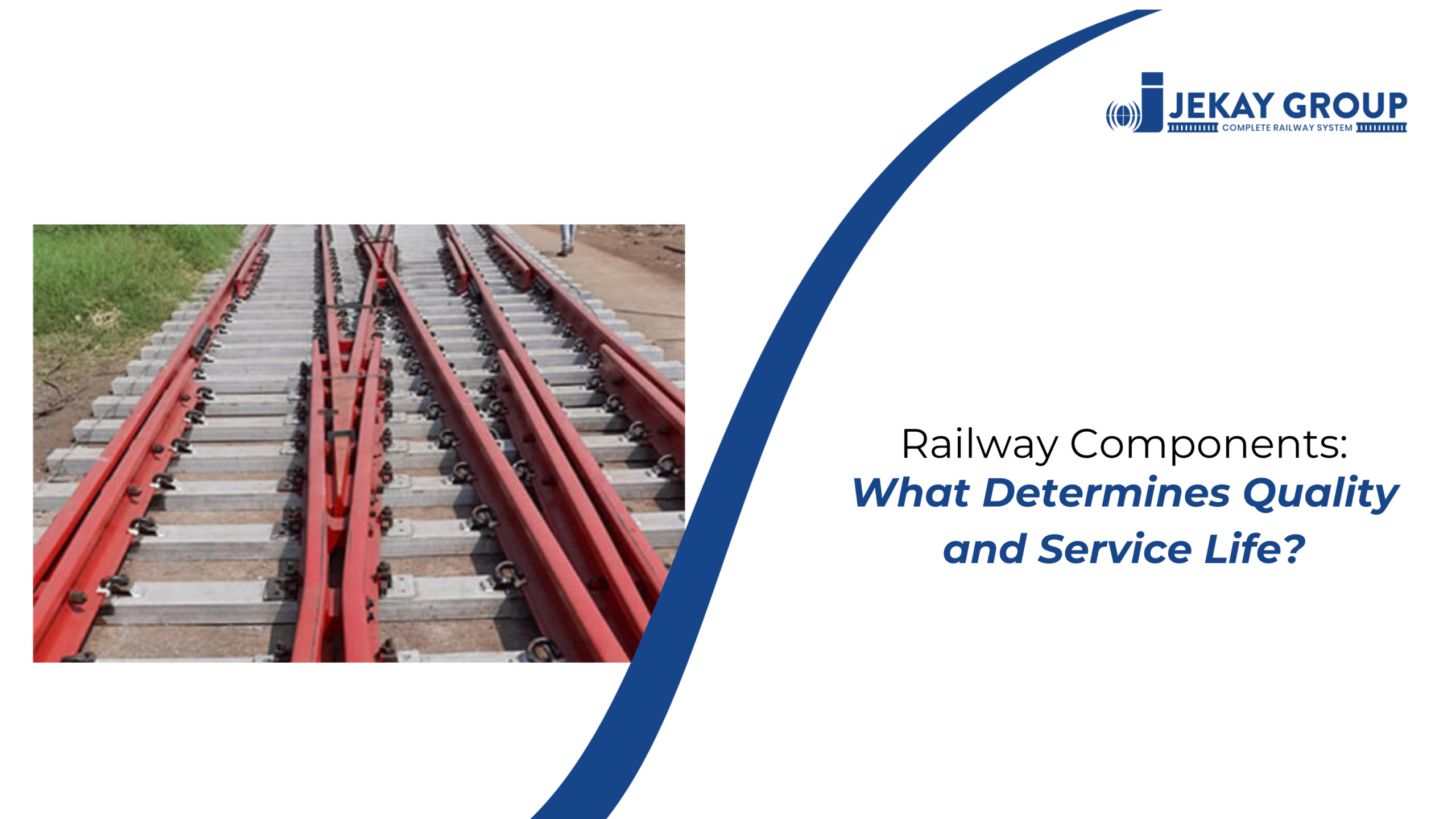
Two fish plates can meet the same specification, carry the same test certificate, and cost within ten percent of each other. One lasts twenty years. The other starts cracking at the bolt holes in three. Nothing on paper predicted the difference, because the things that decide service life mostly happen inside the material and never appear on a datasheet. This guide covers what actually determines how long a railway component survives, what a buyer can verify before purchase, and what has to be demanded rather than assumed. We manufacture these parts, so this is written from the production side of that question.
Service Life Is a Fatigue Problem
Railway components rarely fail by being overloaded once. They fail after millions of load cycles, at a stress concentration, in a place nobody could see.
That reframes the whole quality question. Tensile strength on a certificate tells you what the part survives once. Service life is decided by what happens at cycle four million — and that depends on grain structure, internal soundness, surface finish and residual stress. None of those are on the purchase order.
What Determines Quality
Raw Material and Chemistry
Consistent chemistry across heats is the foundation. Variation in alloying elements changes hardenability, which changes how the part responds to heat treatment, which changes fatigue behaviour. A supplier who cannot show heat-wise traceability cannot show consistency.
Forming Method and Grain Flow
How a part is shaped decides how its internal structure is oriented.
- Forging aligns grain flow along the part’s shape, so the material’s strongest direction follows the stress path
- Casting gives design freedom for complex geometry like crossings and coupler components, with soundness controlled through moulding and pouring practice
- Rolling produces consistent sections with predictable through-thickness properties
Adequate reduction during forging closes internal discontinuities and refines grain. Under-worked material carries its defects forward.
Heat Treatment
The highest-leverage and least visible process step. Heat treatment sets hardness, yield strength, impact energy and residual stress balance in one operation.
It is also where shortcuts are invisible. Improper thermal processing introduces brittleness or distortion that only shows under prolonged service. A part that was under-soaked or quenched from the wrong temperature looks identical to a correct one at delivery and behaves very differently at year five.
Dimensional Accuracy and Surface Finish
Tolerances are a fatigue variable, not a fitting convenience.
- A plate that does not seat fully bears on points instead of faces
- A punched bolt hole carries micro-cracks that a drilled and reamed hole does not
- Machining marks and tool witness lines in a high-stress radius are crack initiation sites
- Batch-to-batch variation forces crews to improvise, which introduces installation defects
Protective Treatment
Corrosion removes section, and lost section is lost fatigue life. Coating specification should follow the actual environment — coastal, tunnel, industrial, level crossing — rather than a default.
What Testing Can and Cannot Tell You
Non-destructive testing catches specific defect classes. Knowing which is which prevents false confidence.
- Ultrasonic testing — internal soundness, inclusions, subsurface flaws
- Magnetic particle inspection — surface and near-surface discontinuities in ferrous parts
- Dye penetrant — surface-breaking cracks
- Radiography — internal defects in castings
- Hardness and mechanical testing — confirms heat treatment achieved its target
- Dimensional verification — confirms the part matches the drawing
What none of them confirms is process control. A sample that passes tells you about that sample. Consistency across a production run is demonstrated by documented process control and traceability, not by a test report on one piece.
The Cost Asymmetry Nobody Prices In
Components are a small share of a track project. Maintenance and renewal over the asset’s life are not.
Life cycle costing on railway track shows how much the timing of renewal dominates. In one study, extending the renewal cycle from six years to twelve by replacing rails mid-life cut the annualised life cycle cost from about 5.8 million to about 3.9 million currency units — roughly a third off the yearly cost, achieved purely by making the structure last longer between reconstructions.
Components that survive longer push renewal further out. That is where the money is, and it is invisible at the tender stage where the unit price is the only visible number.
Standards Are a Floor, Not a Target
A specification defines the minimum acceptable component. It is written to be achievable by a broad range of suppliers, which means meeting it exactly puts you at the bottom of the acceptable band.
That distinction matters most on fatigue-critical parts, where the relationship between material margin and service life is not proportional. Small increases in strength or soundness can produce disproportionate gains in cycles to failure, because fatigue behaviour is governed by defect size and stress concentration rather than by bulk strength.
Two practical consequences follow:
- Specify a target within the band, not just the standard reference — for example, a stated hardness range rather than a minimum
- Ask what the supplier’s process actually delivers, and how much of the band their distribution occupies
A supplier whose output clusters near the top of the range is selling a different product from one whose output scatters across it, even though both pass the same test.
How to Evaluate a Supplier
Ask for the things that indicate control rather than compliance.
- Heat-wise material traceability from raw material through to the delivered part
- Documented heat treatment records — actual furnace data, not a statement that treatment was performed
- In-house process capability — forging, rolling, machining, foundry under one quality system rather than a chain of subcontractors
- NDT scope and acceptance criteria, and who performs it
- Dimensional inspection records across the batch, not a first-article report
- Relevant approvals — RDSO, IRS, UIC, EN, AREMA as applicable to your specification
- Repeat supply history on the same drawing, which proves process stability over time
- The ability to reproduce the part in fifteen years, when you need matching replacements
That last one is underrated. Track outlives procurement cycles. A component you cannot re-order to the same drawing becomes a maintenance problem long before it wears out.
Signs of a Component That Will Not Last
- Punched rather than drilled bolt holes on high-tonnage applications
- Visible porosity, cold shuts or surface defects on castings
- Inconsistent dimensions within a single delivery
- Rough tool marks in fillets and radii
- Coating applied over rust or scale
- Test certificates that cannot be tied to a specific heat or batch
- A price that only makes sense if a process step was skipped
FAQs
Is forged always better than cast? No — they suit different geometries. Forging aligns grain flow with the stress path, which suits simple high-fatigue parts like clips and bolts. Casting handles complex shapes such as crossings and coupler components that cannot be forged. Quality within each method matters more than the choice between them.
Why does heat treatment matter so much? It sets hardness, strength, toughness and residual stress simultaneously, and mistakes in it are invisible at delivery. Two identical-looking parts with different thermal histories can differ by multiples in fatigue life.
Does a test certificate guarantee quality? It confirms that a sample met a requirement. It does not demonstrate consistency across a production run. Process control records and traceability are what indicate the whole batch behaves like the sample.
Why do drilled bolt holes outperform punched ones? Punching leaves a work-hardened, micro-cracked edge that acts as a fatigue initiation site. Drilling and reaming produces a cleaner surface, which matters because bolt holes are where plates and joint components usually crack.
How should component quality be weighed against price? Against replacement cost, not purchase cost. On track components, the material is usually a minor part of the total — labour, possession time and traffic disruption dominate. A component that lasts twice as long avoids that entire cost twice over.
Conclusion
Quality in railway components is decided by material consistency, forming method, heat treatment discipline and dimensional control — and confirmed by traceability rather than by a single certificate. Service life follows from those choices, and service life is what sets renewal timing, which is where the real money sits.
Jekay International Track has manufactured railway components since 1980 — fish plates, base plates, elastic fastenings, rail pads, sleepers, bolts, insulated and expansion joints, CMS crossings, rolled sections and wagon components — with in-house forging plants, rolling mills, CNC machining, a flaskless foundry, high-pressure moulding and CMS welding. Control across those processes is what makes consistency possible.
Evaluating suppliers or specifying for a renewal? Send us your drawings and standards and we will tell you exactly what we can hold.