
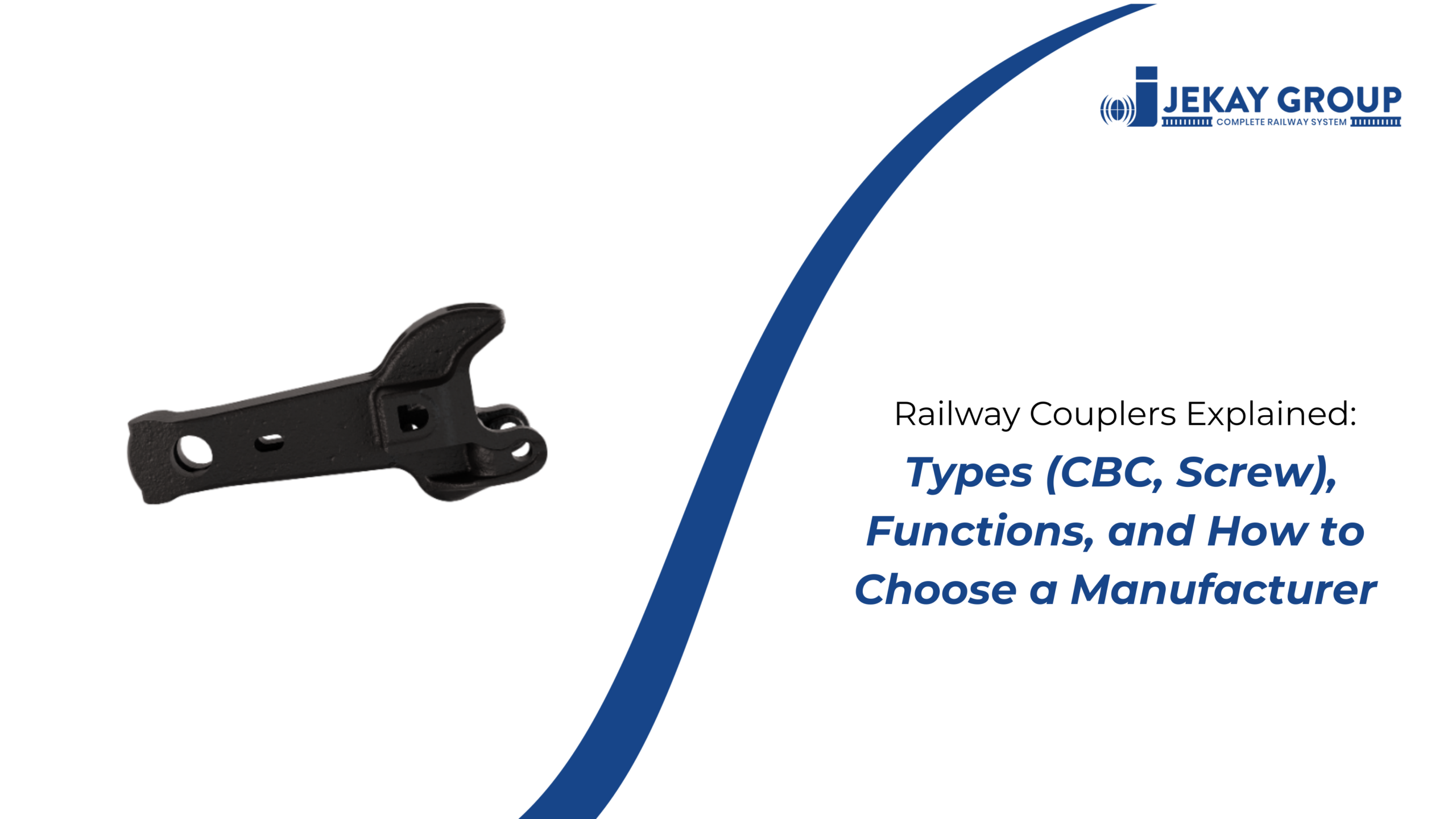
A freight rake of 58 wagons is held together by 57 coupler pairs. Every tonne the locomotive pulls, and every jolt when the rake bunches up under braking, passes through them. When a coupler or knuckle fails, the train parts on the line and the section stays blocked until it is cleared.
This guide explains what railway couplers do, the main types used in India, how a Centre Buffer Coupler is built, and what to check before you choose a manufacturer. It comes from a manufacturer that casts high-tensile CBCs in its own foundry for freight wagons.
What Is a Railway Coupler
A coupler is the device that joins one rail vehicle to the next. It sits at the centre or ends of the vehicle’s headstock and carries the forces that run along the length of the train.
On older stock, separate parts handle pulling and pushing. On modern freight wagons, one Centre Buffer Coupler does both jobs.
Functions of a Coupler
Draft (Pulling)
When the locomotive pulls, tensile force travels from coupler to coupler down the train. The couplers nearest the locomotive carry the highest draft load on a heavy rake.
Buffing (Pushing)
When the train brakes, slows on a down gradient or is shunted, the wagons push into each other. The coupler and its draft gear take this compressive load.
Energy Absorption Through Draft Gear
Behind every CBC sits a draft gear, a spring or elastomer unit that absorbs shocks in both directions. It smooths out the jerks that would otherwise crack castings and damage cargo.
Types of Railway Couplers
Screw Coupling with Side Buffers
This is the older system, still used on many conventional passenger coaches. A draw hook and screw link pull the vehicles together, while two side buffers on each end take the push.
The enhanced screw coupling used on Indian Railways has a working capacity of about 36 tonnes and a proof load of about 60 tonnes. That ceiling limits how long and how heavy a train can be.
Centre Buffer Coupler (AAR E Type)
Indian freight wagons use the high tensile knuckle-type Centre Buffer Coupler based on AAR practice, with an E-type head and F-type shank. It couples automatically when two wagons are pushed together and takes both draft and buffing loads at the centre.
Tight-Lock CBC (AAR H Type)
The H-type is a tight-lock version used on modern passenger coaches. It limits slack between vehicles, which reduces jerks and keeps coaches aligned in a derailment.
Transition Coupler
A transition coupler combines a knuckle coupler with a screw coupling mounted inside it. It lets locomotives and some wagons connect to both CBC-fitted and screw-coupled stock.
CBC vs Screw Coupling: Key Differences
| Feature | Screw Coupling | Centre Buffer Coupler |
| Coupling action | Manual, by hand | Automatic on impact |
| Buffing load | Taken by side buffers | Taken at the centre |
| Load capacity | Limited by weight of parts | Far higher, suits heavy rakes |
| Coupling time | Longer | Much shorter |
| Use in India | Older coaches | Freight wagons and modern coaches |
A tight-lock CBC for passenger coaches is rated at around 200 tonnes, several times the working capacity of a screw coupling. That jump in capacity is a big reason Indian Railways can run longer, heavier freight rakes today.
Main Parts of a Centre Buffer Coupler
A CBC assembly has two groups of parts.
Coupler head assembly:
- Coupler body with head and shank
- Knuckle
- Knuckle pin
- Lock and lock lift assembly
- Knuckle thrower
Supporting gear:
- Yoke
- Draft gear with front follower
- Striker casting and coupler support
- Uncoupling lever
How a Knuckle Coupler Couples and Uncouples
The knuckle coupler works on a simple mechanical sequence.
Coupling:
- One coupler’s knuckle is left open, swung outward on its pin
- The two wagons are pushed together at low speed
- The closed knuckle of one coupler strikes the open knuckle of the other and swings it shut
- The lock drops into place behind the closed knuckle, holding it firmly
- Both couplers are now locked, with no one standing between the wagons
Uncoupling:
- A worker pulls the uncoupling lever at the side of the wagon
- The lever lifts the lock clear of the knuckle
- The knuckle thrower pushes the knuckle open
- The wagons are pulled apart
This automatic action is the main safety gain over screw couplings. A shunter never has to step between moving vehicles to connect them, and coupling a full rake takes far less time.
Coupler Materials and Specifications
Indian freight CBCs are made to RDSO’s specification for upgraded high tensile Centre Buffer Couplers, which builds on AAR standards. The coupler body, knuckle and lock are cast in AAR Grade E steel, a quenched and tempered alloy steel.
Here is a fact few buyers know. The draft capacity of an AAR coupler is set by the knuckle, which is intentionally the weakest part in the chain. When overload happens, the knuckle fails first, and it is far cheaper and quicker to replace than a coupler body or a wagon underframe.
There is also an uncomfortable bit of history. Coupler and knuckle failures on Indian Railways persisted for years under earlier specifications, and the railway once had to import couplers for its new high-capacity wagons. The upgraded specification tightened alloying, heat treatment and testing requirements to fix that.
Common Coupler Defects and Failures
Workshop and field teams look for:
- Cracks in the knuckle, especially at the nose and pin holes
- Worn knuckle nose and stretched contour beyond gauge limits
- Cracked coupler body or shank
- Broken or missing lock parts
- Worn draft gear that no longer absorbs shocks
- Missing knuckle pin cotters
Most of these trace back to casting defects, poor heat treatment or worn draft gear that passes too much shock into the casting.
How to Choose a Coupler Manufacturer
Use this checklist before placing an order:
- Approval status: Confirm RDSO approval or the approval required by your buyer for the exact coupler type
- In-house foundry: Couplers are safety-critical castings, so control over melting, moulding and heat treatment matters
- Moulding technology: Automated moulding lines give better dimensional accuracy than manual moulding
- Heat treatment: Ask about quench and temper facilities and records
- Testing: Look for tensile, impact and hardness testing, plus proof load tests on finished couplers
- Gauging: Check use of contour and wear gauges on every knuckle
- Capacity and track record: Match annual output to your wagon programme
Frequently Asked Questions
Why do Indian freight wagons use CBC instead of screw couplings?
CBCs carry much higher loads, couple automatically and need no side buffers. This allows longer, heavier freight trains and faster shunting in yards.
What is the difference between AAR E and H type couplers?
The E type is a standard knuckle coupler used on freight wagons. The H type is a tight-lock design used on passenger coaches to cut slack and keep vehicles aligned.
What is the weakest part of a CBC?
The knuckle. It is designed to fail before the coupler body or the wagon structure, so damage stays limited to a part that can be swapped quickly.
What does a draft gear do?
The draft gear sits behind the coupler and absorbs shocks in both pulling and pushing. It protects the coupler, the wagon and the cargo from impact damage.
Conclusion
Couplers decide how much a train can pull and how safely it handles braking and shunting forces. For freight, the high tensile AAR E-type CBC is the standard in India, and its reliability depends almost entirely on casting quality and heat treatment. When you choose a manufacturer, look closely at the foundry behind the product.
If you need CBCs for a wagon programme or replacement stock, ask us for a technical datasheet and quotation.
High Tensile CBCs from Jekay International
Jekay International Track Pvt. Ltd. has served railway developers, governments and private operators since 1980. We manufacture high tensile knuckle-type (AAR E) Centre Buffer Couplers for freight rolling stock in our own flaskless foundry. With an annual capacity of 25,000 MT, it runs a fully automated fast-loop moulding line, one of only two such lines in India, backed by in-house metallurgical, mechanical and chemical testing.
Our promise: couplers cast, heat treated and tested under one roof, so every knuckle you fit has a traceable history.