
Introduction
Every year, railroads spend millions replacing wooden ties that crack, split, and fail prematurely. The culprit isn’t always age or weather—it’s rail embedment, a phenomenon where concentrated rail loads gradually press into soft wood fibers, causing permanent deformation. Bearing plates solve this by redistributing vertical forces across a larger surface area, protecting both the rail seat and the structural integrity of wooden sleepers.
This article breaks down how rail embedment happens and what you should look for when you’re sourcing components for sustained performance.
How Rail Embedment Destroys Wooden Sleepers
Rail embedment occurs when the narrow base of a rail concentrates tons of rolling stock weight onto a small contact patch. Wood compresses under this pressure, creating a depression in the sleeper surface.
Over repeated loading cycles, the rail sinks deeper. This process damages wood fibers permanently, making the tie plate sit unevenly and throwing off track gauge. Eventually, the sleeper cracks along the grain or splits completely at the rail seat.
The Chain Reaction Effect
Once embedment starts, it accelerates wear across multiple components. Spikes loosen because the wood around them has lost density. Rail cant changes, altering wheel contact angles. Track geometry degrades faster, requiring more frequent maintenance cycles and earlier replacement schedules.
Untreated wooden sleepers are especially vulnerable in the first two years of service, when the wood is still acclimating to constant dynamic loads.
What Bearing Plates Actually Do
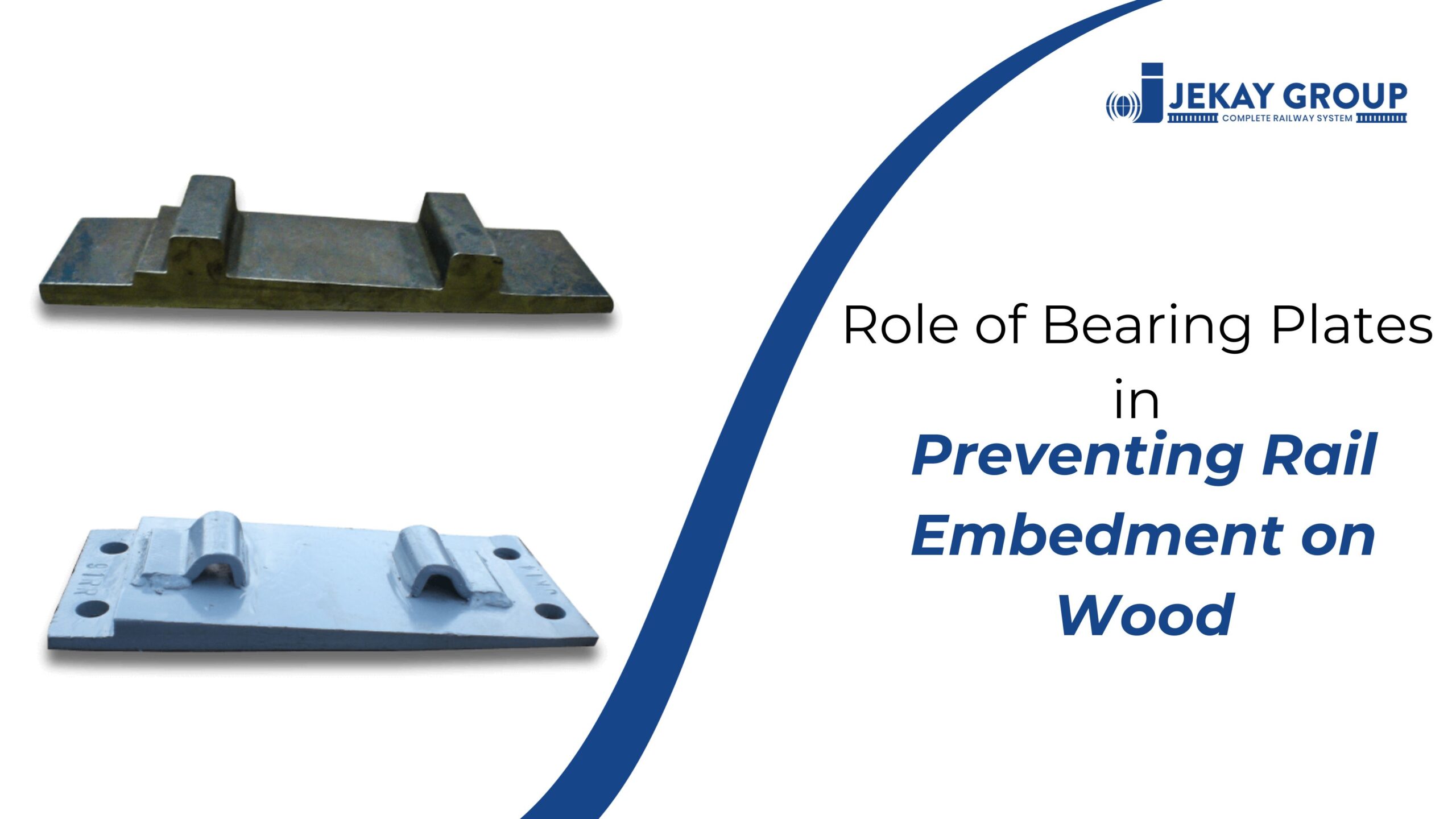
Bearing plates are flat or canted steel plates positioned between the rail base and wooden sleeper surface. Their primary job is mechanical: spread concentrated loads over a wider area to keep pressure below the wood’s compression threshold.
A standard bearing plate increases the contact area by 400-600%, dropping stress levels from rail base dimensions (typically 5-6 inches wide) to plate dimensions (7-9 inches or more). This keeps localized pressure under 800-1000 psi, well within the safe range for treated hardwood species.
Load Distribution Mechanics
When a loaded railcar passes over track, dynamic forces spike to 2-3 times the static wheel load. Without bearing plates, this energy concentrates along the narrow rail footprint, punching into wood grain.
Plates redirect these forces laterally across their full surface area. The result is uniform compression rather than focused deformation. Wood fibers compress elastically and recover between load cycles instead of yielding permanently.
Types of Bearing Plates for Wooden Ties
Flat Bearing Plates
Flat plates sit flush against the sleeper surface and work on straight track sections or where rail cant isn’t required. They’re simpler to manufacture and install, with fewer alignment concerns during tie plate installation.
Common in light-density branch lines and sidings where train speeds stay below 40 mph. Material thickness typically ranges from 0.5 to 0.75 inches depending on axle load specifications.
Canted Bearing Plates
Canted plates include a built-in slope (usually 1:20 or 1:40) that matches rail cant requirements on curved track. This ensures the rail sits at the correct angle without needing to adze or plane the wooden sleeper surface.
Preferred for main lines and curves where proper rail inclination affects wheel-rail contact stress and reduces flange wear. Eliminates the labor-intensive step of shaping each sleeper individually, which also weakens the wood structure.
Key Performance Benefits
Bearing plates deliver multiple operational advantages beyond preventing embedment:
- Extended sleeper life: Properly distributed loads can double or triple the service life of wooden ties, pushing replacement intervals from 15 years to 30+ years
- Reduced spike pull: When wood stays dense and intact around fastening points, spikes maintain holding power longer and resist loosening from vibration
- Stable track gauge: Preventing rail seat deterioration keeps gauge dimensions consistent, reducing the need for spot maintenance and geometry corrections
- Lower maintenance costs: Fewer emergency tie replacements and reduced tamping frequency cut annual maintenance budgets by 20-30%
The Stat No One Talks About
Track maintenance data from North American Class I railroads shows that sections using bearing plates experience 40% fewer unscheduled tie replacements compared to direct rail-to-wood contact configurations. Yet many short-line and regional operators still skip plates to cut upfront costs, despite paying 3-5 times more over the asset lifecycle.
Material Specifications That Matter
Bearing plate performance depends on three factors: steel grade, thickness, and surface treatment.
Hot-rolled carbon steel (typically ASTM A36 or equivalent) provides adequate strength for most applications. Thickness should match expected axle loads—heavy freight corridors need 0.75-inch plates minimum, while lighter passenger or industrial spurs can use 0.5-inch stock.
Corrosion Protection
Untreated steel plates rust quickly when sandwiched between treated wood (which contains copper compounds) and weathering steel rail. Galvanization or powder coating extends plate life and prevents rust staining that can mask inspection findings.
Quality suppliers test coating adhesion and thickness to ensure protection lasts as long as the sleeper itself—typically 20-30 years in service.
Installation Best Practices
Position plates with the rail centerline aligned over the sleeper centerline to ensure balanced load transfer. Fastening typically uses cut spikes or screw spikes driven through pre-punched holes in the plate corners.
Avoid over-driving spikes, which crushes wood fibers and defeats the purpose of load distribution. Spikes should seat the plate firmly without deforming it or compressing the wood excessively.
For canted plates, verify the slope orientation matches the intended rail cant direction—mixing left and right plates creates gauge and alignment problems that compound over time.
FAQs
Q: Can you retrofit bearing plates to existing track with embedded rails?
A: Yes, but the sleeper surface needs to be dressed or shimmed to create a flat bearing surface. If embedment has progressed beyond 1/4 inch, replacing the affected sleepers is usually more cost-effective than attempting repair. Plates installed over existing depressions won’t distribute loads properly.
Q: Do bearing plates work with all wood species?
A: They improve performance across all species, but hardwoods (oak, hickory, jarrah) show the most dramatic longevity gains because they have higher baseline compression resistance. Softer woods like pine benefit from plates but still have shorter overall service lives.
Q: How do you know when plates need replacement?
A: Inspect for rust-through, cracking along fastener holes, or visible deformation. If a plate has bent or dish-shaped under load, it’s no longer distributing forces evenly. Replace any plate that’s lost more than 10% of its original thickness to corrosion.
Q: What’s the difference between bearing plates and tie plates?
A: The terms are often used interchangeably in North American practice. Technically, “bearing plate” emphasizes the load distribution function, while “tie plate” is the broader term that includes plates with additional features like shoulders for lateral rail restraint.
Q: Do concrete sleepers need bearing plates?
A: No. Concrete has much higher compression strength than wood (4000+ psi vs. 800-1200 psi) and rail seats are cast or milled to precise dimensions. The rail base contact area is sufficient for load distribution without additional plates.
Conclusion
Bearing plates are not optional for wooden sleeper installations that need to survive modern freight loads and tight maintenance budgets. They’re the engineering solution that makes wood competitive with concrete and composite alternatives in terms of lifecycle cost and performance reliability.
If you’re specifying track components for new construction or rehabilitation projects, prioritize plate quality and proper installation over initial cost savings. The difference shows up in your maintenance logs within 36 months.
Jekay manufactures bearing plates engineered for Indian Railway specifications and global export standards. Our plates use tested steel grades with hot-dip galvanization for maximum corrosion resistance in all climate conditions. Whether you’re running narrow gauge heritage lines or standard gauge freight corridors, we supply the right plate profile for your load requirements.
Contact our technical team to discuss your project specifications and get a detailed quotation. Visit jekay.com or reach out directly—we’ll help you select components that actually last.