
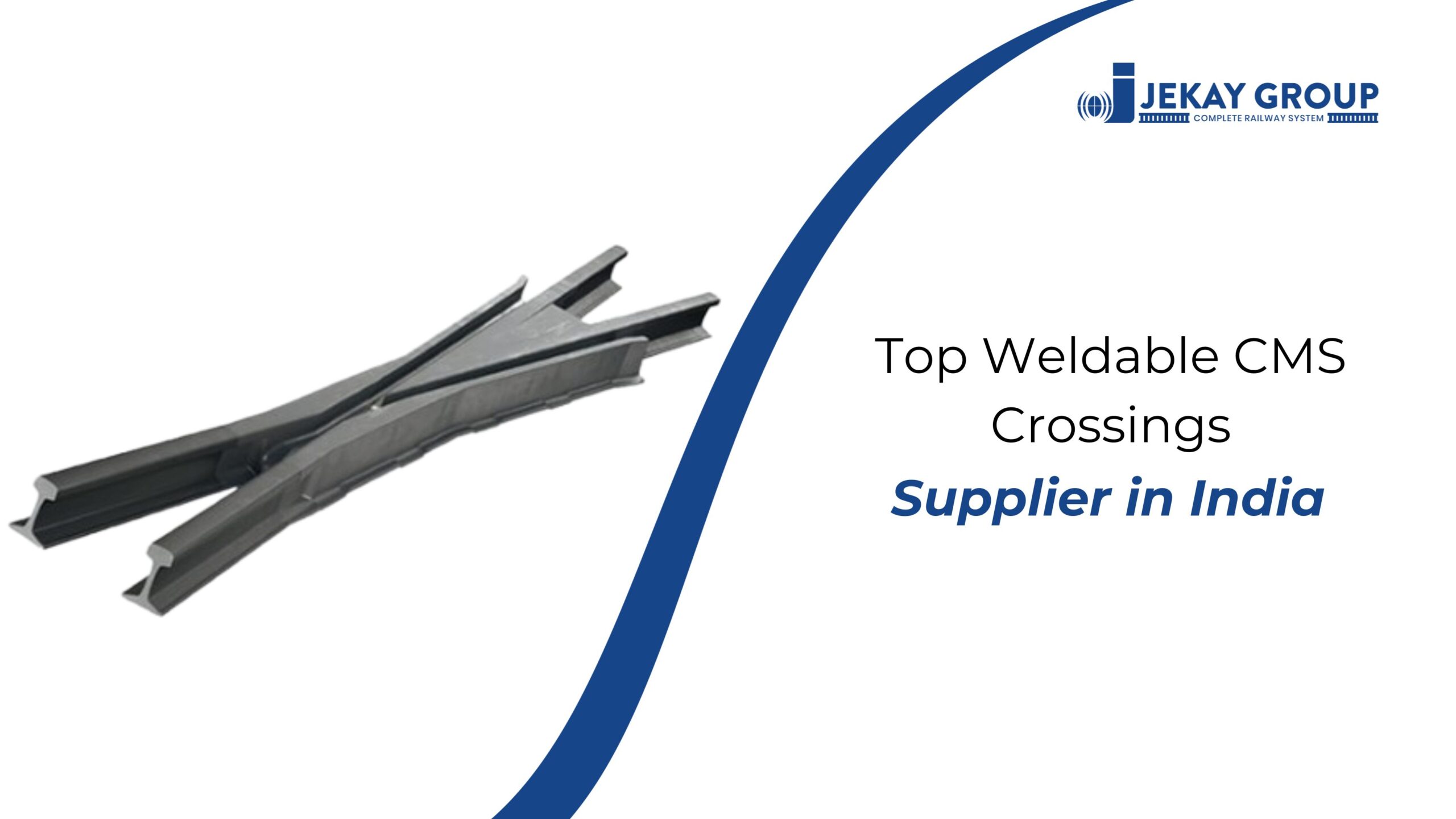
India’s rapid railway modernization has brought the spotlight onto some of the most sophisticated, durable, and intelligently designed components in track engineering. Among these, weldable Cast Manganese Steel (CMS) crossings are pivotal in ensuring the safe and seamless operation of trains across complex rail junctions and high-speed corridors. Choosing a supplier who can consistently meet the demanding standards of Indian and international railways is not just important—it’s critical. Jekay International Track Pvt. Ltd. leads the way as the top weldable CMS crossings supplier in India, delivering products that combine metallurgical excellence, innovative design, tested performance, and exceptional customer support.

What Are Weldable CMS Crossings?
At a fundamental level, railway crossings are track components that allow trains to move from one track to another or cross at grade. CMS crossings (Cast Manganese Steel crossings) are specialized for high-impact areas like turnouts, switch points, and junctions. “Weldable” CMS crossings have been further engineered so that they can be permanently joined to rails via welding, providing a stronger, more durable, and lower-maintenance solution than bolted or plate-connected alternatives.
Key Benefits of Weldable CMS Crossings:
- Exceptional Wear Resistance: Manganese steel’s unique work-hardening property makes the crossing harder at the surface as passing wheels impact it.
- Superior Impact Absorption: Capable of withstanding repeated, high-energy wheel strikes at junctions or diamond crossings.
- Enhanced Track Continuity: Welding creates a monolithic connection, eliminating joint gaps that can cause vibration, noise, and alignment decay.
- Reduced Maintenance: Welded crossings require significantly less realignment and plate/bolt replacements over time.
- Precision Fit: Manufactured to extremely tight tolerances, enabling seamless integration into track layouts for mainlines, metros, freight, and high-speed rail.
The Critical Role of Weldable CMS Crossings in Indian Railways
With India’s mainline network now handling higher speeds, heavier axle loads, and more frequent traffic than ever before, the pressure on crossing assemblies has never been greater. CMS crossings are particularly favored for:
- High Density Zones: Busy junctions, interlockings, and urban turnouts where trains pass in quick succession.
- Heavy Freight Corridors: Lines seeing regular 25+ ton axle loads, such as Dedicated Freight Corridors and industrial sidings.
- High-Speed Lines: Where safety, alignment, and long-term integrity at turnouts are non-negotiable.
International research has confirmed that using weldable CMS crossings can extend the life of track panels by up to 50% compared to conventional assemblies due to their work-hardened, fatigue-resistant nature.
Jekay International Track Pvt. Ltd.: Commitment to Metallurgy, Quality, and Innovation
Decades of Specialized Leadership
Jekay International Track Pvt. Ltd. has over 40 years of experience in manufacturing premium-quality railway components. Renowned across India and globally, Jekay has redefined the standards for weldable CMS crossings with unmatched technical prowess and customer focus.
Advanced Manufacturing Process
- Proprietary Alloying: Jekay uses premium grades of high-manganese steel (typically 13% Mn) known for their work-hardening, crack resistance, and exceptional toughness.
- Precision Molding: Every crossing is sand-cast using advanced pattern and mold technology to ensure internal soundness and structural integrity.
- Computer-Aided Design: CAD/CAM tools allow for exact profile reproduction, customized radius/geometry, and optimal wheel transfer surfaces.
- Controlled Heat Treatment: Post-casting, every CMS crossing undergoes propriety quench-and-temper regimes to develop the proper microstructure for both impact and wear resistance.
- Weldability Optimization: Special attention is paid during composition and finishing to ensure optimal welding performance with thermite or flash-butt techniques, minimizing defect rates on installation.
Testing, Quality Assurance, and International Standards
Every Jekay CMS crossing undergoes:
- Ultrasonic Inspection: To eliminate internal cracks, shrinkage, porosity, or foreign inclusions.
- Metallographic Analysis: Confirms that the desired austenitic matrix and carbide dispersion have been achieved.
- Dimensional Audits: 100% profile checks using coordinate measuring machines (CMM) to guarantee fit and alignment.
- Hardness Testing: Verifies uniformity and correct work-hardening response.
- Weld Simulations: Routine destructive and non-destructive weld tests to confirm field-performance.
Jekay’s crossings comply with and often exceed the requirements of IRS (Indian Railway Standards), RDSO, UIC, AREMA, and relevant international specifications.
Product Range: Weldable CMS Crossings for Every Application
| Crossing Type | Axle Load Capacity | Typical Use | Key Features |
| Standard Weldable CMS Crossing | 25T & above | Mainlines, Passenger/Freight | High wear and shock resistance |
| Low-Angle Weldable CMS Crossing | 16T–25T | Light Rail, Metro, Yards | Optimized for urban/high-frequency services |
| Custom-Radius CMS Crossing | 16T–30T | Industrial, High-Speed | Customized fit for unique turnout layouts |
| Diamond Weldable CMS Crossing | 25T & above | Complex junctions, crossings | Enhanced geometric stability, double-ended |
All types can be tailored for various sleeper materials (wood, concrete, steel), gauge variances, or unique installation requirements.
Why Choose Weldable CMS Crossings from Jekay?
1. Reliability in Indian and International Rail Networks
Jekay crossings are a staple on Indian Railways, metros, and private industrial lines. They have also been adopted in export projects across Africa, the Middle East, and Southeast Asia, earning a global reputation for trouble-free service.
2. Customization and Advisory Support
Every project is unique. Jekay’s design and engineering teams work directly with clients to:
- Analyze turnout geometry and traffic patterns
- Recommend the optimal crossing type, material, and welding method
- Offer end-to-end support from specification and tendering to installation and after-sales service
3. Endurance in Extreme Climates
From the hot, humid coasts of southern India to cold and dry highland railways in the north, Jekay’s CMS crossings are engineered to resist thermal cycling, moisture ingress, and long-term fatigue.
4. Fast, Seamless Weldability
Proprietary finishing and composition modifications ensure that Jekay crossings weld cleanly to existing rails, resulting in fewer weld defects, reduced installation times, and improved track straightness.
5. Cost Efficiency and Lifecycle Value
- Lower lifetime maintenance: Fewer cracks, minimal welding touch-ups, and reduced track “settling” issues.
- Longer crossing life: Proven lifespan of 15+ years in demanding freight/urban traffic, with routine grinding as the only maintenance.
Engineering Insights: The Science Behind Manganese Steel
The secret to the performance of CMS crossings is their unique metallurgical property—work hardening. Rather than becoming brittle, manganese steel becomes even harder and more wear resistant as it is struck repeatedly by passing wheels. This ensures the crossing adapts over its service life, always offering the correct hardness and wear profile needed for Indian traffic mixes.
High carbon levels paired with proper manganese content prevent cracks, while proprietary additions control grain structure and carbide formation for consistent field performance across thousands of load cycles.
Advancing Quality: Jekay’s Commitment to Process Improvement
Jekay invests heavily in continuous process upgrades, embracing:
- Industry 4.0 Tools: Real-time production monitoring, digital twin modeling, and predictive analytics for defect detection and yield improvement.
- Green Manufacturing: Energy-efficient furnaces, effective reclamation and recycling systems, pollution control.
- Skilled Workforce Training: Technicians and welders are certified for the latest track welding and installation standards.
Frequently Asked Questions (FAQs)
How long do weldable CMS crossings last?
Typically 15–20 years, depending on track usage, axle loads, speed, and maintenance. Jekay crossings deliver industry-leading service intervals.
Can CMS crossings be used in metro track systems?
Absolutely. They are especially favored in metro and light rail due to minimal maintenance and superior geometry retention.
What maintenance is required?
Routine surface grinding and alignment checks at set intervals; rarely is a full replacement needed during the service life unless in cases of extraordinary damage.
Are Jekay crossings export-ready?
Yes. Jekay complies with UIC, AREMA, and other international standards. All documentation, testing, and packaging meet or exceed export requirements.
What makes manganese steel the preferred choice for crossings?
Exceptional wear, work-hardening, crack resistance, and welding compatibility—especially vital for high-density traffic and safety-sensitive installations.
Sustainability & Corporate Responsibility
Jekay’s commitment to sustainable growth translates into:
- Environment-first foundry practices and energy-saving production innovation
- Ethical sourcing of inputs and a transparent supply chain
- Focus on reducing emissions and waste in the casting and machining process
- Active community engagement and support for skill development across engineering trades
Client Successes: Proven Performance Nationwide
- Indian Railways Dedicated Freight Corridors: Jekay CMS crossings have outlasted traditional alternatives by years, keeping mega-projects on budget and schedule.
- Leading Metro Networks (Delhi, Mumbai, Kolkata): Track teams report easier integration and fewer mid-life interventions after switching to Jekay’s products.
- Heavy Industry Sidings: Private steel and power plants rely on Jekay for reliable, rugged performance under harsh operating regimes.
Choosing the Right Weldable CMS Crossing: Jekay’s Advisory Checklist
- Confirm axle loads and traffic frequency for correct alloy and casting selection
- Assess turnout and crossing geometry for custom fit solutions
- Specify compliance standards (IRS, RDSO, UIC, AREMA, etc.)
- Check for sleeper/gauge compatibility
- Estimate lifecycle costs, not just purchase price
- Insist on QA/QC documentation and test certificates
- Benefit from supplier-led technical and post-sale support
Conclusion: Partner with Jekay International for Track Excellence
India’s railways are evolving, and so too are the demands placed on every installed component. Only the best-engineered, rigorously tested, and precisely tailored parts can ensure uninterrupted, safe, and efficient rail journeys for the decades ahead. As the premier supplier of weldable CMS crossings in India, Jekay International Track Pvt. Ltd. sets benchmarks in every category: metallurgy, customization, service, and reliability.
For railway authorities, infrastructure developers, and project leaders looking to build railways that last—choosing Jekay is choosing a future built on strength, safety, and seamless track transitions. Experience the Jekay advantage—where quality meets innovation, and India’s railways meet the world’s standards.