
Introduction
Turnout sleeper selection is one of the most consequential decisions in track design, yet many procurement teams treat it as a cost line rather than an engineering choice. The wrong sleeper material under a turnout doesn’t just add maintenance work—it amplifies dynamic forces at the most stressed point in any track structure: the crossing. Concrete and timber behave fundamentally differently under wheel impact, and that difference shows up directly in maintenance frequency, fastening life, and geometry stability. This guide covers the structural differences, load behavior, installation requirements, and lifecycle trade-offs to help you make the right call for your specific traffic and operational conditions.
Basic Sleeper Requirements in Turnouts
Turnout sleepers face demands that plain-line sleepers don’t. Variable spacing from switch to crossing, asymmetric loading across the panel, and concentrated impact at the frog all create conditions that standard rectangular sleepers handle poorly without specific design adjustments.
Three core requirements drive sleeper design for turnouts:
- Variable length: turnout sleepers range from standard lengths at the switch ends to 4.2m or longer through the crossing zone, requiring different structural designs at each position
- Load transfer across multiple rails: in a crossing panel, a sleeper may carry two running rails plus a guard rail simultaneously, creating eccentric loading that plain-line sleepers aren’t designed for
- Consistent bearing area: each sleeper must seat uniformly in compacted ballast to prevent differential settlement that misaligns switch blades and frog geometry
Timber Sleeper Turnout Configurations
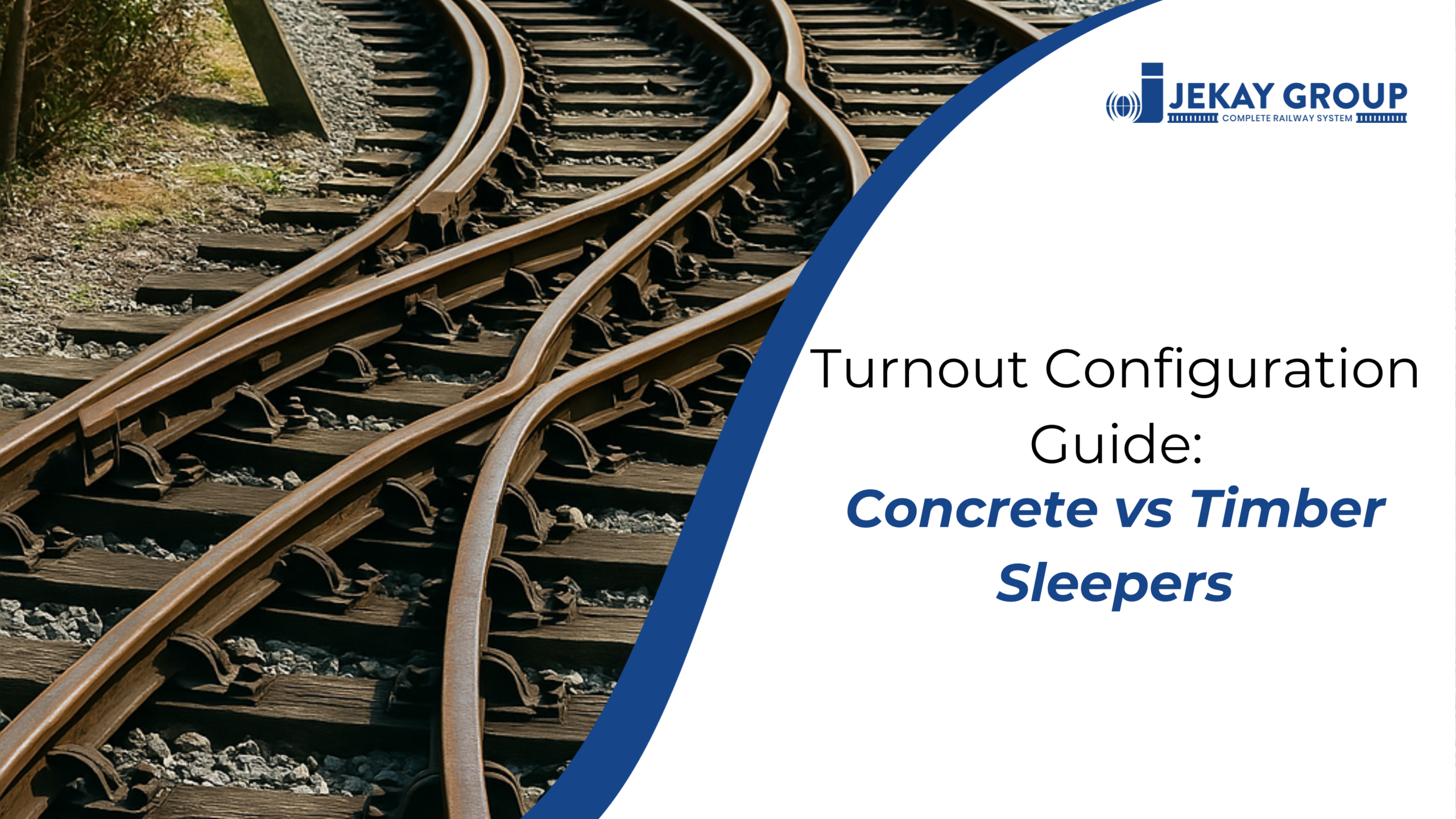
Timber turnouts use creosote-treated hardwood sleepers—oak, beech, or dense tropical species—laid at variable spacing that widens from approximately 400mm at switch tips to 700–750mm through the crossing. Lengths vary from 2.6m at the switch entry to 3.9m–4.2m at the wide end of the crossing.
Timber’s natural elasticity makes it the more forgiving option at the frog. The wood fiber compresses under impact loading and distributes the shock across adjacent sleepers through ballast interaction—a parabolic deflection behavior that reduces peak stress at any single fastening point. This is why many high-maintenance turnout zones historically used timber even after concrete became standard for plain line.
Fastening Hardware on Timber Turnouts
Timber turnouts use a mix of conventional and elastic fastening hardware depending on zone:
- Switch panel: slide chairs, stretcher bars, and screw spikes or dog spikes through base plates
- Closure rail: elastic clips on baseplates where geometry allows; screw spikes in tight areas
- Crossing: hook bolts and fang bolts at guard rail positions; elastic clips at closure rail ends
The variety of fastening types across a timber turnout is one of its practical disadvantages—more hardware SKUs, more installation complexity, more potential failure points.
Concrete Sleeper Turnout Configurations
Indian Railways’ RDSO developed prestressed concrete (PRC) turnout sleepers in two configurations. The older rectangular cross-section design uses 74 sleepers in a fixed layout for 1-in-12 turnouts with 52kg rail. The newer fan-type design uses a trapezoidal cross-section laid in a radial pattern, compatible with both 1-in-8.5 and 1-in-12 turnouts by rotating the same sleeper 10° horizontally between left-hand and right-hand configurations.
Fan-type concrete turnout sleepers use 54 units for 1-in-8.5 turnouts and 83 units for 1-in-12 turnouts, plus approach sleepers. Concrete grade for these applications is minimum 600 kg/cm² 28-day crushing strength—approximately 60 MPa, significantly higher than standard structural concrete.
Fastening Hardware on Concrete Turnouts
Concrete turnout sleepers use elastic fastening systems with components adapted to the turnout zones:
- Switch panel: embedded dowels accept screw fixings for slide chairs; standard elastic clips at approach sleepers
- Closure and crossing panels: grooved rubber pads (standard 4.5mm thickness but varying dimensions per sleeper position) under each rail
- Frog: high-toe-load clips with stiff insulators; some designs incorporate bolt-type fastening as secondary restraint
The precision of concrete sleeper casting makes baseplate positioning highly accurate—rail seat geometry matches design intent within ±0.5mm, compared to ±2–3mm variation typical in hand-drilled timber.
Load Distribution Differences
This is where the choice gets consequential. Timber sleepers deflect parabolically—the loaded sleeper bends and the curve extends to adjacent sleepers, distributing impact energy across 4–5 sleepers simultaneously. Concrete sleepers deflect linearly, concentrating load more tightly at the rail seat.
At a frog crossing, where wheel impact forces spike to 400–500 kN on heavy freight routes, this distinction changes fatigue outcomes at the fastening hardware:
- Timber: load spreads through natural flexion; clips and baseplates see reduced peak stress
- Concrete (unpadded): stiff response concentrates stress at rail seat; requires stiffer, higher-rated clips to prevent loosening
- Padded concrete: rubber padding under the sleeper-ballast interface partially restores distributed deflection, reducing ballast abrasion and bringing behavior closer to timber
A European multi-site study found that concrete turnout sleepers required approximately 19 more maintenance notifications over a 7-year period compared to synthetic wood alternatives placed in the same corridor under identical traffic—largely because the stiffer dynamic response demands more frequent geometry correction.
Installation Process Comparison
Timber Turnout Installation
- Prepare ballast bed to 25cm minimum depth; compact and level
- Lay sleepers to variable spacing pattern; check alignment against design layout
- Install slide chairs and baseplates; drill and fit screw spikes or dog spikes per zone
- Thread closure and crossing rail through; fit elastic clips or hook bolt assemblies per position
- Tamp, align, and pack ballast; check flangeway widths at guard rail positions
Timber installation tolerates minor site imperfections—small variations in ballast level or sleeper position can be shimmed during fastening. This flexibility speeds installation on sites with irregular subgrade.
Concrete Turnout Installation
- Prepare ballast bed to minimum 30cm depth with full compaction using vibrating rollers
- Lift assembled panel sections by crane; cranes of adequate capacity (typically 25–50 tonne) are required for the full crossing assembly
- Position sleepers per fan layout; verify RE-marked ends face right-hand side
- Seat rubber pads into grooves before rail installation; fit elastic clips to torque specification
- Tamp using points-and-crossing tamper; check switch blade contact and frog geometry after tamping
Concrete installation does not tolerate shortcuts on ballast preparation. Inadequate compaction causes differential settlement within 12–18 months that misaligns switch blades and requires early intervention.
Maintenance and Lifecycle Comparison
Timber sleepers in turnouts have a planned service life of 12–20 years in modern creosote-treated hardwood, depending on traffic tonnage and species. Concrete turnout sleepers last 25–35 years under equivalent loads.
What the headline lifespan numbers obscure is maintenance frequency within that period:
- Timber turnouts need earlier switch chair replacement and more frequent spike re-driving, but individual components are cheap and fast to replace without disturbing the wider structure
- Concrete turnouts maintain geometry longer between tamping cycles but require block possessions for any sleeper replacement—a single damaged concrete sleeper in the crossing zone needs crane access and a full gang
The most expensive maintenance scenario is a derailment on a concrete turnout—temporary timber sleepers must be interlaced to restore traffic while the permanent concrete replacements are sourced and installed. Emergency timber always needs to be held in stock at concrete-sleeper locations for exactly this reason.
Advantages and Limitations
Where Timber Wins
- Shock absorption at high-impact frog crossings
- Flexible individual replacement without heavy equipment
- Better performance on lower-axle-load routes where concrete stiffness adds no benefit
- Lower upfront cost for branch lines, yards, and sidings
Where Concrete Wins
- High-speed turnouts above 100 km/h where geometry precision is critical
- Heavy-freight mainlines where timber degradation from high tonnage accelerates beyond economic replacement intervals
- New construction where ballast quality and site access allow full crane assembly
- Reduced dependence on treated timber supply chains
When Not to Mix Materials
Mixing concrete and timber sleepers within a single turnout panel creates a differential stiffness boundary that concentrates dynamic forces at the transition point. If emergency timber interlacing is used after concrete sleeper damage, restrict speeds to 30 km/h or below and replace with permanent concrete as the first priority—don’t leave mixed sections in service under normal operating speeds.
FAQs
Can timber and concrete sleepers mix in one turnout permanently?
No. Permanent mixed-material turnouts create differential track modulus at every timber-concrete boundary. Wheels crossing these boundaries generate additional dynamic impacts, accelerating wear on both the sleepers and fastening hardware at the transition. Emergency interlacing is acceptable under speed restriction only, and only until the damaged concrete units are replaced.
Which lasts longer under heavy freight conditions?
Concrete sleepers last longer in raw years—25–35 years versus 12–20 for timber under high-tonnage corridors. However, concrete turnouts typically accumulate higher maintenance costs within their service life due to more frequent geometry corrections. If total cost of ownership is the measure, padded concrete or synthetic alternatives often outperform both on heavy-freight turnouts.
How does sleeper choice affect the turnout’s speed rating?
Concrete sleepers with elastic fastening systems are required for turnouts rated above 100 km/h on the diverging route in most railway standards. Timber sleepers are generally capped at 50–80 km/h on the diverging route because the elasticity and variable spike holding power introduce more geometric variation than high-speed rail tolerances permit.
What causes concrete turnout sleeper cracking?
Three main causes: insufficient ballast depth allowing point loading under individual sleepers, inadequate curing before service loading, and impact from derailments. Cracks typically originate at rail seat edges and propagate longitudinally. Any sleeper with through-cracking at the rail seat must be replaced—it no longer provides reliable load transfer and will accelerate fastening loosening.
Are timber sleepers viable for new turnout installations today?
Yes, for low-speed sidings, yards, and branch lines where axle loads stay below 22.5 tonnes and speed limits on the diverging route are under 50 km/h. For new mainline construction, concrete is the standard choice. The practical constraint is often timber availability—the long sleeper lengths required for high-number turnouts (1-in-12 and above) are increasingly difficult to source in consistent quality at scale.
Conclusion
Concrete and timber sleepers aren’t interchangeable options—they’re different engineering tools that perform differently depending on traffic density, axle load, speed, and maintenance resources. Concrete delivers long geometric life and precision. Timber delivers shock absorption and maintenance flexibility. The choice hinges on which failure mode is more expensive to manage in your operating environment.
Match the sleeper type to the turnout number, speed rating, and axle load before you specify fastening hardware—the fastening system can only perform as well as the sleeper it anchors into.
Jekay manufactures fastening components engineered for both concrete and timber turnout sleepers, including grooved rubber pads in custom dimensions for PRC turnout sleepers, high-toe-load elastic clips for crossing panels, and hook bolt assemblies for guard rail installations. Our components are produced to IRS specifications with full dimensional traceability and are available for standard turnout configurations and custom project layouts.
Contact Jekay to discuss your turnout fastening requirements and request a technical quotation. Visit jekay.com and connect with our engineering team—we’ll help you match every fastening component to the sleeper type, zone, and load condition in your turnout design.