
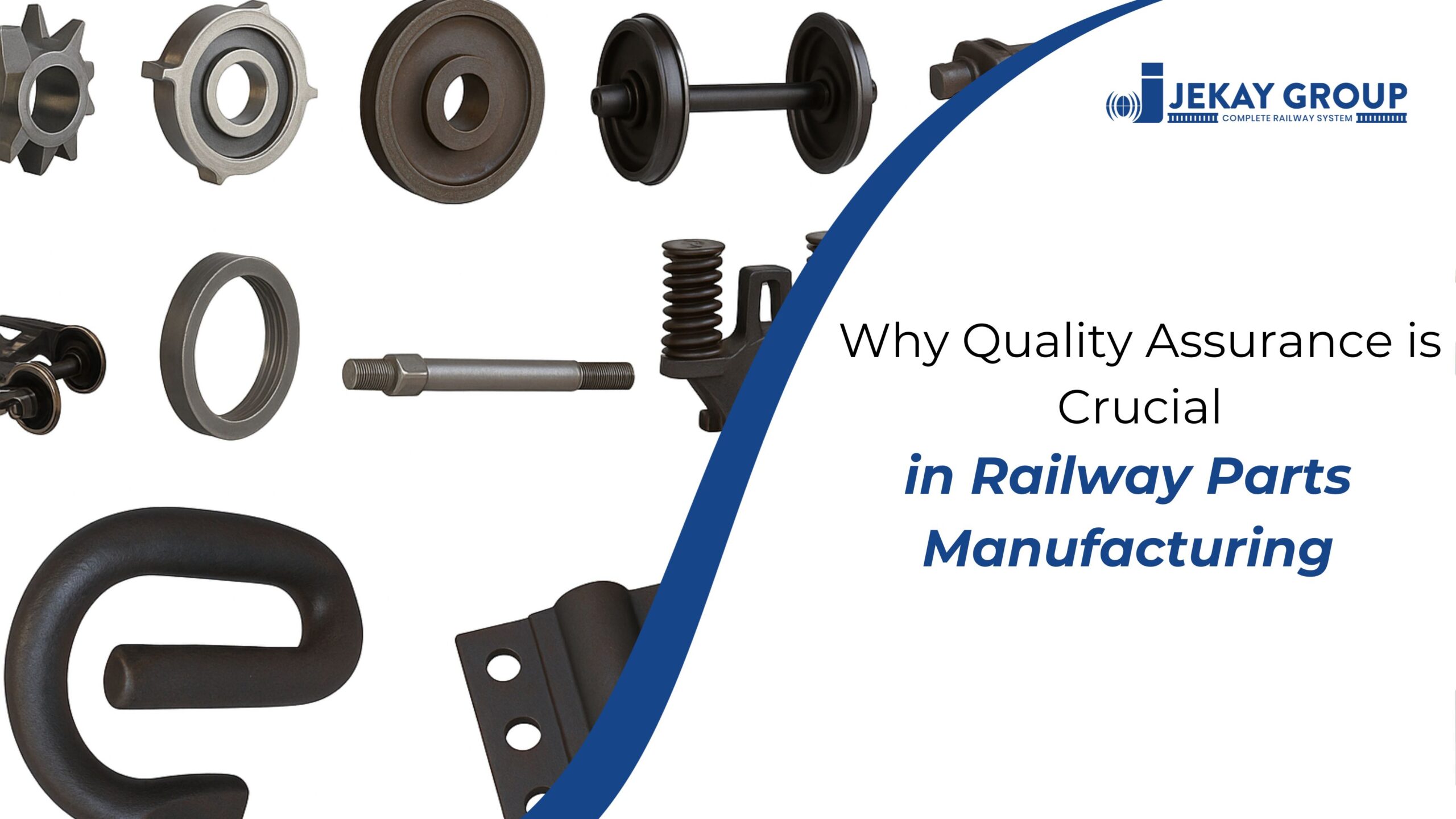
Every day, India’s vast network of railways carries millions of passengers and tonnes of freight—making rail the backbone of the nation’s transportation infrastructure. Yet, beneath this seamless operation lies a latticework of parts and components that must work in absolute harmony. The real linchpin? Quality assurance (QA) in railway parts manufacturing. It’s not just a protocol—it’s the difference between safety and catastrophe, operational efficiency and costly breakdowns, customer trust and reputational damage.
The High Stakes: Why QA Matters in Railways?
Railway systems operate under unforgiving demands—high speeds, extreme axle loads, and tough climate cycles. If a single component fails the quality test, consequences can escalate rapidly:
- Safety Risks: A defective part can trigger derailments, signal failures, or loss of life—often with national attention and deep consequences.
- Operational Disruption: Sudden part failures halt entire lines, causing cascading delays and financial losses measuring in crores.
- Maintenance Overhead: Poor quality accelerates wear, leading to higher maintenance cycles and increased replacement costs.
- Regulatory Liability: Rail part manufacturers face strict scrutiny and legal repercussions when standards are compromised.
A landmark study showed that almost 28% of rail incidents in developed networks trace back directly to component failure—a glaring call for rigorous quality control.
Beyond the Minimum: Comprehensive Criteria for Quality Assurance
Quality assurance isn’t just about catching the obvious defects. It’s about establishing a bulletproof system at every stage:
1. Supporting Even Rail and Track Alignment
Incorrectly manufactured parts can cause track misalignment—leading to rough rides, increased wear on train wheels, or, in the worst cases, catastrophic derailments. Advances in surveying with drones, LiDAR, and GPS now let manufacturers and operators ensure installations are laser-precise, dramatically reducing error margins.
2. Precision in Custom Parts and Measurements
From specialty base plates for metros to custom rail joints for freight corridors, every millimeter counts. Even a 2-3 millimeter discrepancy in a part’s measurement can create vibrations, compromise fitment, and dramatically shorten a component’s service life. That’s why the best manufacturers, like Jekay International Track Pvt. Ltd., cross-verify all custom specifications with advanced metrology equipment and proactive customer consultations.
3. Adherence to Industry Standards
True QA hinges on global and regional standard compliance. The best parts are those that align with:
- European Standards (EN)
- Japanese (JIS)
- American (AREMA/ASCE)
- International (UIC, IRS, DIN, BS)
Manufacturers must also regularly update practices to reflect evolving codes, ensuring their components meet or exceed every requirement for intended use.
4. Fit-for-Purpose Selection
Not all railway parts are created equal—rails for high-speed lines, metros, or industrial yards all require tailored properties in thickness, alloy composition, and tolerances. Using the wrong part can introduce misalignment, excessive vibration, and even derailments. Jekay’s technical team offers advisory support to guarantee that every component fits its intended role perfectly.
5. Installation by Qualified Professionals
The best-manufactured parts still require skilled installation to realize full benefit. Quality assurance checks here involve ensuring certified professionals handle the fitment and that the assembly itself is validated before the rail line goes operational.
The Jekay Advantage: QA as a Core Business Philosophy
At Jekay International Track Pvt. Ltd., quality assurance is hardwired into every process:
Advanced Materials and Traceability
Jekay sources premium steels and composites, employing rigorous batch traceability. Every lot is tracked from initial processing through final shipment, ensuring defective material never enters the supply chain.
Process Control and Automation
- Automated CNC Machining: Delivers precision to tolerances of ±0.1mm, far surpassing manual capabilities.
- In-line Inspection: Real-time defect detection using ultrasonics, eddy current, and magnetic particle inspection.
- Heat Treatment Validation: Ensures uniform hardness, grain structure, and performance in every batch.
Metrology and Testing
Every product undergoes:
- Dimensional checks using 3D scanners and CMMs (coordinate measuring machines).
- Mechanical tests for fatigue, impact, tensile, and compressive strength.
- Environmental simulations: Corrosion, temperature cycling, and vibration tests, replicating real-world extremes.
Certifications and Documentation
Jekay’s products come with full quality certificates, compliance documentation, and traceable serial markings. Their manufacturing units are ISO 9001:2015 certified and approved by industry associations and regulatory authorities.
Technology-Powered QA: The Modern Landscape
Industry leaders have embraced digital transformation in QA:
- Predictive Analytics: Machine learning analyzes inspection data to forecast part failures before they affect service.
- Digital Twins: Virtual models of rail parts and installations offer unprecedented insights into stress points and life expectancy.
- Automated Non-Destructive Testing (NDT): Employs robotics for high-volume, high-accuracy inspections, ensuring zero human error.
Extra Guidance: What Savvy Rail Purchasers Ask
To guarantee optimal results, buyers should clarify:
- Does the part support even alignment and match installation tolerances?
- Are custom specifications thoroughly validated before production?
- Is the manufacturer up to date with the latest codes and standards?
- Can the supplier provide full QA documentation and traceability on every component?
- Are their installation teams certified and trained for your rail type?
A buyer empowered by these questions minimizes risk, streamlines approvals, and enhances track safety.
Case Examples: The High Cost of Ignoring QA
- Track Buckling Incident: A major metro faced a 48-hour shutdown due to misaligned base plates, traced back to faulty custom measurements and poor installation QA.
- Premature Rail Joint Failure: An industrial siding suffered repeated fractures—root cause analysis revealed substandard alloy composition, leading to high wear rates and costly emergency replacements.
- Switch Malfunctions: Inconsistent quality in thick web switches created erratic signaling and unplanned halts, resolved only after supplier audits and rigorous QA protocol upgrades.
In each scenario, robust QA could have prevented disruption, reinforcing why manufacturers like Jekay never compromise on standards.
How Jekay’s Quality Assurance Process Powers Customer Success?
- All products follow a “design for manufacture” principle—QA begins at CAD modeling, not post-production.
- Multistage inspections and traceability prevent any single-point failure from cascading into system-wide risks.
- The Jekay team works closely with clients, offering on-site support, installation training, and ongoing performance audits.
Customers report dramatic drops in part failure rates, extended maintenance intervals, and overall life-cycle cost savings—clear evidence that rigorous QA delivers concrete results.
Conclusion: Building India’s Railways Stronger, Safer, and Smarter
Quality assurance isn’t just a layer—it’s the bedrock of India’s railway modernization. With Jekay International Track Pvt. Ltd., partners gain access to a philosophy that puts rigorous QA at the center of every part, project, and partnership. It’s a holistic approach that keeps the nation’s railroads safe, efficient, and ready for tomorrow.
When you choose Jekay, you’re investing in railway parts that not only meet but anticipate future standards—ensuring a legacy of safety, performance, and reliability for decades to come.