
Introduction
Most track failures in Indian Railways don’t happen in the middle of rails—they occur at joints where fish plates connect rail ends. Despite the push toward continuous welded rail (CWR), Indian Railways still operates thousands of kilometers of jointed track, plus critical locations like expansion joints, turnouts, and buffer rails where fish plates remain essential. Selecting the wrong type or accepting non-compliant specifications leads to premature wear, alignment issues, and safety incidents. This guide decodes IRS standards, explains each fish plate type used across the network, and clarifies when to deploy which variant for reliable track performance.
Basics of Fish Plates in Indian Railways
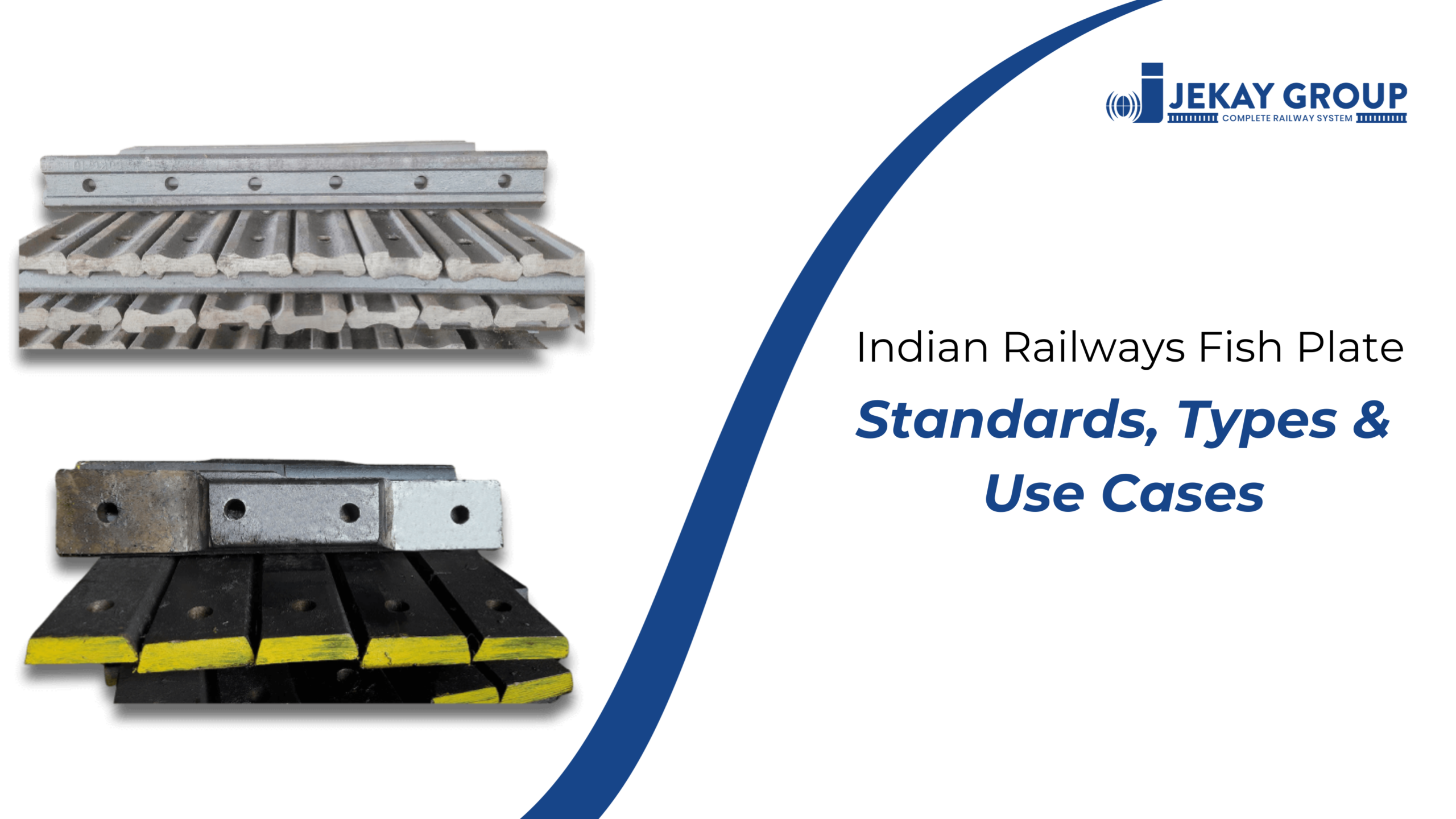
Fish plates join two rail ends and transfer vertical, lateral, and longitudinal loads between them. They maintain rail alignment at joints where the track is most vulnerable to displacement under train loads.
Indian Railways uses fish-plated joints extensively in several scenarios. Newly laid track on routes awaiting welding, buffer rails at both ends of LWR/CWR sections, special expansion joints (SEJs), insulated joints for traction return and track circuits, and emergency repairs all depend on properly specified fish plates.
The joint must handle dynamic impact loads that can be 2-3 times the static axle load. Poor joint performance accelerates rail-end battering, sleeper damage, and ballast degradation.
Indian Railways Standards and Specifications
IRS T-1-2012 governs fish plate manufacturing for Indian Railways, replacing earlier 1966 specifications. This standard defines exact requirements that separate compliant products from substandard ones.
Material Requirements
Fish plates must use killed carbon steel with controlled chemistry. Minimum mechanical properties include:
- Ultimate tensile strength: 620 MPa
- Yield strength: 320 MPa
- Elongation: 15% minimum
- Hardness: 175 BHN minimum
These specifications ensure the fish plate won’t crack under cyclic loading or deform permanently when joints experience heavy axle loads.
Dimensional Tolerances
IRS T-1 specifies tight tolerances on every dimension. Length tolerance is ±2.0mm, thickness is +1.5mm/-1.0mm, and hole center-to-center distance cannot deviate more than ±2mm. Straightness must be within 0.16mm per 100mm horizontally and 0.10mm vertically.
These tolerances matter because misaligned holes create uneven bolt loading, and thickness variations change the gap between rail web and fish plate fishing surface.
Marking and Traceability
Every fish plate must carry permanent markings showing manufacturer’s name or code, heat number, year of manufacture, and rail section designation. This traceability allows track maintainers to identify batches if failures occur and enables quality audits during procurement.
Types of Fish Plates Used in Indian Railways
Indian Railways deploys six distinct fish plate types, each engineered for specific applications.
Standard Fish Plates
These are ordinary fish plates matching specific rail sections—60 kg, 52 kg, 90 R, UIC 60, etc. They create conventional four-bolt or six-bolt joints in plain track. Standard plates work for general-purpose jointed track on routes where traffic loads and speeds fall within normal parameters.
Joggled Fish Plates
Joggled plates have an offset or “jog” in the middle section that allows them to clear weld beads when joining rails near welded joints or accommodating rail-end geometry at special locations. They’re essential at buffer rail connections and certain turnout locations where standard flat fish plates won’t fit properly.
Combination (Compromise) Fish Plates
These join two different rail sections—for example, connecting 52 kg to 60 kg rails during track upgrades. Each side of the fish plate matches the web profile of a different rail section. Without combination plates, transitioning between rail sections requires complex geometry or premature rail cuts.
Insulated Fish Plates
Made from non-conductive materials or incorporating insulation layers, these create electrical breaks in the running rail. Indian Railways uses them extensively in electrified territory for traction return circuits and across the network for track circuit isolation in signaling systems. They must maintain electrical resistance above specified thresholds while providing mechanical strength comparable to steel plates.
Special Fish Plates
Various special designs exist for specific rail profiles, increased depth for heavy-duty applications, and emergency one-meter lengths for fracture repairs. These address non-standard situations where ordinary fish plates don’t provide adequate performance.
Design Features and Engineering Requirements
Fish plate geometry directly affects joint performance. Indian Railways originally used bone-shaped fish plates with reduced section in the middle but has moved toward increased-depth designs for better load distribution.
The fishing surface—where the fish plate contacts the rail web—must be machined to precise contours matching the rail profile. Poor contact creates point loading and accelerates wear.
Hole patterns vary by rail section and application. Four-hole patterns suffice for lighter rails and lower traffic densities. Six-hole configurations distribute loads better and are standard for 60 kg rails on main lines.
All fish plates undergo normalizing heat treatment at 830-860°C followed by air cooling. This creates uniform mechanical properties and relieves internal stresses from rolling and machining.
Use Cases Across the Indian Rail Network
Plain Track Joints
Newly laid jointed track and routes not yet converted to LWR use standard fish plates appropriate to the rail section. While Indian Railways aims to eliminate fish-plated joints on main lines, thousands of kilometers remain in service on branch lines and newly constructed routes awaiting destressing and welding.
LWR/CWR Buffer Rails and SEJs
Even on welded tracks, fish plates appear at both ends of every long welded rail panel as buffer rails and at special expansion joints that accommodate thermal movement. These locations experience higher dynamic forces than conventional joints because adjacent track is constrained.
Electrified Routes and Signaling Zones
Insulated fish plates create electrical breaks wherever needed for track circuits or to isolate traction return paths. A single missing or failed insulated joint can disable signaling for an entire block section.
Turnouts and Transitions
Switches, crossings, and approaches to structures often require combination fish plates to transition between rail sections or joggled plates to accommodate geometrical constraints.
Maintenance and Inspection
Track walking crews check fish-plated joints for visible cracks in the plate, wear at fishing surfaces, elongated bolt holes, and loose fish bolts. Joints showing any of these conditions require immediate attention.
Reconditioning involves removing rust, checking dimensions with gauges, and replacing if wear exceeds limits. Many fish plates are discarded prematurely because field staff lack proper gauges to assess actual condition.
The most common failure mode in Indian conditions is cracking near bolt holes due to inadequate heat treatment or material defects. IRS T-1 specifications directly address this through controlled chemistry and mandatory mechanical testing.
Procurement Considerations
Buyers must match fish plate section code exactly to the rail profile in use. A 60 kg (90 UTS) rail requires fish plates manufactured to that specific drawing, not a generic “60 kg” variant.
Demand mill test certificates showing chemical analysis and mechanical test results for each heat. Verify that dimensional inspection reports reference RDSO-approved templates.
Insist on proper packaging that prevents bending during transport. Fish plates damaged in transit won’t meet straightness tolerances even if manufactured correctly.
FAQs
What’s the difference between standard and special fish plates in IRS specifications?
Standard fish plates fit common rail sections like 52 kg and 60 kg with conventional geometry. Special fish plates cover less common profiles, increased-depth designs for heavy-duty service, or one-meter emergency lengths for quick fracture repairs. Special types require specific RDSO drawing references when ordering.
Can combination fish plates replace welding when transitioning rail sections?
Combination plates provide a permanent mechanical joint between different rail sections, avoiding the complexity of welding dissimilar profiles. They’re the standard solution during track upgrades where old and new rail must coexist. However, they still create a joint with associated maintenance compared to homogeneous welded rail.
How do you verify fish plate compliance with IRS T-1-2012?
Check permanent markings for manufacturer identification and heat number. Request mill test certificates showing tensile strength ≥620 MPa, elongation ≥15%, and hardness ≥175 BHN. Verify dimensional inspection reports against RDSO templates for your specific rail section. Sample inspection using calibrated gauges confirms hole spacing, thickness, and straightness tolerances.
Why do insulated fish plates fail more often than steel ones?
Insulated plates must balance conflicting requirements: electrical isolation demands non-conductive materials while mechanical loads require steel-like strength. Moisture ingress degrades insulation resistance over time. Regular testing of electrical resistance and mechanical integrity prevents service failures in critical track circuit locations.
When should joggled fish plates be used instead of standard types?
Deploy joggled plates where weld beads, rail-end geometry, or clearance constraints prevent standard flat fish plates from seating properly against the rail web. Common applications include buffer rail connections near welded joints and certain turnout configurations. Using standard plates where joggled ones are required creates poor contact and premature failure.
Conclusion
Fish plate selection and procurement isn’t about finding the cheapest price per piece—it’s about matching exact IRS specifications to your track conditions and ensuring every batch meets material, dimensional, and traceability requirements. The right fish plates, properly specified and inspected, prevent joint failures that cascade into track geometry defects and traffic disruptions.
Jekay International Track Pvt. Ltd. manufactures fish plates compliant with IRS T-1-2012 specifications across all rail sections used in Indian Railways. Our production process controls material chemistry, heat treatment, and dimensional accuracy to deliver fish plates that meet RDSO standards and perform reliably in demanding track conditions.
Ready to procure IRS-compliant fish plates with full traceability and technical support? Contact Jekay today to discuss your rail section requirements, delivery schedules, and mill test documentation for your next track project.