
Introduction
Rail failures rarely begin at the rail itself—they begin at the connection point between rail and sleeper. Conventional rigid fastenings lock the rail in place but transfer every dynamic force directly into the sleeper and ballast, accelerating deterioration with every wheel pass. Elastic rail fastenings solve this by maintaining continuous, calibrated clamping force while absorbing vibration, controlling rail movement, and protecting the track structure across millions of load cycles. This guide covers what elastic fastening is, how each component functions, which clip types suit which applications, and what specifications actually determine long-term performance in heavy-traffic corridors.
What Is Elastic Fastening?
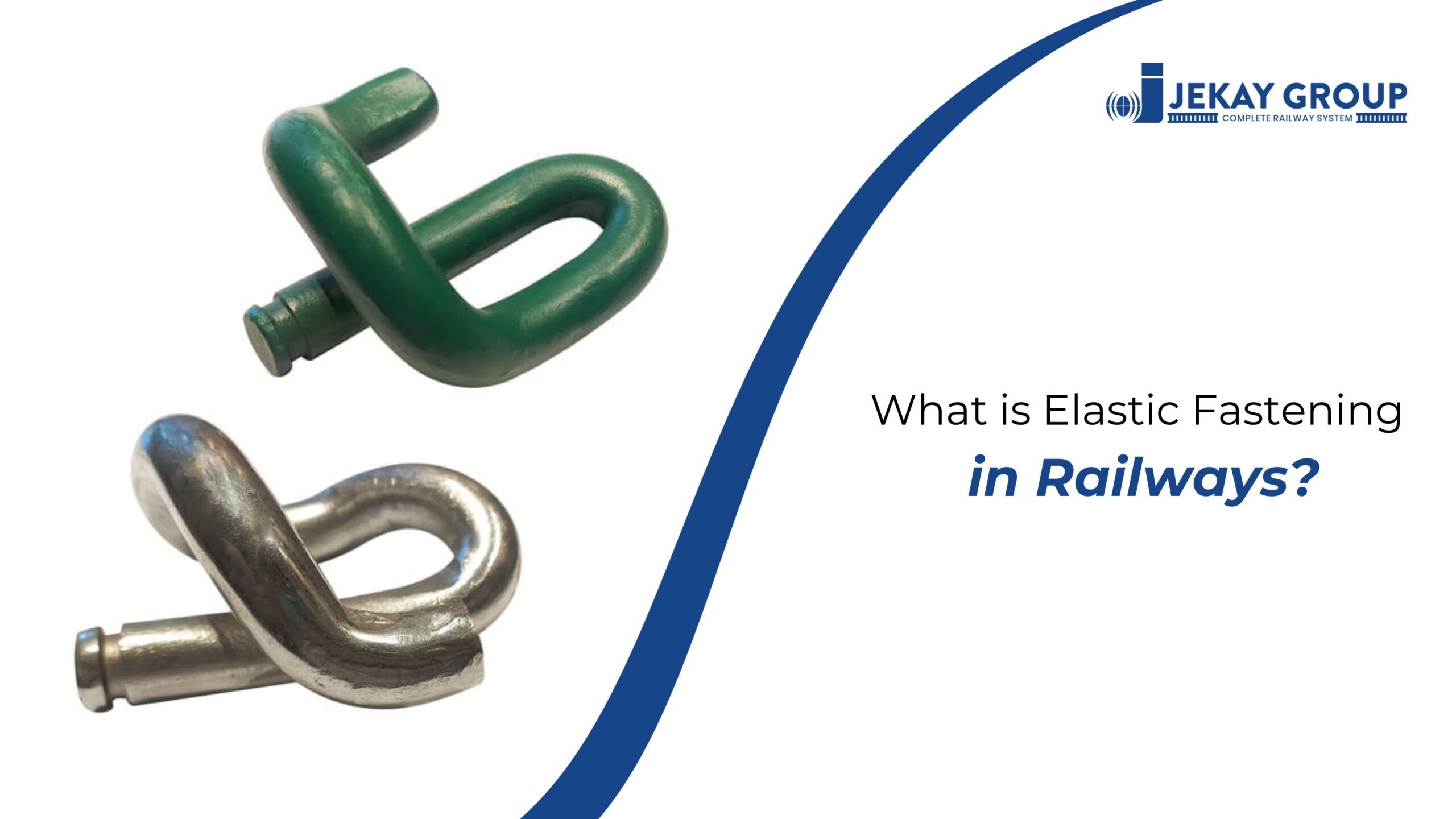
Elastic rail fastening is a track fixing system that uses spring-steel clips to apply continuous toe load—typically 9–14 kN—against the rail foot, holding the rail firmly against the baseplate or sleeper surface without rigid bolting.
The key distinction from conventional rigid fastenings is spring deflection. Elastic clips flex under load and return to their original position, maintaining clamping force throughout the deflection cycle. Rigid fastenings, by contrast, rely on friction and bolt tension, which degrades progressively under vibration.
A track section with elastic fastenings retains its designed clamping force for 15–25 years. Equivalent rigid-fastened track typically needs re-tightening or spike re-driving every 3–5 years in moderate-traffic conditions.
Components of Elastic Fastening
Every elastic fastening assembly contains four functional elements:
- Spring-steel clip: the core component; generates and maintains toe load through its deflected spring geometry, not through bolt tension
- Rubber rail pad: sits between rail base and baseplate; absorbs vertical shock and prevents metal-to-metal contact that would destroy the rail seat
- Nylon insulator/liner: positions the clip laterally, provides electrical isolation between rail and sleeper, and acts as a sacrificial wear surface protecting the clip and rail web
- Baseplate or shoulder: anchors the clip to the sleeper, resists lateral rail movement, and transfers loads from rail foot to sleeper surface
All four elements must be co-specified. Substituting one component without adjusting the others changes the system stiffness and accelerates wear on every remaining element.
How Elastic Fastening Works
When a loaded wheel passes over rail, the rail deflects vertically by 1–3mm and experiences lateral forces from wheel flange contact and cornering. The elastic clip resists both movements simultaneously.
The Toe Load Mechanism
The clip is installed in a pre-stressed deflected state. This stored spring energy generates constant downward force on the rail foot—the toe load. The rail cannot lift, rotate, or migrate laterally without working against this continuous force.
Unlike a bolt that either holds or strips, a spring clip degrades gradually. Maintenance teams can measure residual toe load with a calibrated tool and replace clips before holding capacity drops below the safe threshold—a predictable failure mode rather than a sudden one.
Vibration and Shock Absorption
The rubber pad handles energy that the clip doesn’t. Peak dynamic forces during wheel-rail impact spike to 150–200% of static wheel load. The pad compresses elastically under this load, extending the impact duration and reducing peak stress at the rail seat. European high-speed line data shows quality pads cut peak dynamic forces on concrete sleepers by 30–40%, directly extending sleeper life.
Functions and Benefits
Elastic fastenings deliver measurable performance gains across every track structure element:
- Gauge retention: clips maintain rail position within ±1mm over 15-year intervals; conventional spike systems drift ±4–6mm on mixed-traffic corridors
- Anti-creep performance: continuous toe load resists longitudinal rail migration from traction and braking forces
- Noise and vibration reduction: elastic assemblies cut wheel-rail noise by 3–8 dB—relevant for metro systems and urban corridors where ground-borne vibration affects adjacent structures
- Fastener longevity: clips in well-maintained track last 15–25 years; spike systems need intervention every 3–5 years
- Rail seat protection: rubber pads eliminate metal-to-metal abrasion that causes rail seat deterioration (RSD) on concrete sleepers, extending sleeper life from 8–12 years to 20–30 years in comparable conditions
Types of Elastic Rail Fastenings
E-Clip Systems
E-clips use a double-coil spring shape that grips the rail foot from both sides. They’re direct-fastened to cast-in or drilled shoulders and are widely used on Indian Railway PSC sleepers. Standard toe load for E-clips is 9–12 kN. Simple to install and remove with a basic insertion tool—no special equipment needed.
Tension Clamp (SKL-Type) Systems
Tension clamps use a single-wire spring bent into a defined profile that generates higher toe loads—typically 14–20 kN—through a longer spring arm. Better suited for high-speed and heavy-haul applications where higher clamping forces are needed to resist the greater dynamic loading. Installation requires a dedicated torque tool to achieve consistent seating.
IRN and Indian Railway Clip Variants
Indian Railways uses several clip configurations developed through RDSO specifications, matched to specific sleeper types, rail sections (52kg/m and 60kg/m), and track classes. Each clip profile is dimensioned for a specific sleeper shoulder geometry—mixing clips and shoulders from different specifications creates inconsistent toe load distribution.
Elastic Fastening in Different Track Applications
Concrete Sleeper Track
Concrete sleepers are the primary application for elastic fastenings globally. The hard, dimensionally precise rail seat surface allows tight clip-to-shoulder fits that deliver consistent toe load. Rubber pads are mandatory on concrete—without them, rail seat abrasion begins within months of service under freight loads.
Wooden Sleeper Track
Elastic clips on timber sleepers use a different baseplate configuration that compensates for the wood’s lower compression strength. Screw spikes or coach screws anchor the baseplate, and the clip geometry must allow for minor dimensional variation in the timber surface. Timber installations benefit significantly from elastic clips because the clips maintain holding force even as the wood compresses slightly under load—something spike systems cannot do.
Turnouts and Special Track
Turnout zones use higher toe load clips (14–20 kN) to handle the elevated impact forces at switch points and crossings. The clip geometry also changes through the turnout to accommodate variable rail sections, cant requirements, and guard rail positions. Using plain-line clips in a crossing panel is a common specification error that typically causes clip failure within 6–18 months.
Design Considerations That Determine Performance
Specifying elastic fastening hardware correctly requires decisions across five parameters:
- Toe load: match to axle load and traffic density—9–12 kN for standard passenger/mixed, 14–20 kN for heavy freight and turnouts
- Pad stiffness: softer pads (60–100 kN/mm static stiffness) for vibration-sensitive metro environments; stiffer pads (150–250 kN/mm) for heavy freight where excessive deflection increases frog impact forces
- Clip material: spring steel with controlled carbon content (0.60–0.75%) and specific heat treatment to achieve the right balance of hardness and ductility; under-hardened clips take permanent set, over-hardened clips crack at the bend radius
- Insulator material: PA66 nylon for standard conditions; glass-filled nylon or UHMWPE for high-wear zones with continuous rail movement
- Rail section compatibility: clip profile must match the rail foot width exactly—a clip designed for 52kg/m rail does not generate correct toe load on 60kg/m rail due to the wider base
Installation and Maintenance
Installation Steps
- Clean the rail seat surface before placing the rubber pad—scale, rust, and debris create stress concentrations under the pad
- Seat the insulator fully in the shoulder before positioning the clip; a partially inserted insulator creates uneven toe load across the rail foot
- Insert the clip using a calibrated installation tool to achieve full seating without over-driving
- Verify clip foot contact across the full rail base width after installation; a clip sitting flat on one side only contributes asymmetric toe load
What to Inspect and When
- Clip foot contact: check that both clip feet maintain contact with the rail base; a lifted foot contributes zero effective toe load
- Insulator condition: cracks, splits, or missing sections mean the clip is no longer correctly positioned and electrical isolation is compromised
- Pad condition: compressed beyond 80% of original thickness, cracked, or displaced pads change track stiffness and accelerate clip wear
- Replace any clip showing deformation at the bend radius, cracking, or measured toe load below 8 kN
A counterintuitive maintenance pattern: sections with elastic fastenings often show no visible deterioration for 10–12 years, then require rapid intervention as clips approach end-of-life simultaneously. Planning replacement by installation date rather than by visible condition prevents the bunching effect.
FAQs
What makes elastic fastenings better than conventional dog spikes?
Dog spikes rely on friction between spike shank and timber to hold the rail—friction that degrades under vibration within 2–5 years. Elastic clips maintain force through spring geometry, not friction, and retain their holding capacity for 15–25 years with minimal maintenance. The practical result is 60–70% fewer unplanned fastening interventions over a 20-year track lifecycle.
Can elastic clips be reused after removal?
Clips removed carefully with the correct extraction tool can be reused if they pass a visual inspection showing no deformation, cracking, or permanent set at the bend radius. Clips that were over-driven during installation or removed with improvised tools typically develop micro-cracks at the critical radius and should be replaced. A simple toe-load test after re-installation confirms whether the clip still meets specification.
What causes elastic clip failure before the expected service life?
Three main causes: incorrect clip-to-shoulder combination producing mismatched toe load, over-driving during installation that pre-stresses the clip beyond its elastic range, and chemical contamination from aggressive wood preservatives or de-icing salts that cause stress corrosion cracking in the spring steel. Material quality is the differentiating factor—clips manufactured from correctly specified spring steel with proper heat treatment resist all three failure modes significantly better than lower-grade substitutes.
Do elastic fastenings work on ballastless track?
Yes. Ballastless track (slab track) uses the same elastic clip and pad principles but with different baseplate designs embedded in the concrete slab. The absence of ballast compliance makes pad stiffness selection even more critical—the pad provides the only elastic element in the system, so stiffness must be tuned carefully to the design dynamic load case.
Conclusion
Elastic fastening systems are the reason modern high-speed and heavy-freight railways achieve 20–30 year track geometry lifetimes without constant re-fastening. The spring-steel clip, rubber pad, insulator, and baseplate function as a system—each component’s specification affects every other’s performance.
If you’re evaluating fastening components for new track, rehabilitation, or a track class upgrade, start with the axle load and clip toe load requirement, then work outward to pad stiffness and insulator material. Get the specification right at procurement and the maintenance burden stays predictable for decades.
Jekay manufactures elastic rail fastening components to RDSO and IRS specifications, including E-clips, rail pads, nylon insulators, and baseplates for Indian Railway PSC sleeper profiles and custom export configurations. Every component is dimensionally inspected against design drawings with full material traceability, ensuring consistent toe load performance across project batches.
Contact Jekay to discuss your fastening specification and request technical samples or a project quotation. Visit jekay.com and connect with our engineering team—we’ll match the right clip, pad, and insulator combination to your track class, axle load, and sleeper type before you commit to procurement.