
Introduction
Rail base plates sit between every rail and sleeper on your track—yet they’re the component most often under-specified or sourced as an afterthought. Mismatched base plates cause sleeper indentation, gauge deviation, and premature fastening failure. In fact, localized bearing stress from incorrectly sized plates can crush wooden sleeper fibers by 3-5mm within the first year of heavy service, permanently distorting track geometry. This guide explains what base plates are, why they matter mechanically, what types exist for different sleeper and track combinations, and how to select the right design for your application. You’ll get a clear, technical picture from function through installation—without having to piece it together from scattered catalog pages.
What Is a Base Plate?
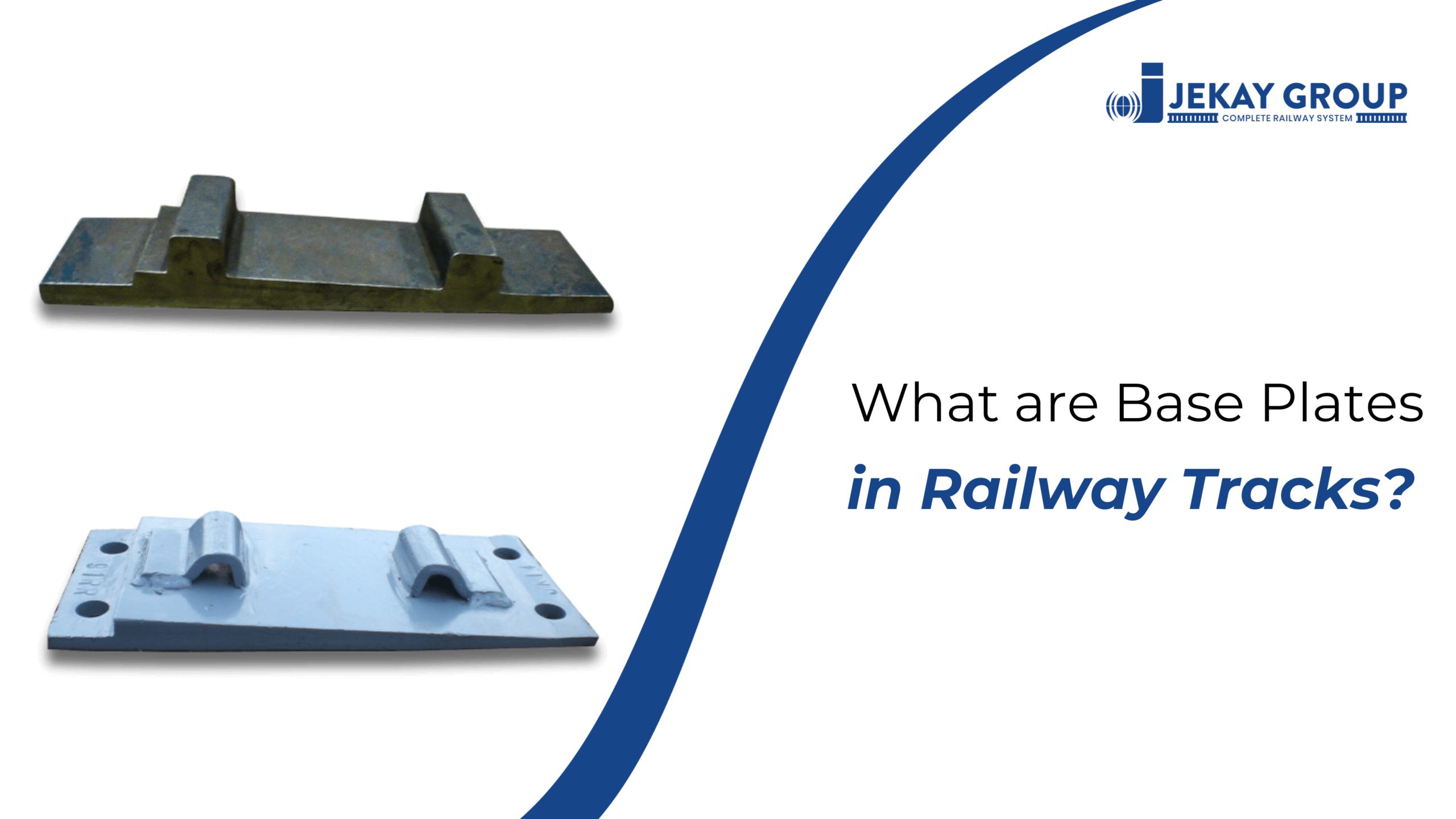
A railway base plate (also called a tie plate or sole plate) is a flat steel component placed between the rail foot and the sleeper surface. It creates a stable interface between the rail and the sleeper, acting as a mechanical buffer rather than allowing direct metal-to-wood or metal-to-concrete contact.
In most track systems, the base plate also incorporates shoulders—raised steel sections that position and retain elastic clips or spikes. These shoulders hold the rail in gauge and resist lateral displacement from wheel flange forces.
The base plate’s position in the assembly: sleeper surface → base plate → rail pad → rail foot → clips or spikes. Every component above it depends on the base plate for alignment and load distribution.
Main Functions of Base Plates
Base plates perform five distinct mechanical roles simultaneously:
- Load transfer: Spread concentrated rail loads across a larger sleeper bearing area, reducing stress per unit area by 40-60% compared to direct rail-on-sleeper contact
- Gauge control: Shoulders or ribs constrain the rail laterally, maintaining the 1,435mm (or project-specific) gauge under dynamic wheel forces
- Rail cant: Incorporate an inward slope (typically 1:20 or 1:40) that tilts the rail head toward the track centerline, optimizing wheel-rail contact geometry
- Sleeper protection: Prevent rail foot edges from cutting into concrete or wood under cyclic load, extending sleeper service life by 25-40%
- Vibration reduction: When used with rubber pads bonded to the underside, attenuate dynamic forces before they reach the sleeper
Removing the base plate from this equation doesn’t simplify the system—it transfers all five demands to components not designed to handle them.
Types of Base Plates
By Shoulder Configuration
Single shoulder plates provide a bearing face on one side of the rail foot. Used where clips engage on one side only—typically in older fastening systems or specific light rail configurations.
Double shoulder plates incorporate shoulders on both sides of the rail foot, delivering symmetric lateral restraint. Standard for mainline elastic fastening systems using clips on both sides.
Ribbed base plates feature transverse or longitudinal ribs pressed or rolled into the plate surface. Ribs key into concrete sleeper surfaces to resist longitudinal creep without depending solely on bolt friction.
By Application Type
Standard flat plates suit straight track with uniform rail profiles. Hook twin tie plates combine two rail seats into one unit for close-rail spacing in special trackwork. Adjustable base plates incorporate slotted holes allowing gauge fine-tuning in the field without replacing plates.
Turnout and crossing base plates carry asymmetric loading and require custom shoulder positions and hole patterns not available in standard catalog ranges.
Base Plates by Sleeper Type
Wooden Sleepers
Wooden sleeper plates use larger bearing areas (typically 150-200 cm²) because wood compresses under point loads. The rail cant angle is built into the plate inclination—wood can’t hold a separate canting component under cyclic loading.
Spike hole patterns must avoid wood grain splitting risks. Holes closer than 25mm to each other or to timber edges risk longitudinal fractures during spike driving.
Concrete Sleepers
Concrete sleeper plates typically feature ribbed undersides that key into the cast sleeper surface. The ribbing prevents lateral plate migration without relying solely on anchor bolt friction—critical since concrete provides no mechanical grip for friction alone.
Cast-in plates (embedded during sleeper manufacturing) achieve positional accuracy of ±0.3mm. Surface-mounted plates installed post-casting achieve ±0.8mm—adequate for most applications but insufficient for high-speed geometry requirements.
Steel Sleepers
Steel sleeper base plates must prevent galvanic corrosion at the metal-to-metal interface. Zinc-rich coating, isolation layers, or stainless steel contact surfaces address this—unprotected steel-on-steel interfaces corrode through within 5-8 years in moderate climates.
Bearing areas on steel sleepers run larger than on concrete (200-250 cm²) because steel channel sections flex more than rigid concrete, distributing load over a wider zone.
Materials and Manufacturing
Carbon steel (Q235 or equivalent, 400-500 MPa tensile) handles standard applications on passenger and light freight lines. Alloy steel grades (600-800 MPa) serve heavy-haul corridors where sustained high axle loads create fatigue conditions that exhaust standard steel within 10-15 years.
Manufacturing routes include:
- Hot rolling + machining: Produces consistent flat plates with tight thickness tolerances (±0.3mm); suits high-volume standard sizes
- Casting: Allows complex shoulder geometry but yields slightly lower material strength; suits special trackwork plates
- Welded fabrication: Attaches shoulders to flat plate blanks; flexible for custom designs but requires weld quality verification at each shoulder joint
Surface treatment determines service life in aggressive environments. Hot-dip galvanizing (85 micron minimum) provides 25-40 years corrosion protection. Epoxy coating suits chemical exposure zones. Untreated plates corrode through in 8-12 years in coastal or industrial environments.
Design Features and Technical Factors
Rail cant—the inward tilt of the rail head—matters more than most buyers realize. Running trains on zero-cant track concentrates wheel-rail contact at the rail head edge rather than distributing it across the crown. This accelerates rail wear by 30-50% and generates lateral forces that loosen fastening systems within 2-3 years.
Shoulder height and geometry govern clip engagement. A 1mm deviation in shoulder position changes effective toe load by 10-15%—enough to push high-speed fastenings below minimum specification while appearing dimensionally acceptable on visual inspection.
Plate thickness scales with axle load and sleeper stiffness. Typical ranges run 8-12mm for standard applications and 14-20mm for heavy-haul or turnout service.
Standards and Specifications
Indian Railways specify steel base plate requirements through RDSO IRS standards, covering material grade, plate dimensions, shoulder geometry, and surface treatment for each rail section (52kg, 60kg, etc.).
International references include EN standards for European projects and AREMA specifications for North American applications. Buyers sourcing for mixed international projects should verify which standard governs the project contract before specifying.
Every compliant base plate carries identification markings: manufacturer code, production date, material grade, and applicable rail section compatibility. These markings enable traceability to production batch records and inspection data—without them, quality verification depends entirely on supplier documentation rather than the physical part.
Selection Guide for Buyers
Match base plate selection to these four parameters in sequence:
- Rail section: Plate width, shoulder spacing, and hole positions derive directly from the rail foot dimensions; 52kg rail plates won’t fit 60kg rail
- Sleeper material: Determines bearing area, cant incorporation method, and attachment hardware
- Speed and axle load: Governs material grade, shoulder precision requirements, and plate thickness
- Environment: Coastal, industrial, or extreme temperature zones dictate surface treatment and material specification
Customization becomes necessary for turnout locations, non-standard rail profiles, transition zones between different track types, and industrial sidings with unusual geometry. Standard catalog plates cover approximately 70-75% of applications; the remainder needs engineering input.
Installation and Maintenance
Proper installation prevents the most common base plate failure modes before they begin:
- Clean bearing surface completely before placing the plate—grit or scale under the plate creates localized stress concentrations
- Verify plate orientation—cant slope must face inward toward track centerline; reversed plates cause outward rail lean within months
- Tighten anchor bolts to specified torque: 200-300 Nm for concrete sleeper anchors; use calibrated wrenches, not impact drivers
- Check gauge at every plate location after installation—shoulder contact with rail foot should be uniform, not one-sided
Inspection intervals: annual visual checks for standard mainlines, semi-annual for heavy-haul corridors. Replace plates when shoulder height reduces by 20%+ from wear, when corrosion penetrates more than 15% of plate thickness, or when bolt holes elongate beyond 2mm.
Choosing the Right Manufacturer
Dimensional precision separates quality base plates from catalog fillers. Shoulder position accuracy within ±0.5mm and plate thickness consistency within ±0.3mm are achievable with proper tooling. Suppliers who can’t confirm these tolerances with batch inspection records are specifying to different standards than they’re delivering.
Engineering support matters for non-standard applications. Turnout base plates, plates for non-standard rail sections, and designs for unusual sleeper geometries require modification capability rather than catalog substitution.
Request material certificates confirming steel grade, dimensional inspection reports from each production batch, and surface treatment validation (hot-dip galvanizing thickness measurements, for example) as standard documentation—not an upgrade.
Frequently Asked Questions
Do concrete sleepers always need base plates?
Not always. Some modern pre-stressed concrete sleepers incorporate the rail seat geometry and shoulder positions directly into the cast profile, eliminating the separate base plate. However, separate base plates remain common because they allow replacement without scrapping the sleeper when the rail seat wears or shoulders crack.
Can I use the same base plate for both 52kg and 60kg rail?
No. Rail foot width differs between sections—52kg rail has a narrower foot than 60kg. Shoulders positioned for 52kg rail leave gaps against 60kg rail foot, eliminating lateral restraint. Always match plate design to the specific rail section in use.
How does a base plate differ from a rail pad?
Base plates are structural steel components providing load distribution and gauge control. Rail pads are elastomeric (rubber, polyurethane, or composite) components placed between the base plate and rail foot to absorb vibrations and reduce dynamic loads. Both are distinct components serving different functions—a base plate doesn’t replace a pad, and vice versa.
What happens if base plate cant angle is wrong?
Incorrect cant angle concentrates wheel-rail contact at the rail head edge rather than across the crown. This accelerates rail wear by 30-50%, generates lateral forces that loosen fastenings, and can trigger corrugation on high-speed sections. On curved track, wrong cant combines with superelevation errors to create persistent geometry defects.
Conclusion
Base plates aren’t passive spacers—they actively distribute load, control gauge, set rail cant, and protect sleepers from the forces that would otherwise destroy them within years. Every specification decision—material grade, shoulder geometry, bearing area, surface treatment—has measurable consequences for track life and maintenance costs. Identify your rail section, sleeper type, and traffic demands first, then specify base plates engineered for those exact parameters.
Specifying base plates for a new project or track upgrade? Share your rail profile, sleeper type, and operating conditions with our engineering team for a compatibility-verified recommendation.
Why Choose Jekay International for Railway Base Plates?
Since 1980, Jekay International manufactures precision steel base plates for wooden, concrete, and steel sleeper applications across 13+ countries. Our production covers single and double shoulder designs, ribbed plates for concrete sleeper applications, heavy-duty alloy steel plates for 25+ tonne axle load corridors, and custom turnout base plates—all meeting RDSO IRS standards and international rail specifications.
Dimensional precision underpins everything we produce. Shoulder position accuracy within ±0.5mm, plate thickness consistency within ±0.3mm, and hot-dip galvanizing to 85+ micron minimum ensure components perform as specified over full service life. Every production batch ships with material certificates, dimensional inspection reports, and surface treatment validation.
Engineering support extends to non-standard applications. Our team adapts shoulder geometry, hole patterns, and cant angles for specific rail sections, turnout configurations, and unusual sleeper geometries—without the multi-month lead times typical of custom tooling projects.
Discuss your base plate requirements with our specialists. Visit jekay.com or request technical specifications and project quotations through our website. Four decades of railway component manufacturing, built around the precision your track geometry demands.