
Introduction
Most track failures don’t originate in the middle of a rail—they start at the joint. Rail ends that separate, misalign, or hammer against each other under repeated axle loads create defects that account for over 60% of track maintenance calls globally.fish plates are the mechanical solution that holds two rail ends together in alignment, transfers loads across the gap, and maintains track continuity for decades when properly specified and installed. This guide explains what fish plates are, how they function, which types suit which applications, and what to verify before purchasing—so you source components that perform reliably from day one.
Fish Plate Basics
What a Fish Plate Is
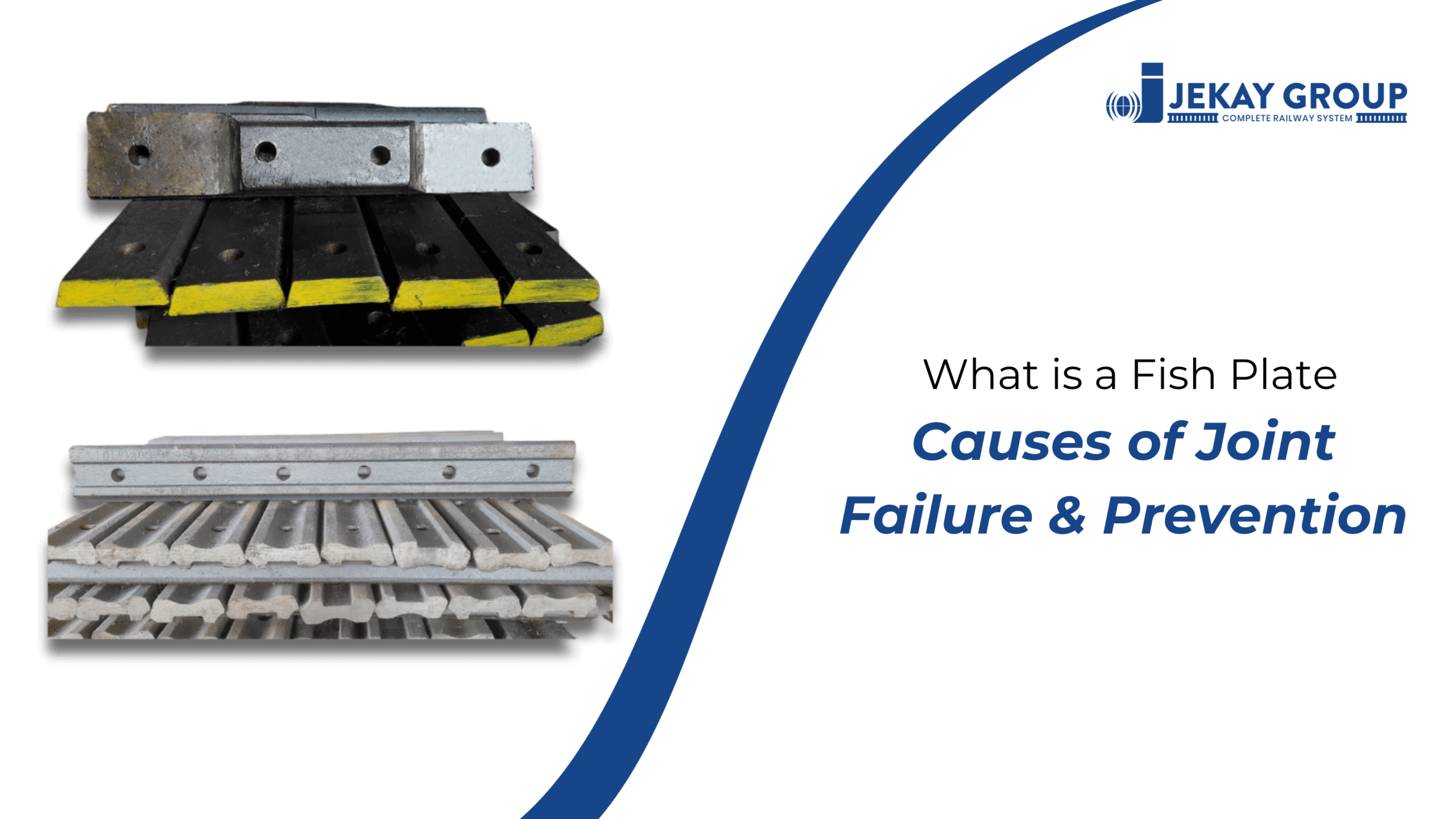
A fish plate—also called a splice bar or joint bar—is a flanged steel bar bolted to both sides of the rail web at the point where two rail ends meet. The plates clamp the joint from each side, creating a sandwiched connection that locks rail ends into alignment both vertically and horizontally.
The name derives from the cross-sectional profile: the tapered flanges of a standard fish plate resemble the side view of a fish when cut transversely. This profile geometry is functional, not decorative—the taper creates tight contact against the rail web and foot without requiring machined surfaces.
Where Fish Plates Sit in Track
Fish plates occupy the most mechanically demanding location in jointed track. Every wheel passage creates a dynamic impact as it crosses the gap between rail ends. The fish plate absorbs this impact through bolt clamping force and transmits load between the departing and approaching rail sections.
On a standard Indian Railways broad gauge layout, fish plate joints appear at 13-metre intervals on older jointed track. Even on continuously welded rail (CWR) lines, fish plates appear at insulated joints, expansion joints, and welded joint repairs.
Main Functions
Fish plates serve four distinct mechanical roles simultaneously:
- Load transfer — share vertical wheel loads between the departing and arriving rail sections, reducing peak stress at the unsupported rail end by 40-50%
- Alignment retention — lock both rails in the same horizontal and vertical plane, preventing step differences that amplify impact forces
- Gauge control — resist lateral spread at joints where gauge is most vulnerable to widening under wheel flange pressure
- Longitudinal continuity — allow controlled thermal movement through the gap while preventing rail ends from pulling apart under tensile stress
A fish plate that loses bolt torque stops performing all four functions simultaneously—this is why a single loose joint degrades faster than the combined effect of worn ballast and poor drainage in the same location.
Types of Fish Plates
Standard Fish Plates
Standard fish plates suit straight track and gentle curves on homogeneous rail sections. They come in four-hole and six-hole variants—six-hole plates develop higher clamping force and suit high-traffic lines carrying 10+ MGT annually.
Joggled Fish Plates
Joggled designs offset the plate vertically so bolt holes don’t align with the fish bolt holes in the rail web. This prevents stress concentration at the hole positions, reducing fatigue crack initiation by 25-30%. Specify joggled plates for curves tighter than 600m radius and heavy-haul freight corridors.
Compromise Fish Plates
Compromise plates join two different rail sections—52 kg/m to 60 kg/m, for example—during track upgrades or at temporary junctions. They feature asymmetric profiles matching each rail section. These joints require closer inspection intervals because the strength of the connection equals the weaker rail section.
Insulated Fish Plates
Insulated joints electrically isolate adjacent rail sections for track circuit signalling systems. They incorporate non-conductive liners, end posts, and insulated bolts between fish plates and rail. Electrical resistance across the joint must exceed 1 Ohm under field conditions—dimensional precision in these plates affects both mechanical and electrical performance.
Materials and Design
Fish plates for Indian Railways applications require killed steel with documented chemical composition. Carbon content between 0.40-0.50% provides the balance of strength and weldability. Minimum tensile strength of 690 MPa with elongation above 14% ensures the plate survives cyclic loading without brittle fracture.
Bolt hole geometry determines fatigue life more than overall plate dimensions. Holes drilled oversize by even 1mm reduce effective wall thickness at the stress concentration point, compressing service life from 25+ years to under 10. This is the most common manufacturing shortcut that passes visual inspection but fails in service.
Standards and Compliance
IRS T-1-2012 specifies dimensions, material requirements, and inspection criteria for fish plates used on Indian Railways. RDSO approval validates that a manufacturer’s production processes and quality systems meet these specifications before orders are placed.
Material test certificates must accompany every delivery, linking the supplied batch to specific steel heats with verified chemical composition and mechanical properties. Without this traceability, warranty claims and failure investigations have no foundation.
Installation and Use
Correct fish plate installation follows a defined sequence:
- Clean rail end faces and fish plate bearing surfaces to remove rust, scale, and grease
- Position fish plates on both sides of the rail web with holes aligned
- Insert all fish bolts before tightening any
- Torque bolts from the center pair outward in two passes to 50%, then 100% of specification
- Re-check torque after 24 hours to account for initial seating
A surprising pattern: studies of joint maintenance records show that 35% of fish plate failures trace directly to incorrect installation sequence rather than material defects. Bolt tightening order matters more than most site supervisors acknowledge.
Maintenance and Inspection
Signs That Demand Immediate Attention
Replace or re-torque fish plates when any of these conditions appear:
- Visible cracks running from bolt holes toward plate edges
- Bolt holes elongated beyond 2mm from original diameter
- Plate movement or rocking under hand pressure
- Rail end step exceeding 2mm measured with straightedge
- Rust streaking from bolt holes indicating internal fretting
Inspection Intervals
Main freight lines require torque verification every 3-6 months. Secondary lines need annual checks. Post-monsoon inspection catches ballast disturbance that allows joint settlement and shifts clamping geometry outside specification.
Applications in Railway Systems
Fish plates appear across more track applications than most procurement teams account for:
- Mainline jointed track — standard and six-hole variants at 13-metre joint intervals
- Turnouts and crossings — specialized profiles matching switch rail and crossing nose geometry
- Insulated block joints — electrical isolation for signalling track circuits
- Emergency repairs — re-jointing fractured CWR before permanent welded repair
- Transition zones — compromise plates at rail section changes during staged upgrades
Each application demands a different fish plate specification. Using standard plates in insulated joint positions, or four-hole plates in high-tonnage freight applications, creates premature failure patterns that appear as “poor quality” but are actually specification mismatches.
Buyer Selection Points
Matching Plate to Rail Section
Always specify fish plates by rail weight per metre (52 kg, 60 kg, 90R, etc.) and provide the relevant IRS drawing number. Generic descriptions without rail section reference allow suppliers to ship non-matching profiles that appear dimensionally similar but create uneven bearing contact. Verify that supplier quotations explicitly reference the correct drawing numbers before confirming orders.
What to Verify Before Ordering
Request copies of current RDSO approval letters showing approved product scope, recent material test certificates from production in the last 12 months, and a dimensional inspection report from the proposed production batch. Suppliers who can’t produce these within 48 hours of request signal documentation gaps that will cause inspection delays later.
FAQs
How do I identify the correct fish plate for my rail section?
Fish plates match rail sections by weight per metre and profile designation. Provide your rail type (52 kg/m, 60 kg/m, 90R, etc.) and the relevant IRS drawing number to your supplier. Confirm that the supplier’s proposal explicitly references that drawing rather than a “similar” alternative. Mismatched profiles create uneven bearing contact that accelerates both fish plate and rail web wear.
What is the standard torque for fish plate bolts?
M24 fish bolts on standard broad gauge joints require 400-450 Nm applied torque. Heavier rail sections with 32mm diameter bolts require 600-650 Nm. Always use a calibrated torque wrench—impact wrenches can’t confirm final torque and frequently over-tighten, damaging threads and reducing effective clamping. Verify torque values against IRS specifications for your specific rail section rather than applying generic bolt-size tables.
When should I choose six-hole fish plates over four-hole?
Six-hole fish plates develop higher clamping force over a longer rail section, making them mandatory for lines carrying above 10 MGT annually. They also suit locations with tight curve content, steep gradients, or any section where longitudinal rail movement is a documented issue. Four-hole plates work for secondary lines and sidings with lighter, less frequent traffic.
Can fish plates be reused after removal?
Reuse depends on the condition after removal—not on service time alone. Inspect for bolt hole elongation, plate bending, surface cracks, and thickness loss from fretting wear. Plates with no visible defects and holes within 1mm of original diameter can return to service in lower-traffic locations. Never reuse insulated fish plates; the electrical insulation components degrade with compression cycles and rarely meet resistance specifications after a second installation.
Conclusion
Fish plates are the most maintenance-sensitive components in jointed track—small enough to overlook in procurement, consequential enough to trigger derailments when they fail. Getting the type, material grade, and installation sequence right determines whether your joints last 25+ years or become routine maintenance problems. Visit jekay.com today to source RDSO-approved fish plates across all standard Indian Railways profiles—backed by verified killed steel, precision hole tolerances, complete material traceability, and 40+ years of railway track component expertise. Contact our team now to match the right fish plate specification to your rail section and traffic loading before your next track possession window.