
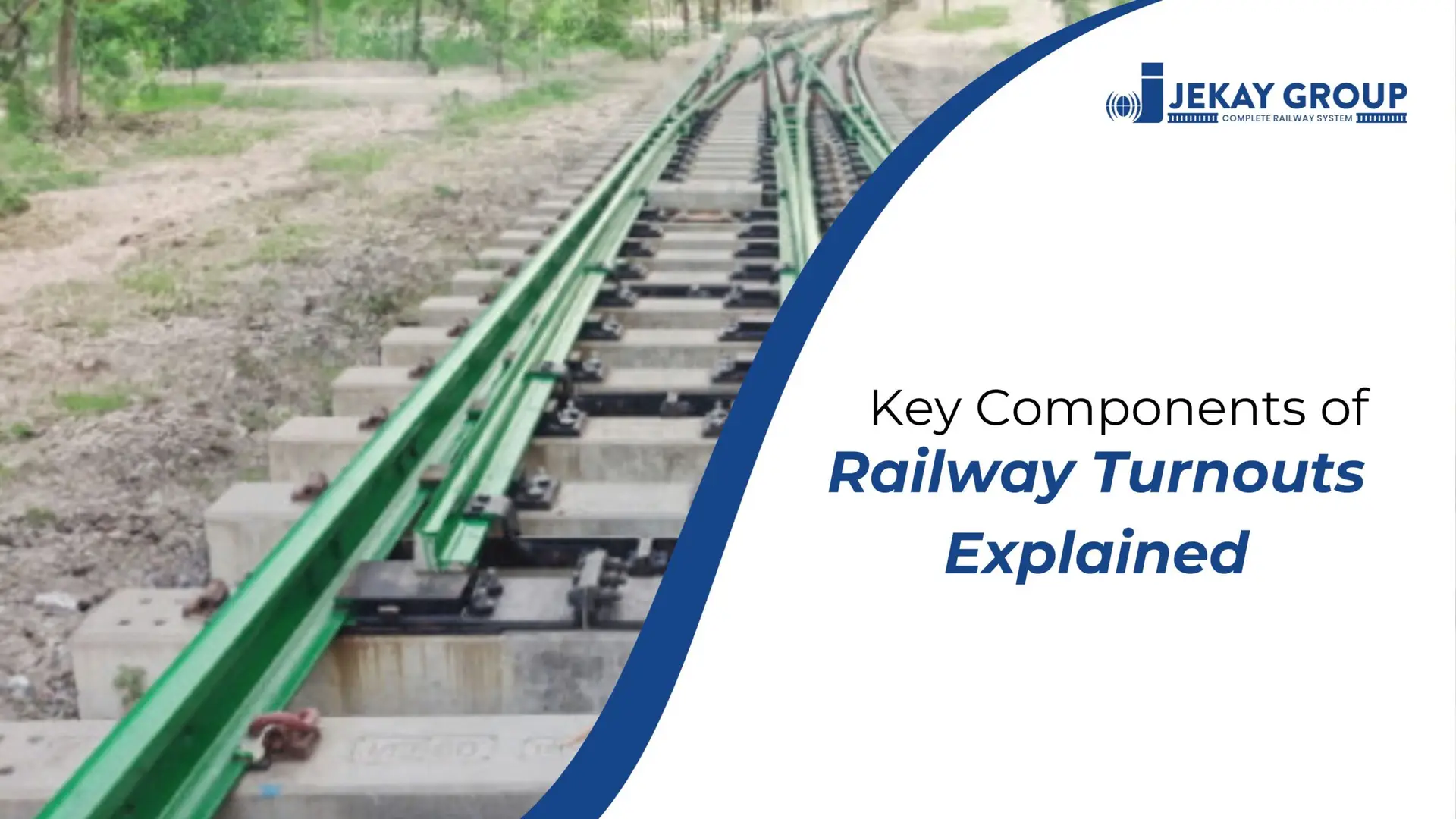
Railway turnouts represent critical nodes in rail infrastructure, facilitating the transition of rolling stock between tracks. As these assemblies concentrate higher dynamic stresses than plain-line track, their operational failure often results in significant network disruption, schedule instability, and increased risk to safety. Effective management of these assets requires a comprehensive understanding of their constituent components and the engineering principles governing their performance.
This technical overview details the mechanical functions of turnout components, the geometric constraints of various configurations, and the evidence-based maintenance protocols required to mitigate structural risk and ensure long-term network reliability.
Introduction to Railway Turnouts
A railway turnout — also called a switch or points assembly — is the track device that diverts rolling stock from one rail line to another. It is, in effect, the decision-making node of any rail network.
The development of turnouts has evolved from simple pivoting timber rails used in 18th-century mining operations to modern precision-engineered assemblies. Current standards utilize materials such as high-manganese steel, manufactured to millimetre-level tolerances to accommodate increasing axle loads and traffic density.
While turnouts occupy a small percentage of total track length, they can represent up to 20% of track investment costs in specific jurisdictions. This disproportionate expenditure is driven by the complexity of the engineering required and the financial risk associated with component failure.
Core Structure of a Turnout
Every turnout is divided into three functional zones:
- Switch Assembly — controls the entry and diverging direction
- Closure (Lead) Assembly — transitions the wheel path between zones
- Crossing Assembly — manages the point where two rail paths intersect
Each zone consists of specialized components designed for specific load-bearing and guidance requirements. Analytical assessment of these zones is essential for evaluating material quality and predicting maintenance cycles.
Key Turnout Components
Switch Rails (Points)
Switch rails — also called point blades — are the movable rails that physically redirect a train. They are tapered at the tip (the switch toe) so they press flush against the stock rail when locked in position. The opposite end, the switch heel, pivots on a heel block connected to the closure rails.
Precision in the machining of the switch toe is critical; even a 2 mm gap between the toe and stock rail under high axle loads can transmit impact forces that significantly reduce the assembly’s operational life.
Stock Rails
Stock rails are the fixed, continuous running rails that the switch rails press against. They form both the straight route and the base reference for the diverging route. Wear on the inner face of a stock rail is one of the earliest signs of misalignment in the switch zone.
Closure Rails (Lead Rails)
Closure rails connect the switch heel to the frog. They carry the wheel through the transition zone while it follows either the straight or diverging geometry. Lead rails on curved turnouts carry significantly higher lateral stress than those on straight turnouts.
Frog (Crossing)
The frog is where the two rail paths physically cross. It has a pointed nose flanked by two wing rails, and it contains a flangeway gap — the slot that lets wheel flanges pass through. That gap is an unavoidable structural weak point: it causes a brief loss of support as each wheel crosses over.
There are two frog types:
- Fixed frog — standard in lower-speed and freight applications; cost-effective but generates impact at the gap
- Swing-nose (movable) frog — the nose shifts to close the gap in the active direction; used in high-speed routes; dramatically reduces wear and impact forces
Wing Rails
Wing rails sit alongside the frog and support the wheel as it crosses the flangeway gap. Without correct wing rail height relative to the frog nose, wheels drop sharply into the gap — the classic cause of rough ride at crossing zones.
Check Rails (Guard Rails)
Check rails are placed opposite the frog to constrain lateral wheel movement. They prevent a wheel from drifting into the wrong flangeway and derailing at the crossing. On fixed-frog turnouts, check rails are non-negotiable. Swing-nose frogs typically eliminate the need for them.
Bearers and Fastening System
Bearers — concrete or timber — carry the entire assembly and transfer vertical and lateral loads to the subgrade. Fasteners (base plates, tie rods, chair screws, elastic clips) lock each rail component at its designed position.
A compromised fastener on a bearer near the frog is a frequently underreported cause of progressive track misalignment, leading to increased lateral vibration and structural wear.
Types of Railway Turnouts
| Type | Application |
| Single turnout | Standard line divergence |
| Symmetrical (wye) turnout | Yard layouts, two equal diverging routes |
| Double crossover | Connecting two parallel tracks, both directions |
| Diamond crossing | Intersecting tracks, no lane change |
| Single / double slip | Intersection with lane-change capability |
| Three-way (lapped) turnout | Compact yards needing three routes |
Turnout Geometry and Speed
Turnout geometry is expressed as a ratio — 1:n — where n is the crossing number. A 1:18 turnout has a shallower angle than a 1:9, allowing higher diverging speeds. Higher crossing numbers also require longer assemblies and more precise manufacturing.
The permissible train speed is governed by both the crossing angle and the diverging radius. Factors such as cant deficiency and wheel-rail interaction serve as the primary engineering constraints for high-speed applications.
Maintenance and Operational Impact
Turnouts are the highest-stress zones on any track. Even minor deviations in level or alignment in the switch or crossing zone amplify into ride discomfort, accelerated wear, and rising maintenance costs.
Maintenance frequency is directly influenced by three technical variables:
- Rail metallurgy — higher manganese content at the frog nose extends crossing life
- Fastener tension — loose fasteners allow micro-movements that accumulate into measurable misalignment
- Subgrade stability — bearer settlement is faster under turnouts than on open track due to variable load patterns
Design Standards and Classification
Turnouts are specified by a multi-variable designation covering:
- Rail profile (e.g., 60 kg/m UIC)
- Branch radius
- Crossing number
- Switch tongue type (undercut, straight cut, overriding)
- Bearer type (concrete or timber)
Current industry standards for mainline and high-speed corridors increasingly utilize alloy steel and through-sleeper designs. Interlaced sleeper configurations remain standard for the tighter-radius requirements found in urban and tram networks.
FAQs
What is the difference between a frog and a crossing?
They refer to the same component. “Frog” is the North American term; “crossing” is standard in British and European railway terminology. Both describe the cast or fabricated rail intersection piece at the heart of the turnout assembly.
When should you choose a swing-nose frog over a fixed frog?
If trains will pass through the diverging route at speeds above approximately 80 km/h, a swing-nose frog is the engineered answer. It eliminates the impact at the flangeway gap, cuts frog wear by a significant margin, and lowers long-term maintenance costs despite higher upfront investment.
What causes most turnout failures in the field?
Frog nose wear and switch rail tip damage account for the majority of reported failures. Both trace back to either poor material grade at manufacture or improper maintenance intervals — not to design faults in the turnout itself.
How long does a turnout last?
Service life depends on traffic tonnage, train speed, and maintenance quality. Mainline freight turnouts on high-tonnage corridors may need frog replacement within five to seven years. Lightly trafficked sidings can run for decades without major intervention.
Conclusion
Turnouts are complex engineering assemblies rather than simple commodities. Each component, from the switch toe to the check rail, plays a documented role in maintaining safe rail operations. Procurement strategies that prioritize acquisition price over metallurgical standards and geometric precision often lead to higher lifecycle costs and premature infrastructure overhauls.
Effective infrastructure sourcing begins with a detailed evaluation of frog specifications and component metallurgy. These technical parameters serve as reliable indicators of manufacturing capability and long-term asset performance.
About Jekay International Track
Jekay International has been engineering railway track systems since 1980 — supplying turnouts, track fastening systems, and rolled sections to railway developers and governments across five continents. Our assemblies are built to international standards, with a customer-first approach that covers everything from specification to installation support.
Explore our turnout range at jekay.com/turnout-system/.