
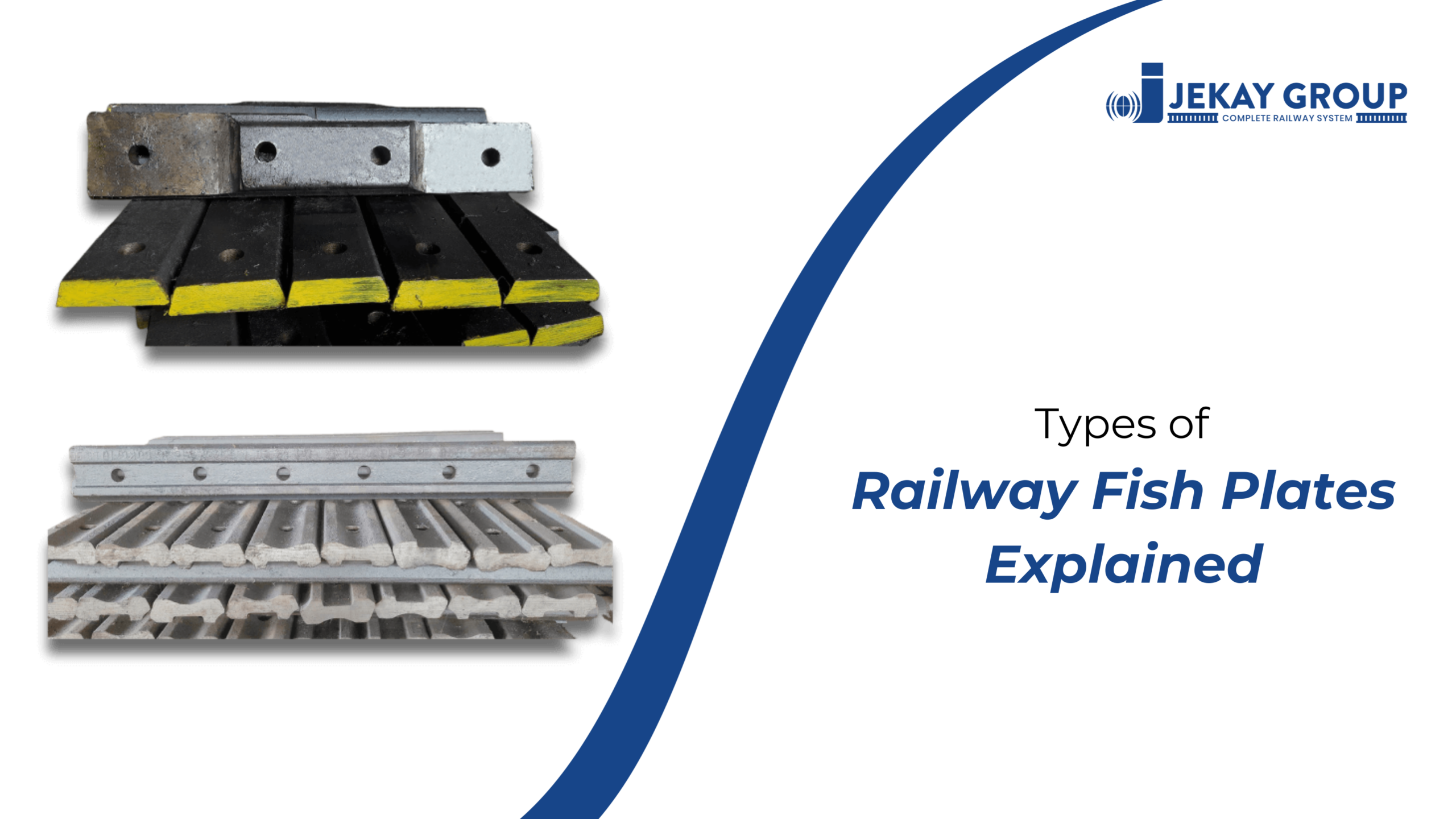
Railway fish plates, also designated as joint bars or splice bars, are critical infrastructure components designed to maintain track geometry, ensure structural alignment at rail joints, and manage operational risks associated with dynamic loading. Proper specification of these components is essential for mitigating longitudinal and vertical displacement.
This technical guide outlines the primary classifications of fish plates, their material properties according to international standards (IRS, RDSO, ISO, UIC), and engineering criteria for application-specific selection.
What Is a Fish Plate
The primary function of a fish plate is to bridge the gap between adjoining rail ends, ensuring continuity of the running surface. By securing the rail web via high-tensile bolts, these components distribute vertical and lateral axle loads, preventing excessive deflection and rail-end batter.
Component performance is measured by the ability to withstand cyclic dynamic stresses, often exceeding several tonnes per axle, while maintaining precise tolerances to avoid signaling failures or track misalignments.
Types of Fish Plates
1. Standard Fish Plate
Standard fish plates are utilized for joining rails of identical cross-sections. They are typically manufactured from carbon steel to meet IRS T-1-2012 or UIC 864-4 specifications.
- Available in 4-hole and 6-hole configurations
- 6-hole versions handle higher load frequencies better
- Used across mainline, siding, and loop tracks
Operational reliability is dependent on strict adherence to bolt torque specifications (typically 400-600 Nm) and regular inspection of the fishing surface to ensure proper load transfer.
2. Joggled Fish Plate
Joggled plates feature a specific geometric offset to accommodate weld beads at welded joints or to facilitate clearance for insulating components. They are essential for ensuring full contact along the rail web in non-standard geometry.
- Maintains full contact along the rail web despite the offset
- Prevents the insulating layer from buckling under load
- Required wherever track circuits are active
3. Compromise Fish Plate (Combination Joint Bar)
Used at transition points where two rails of different sections meet. This happens most often during rail renewal, gauge upgrades, or when connecting legacy tracks to new sections.
- One side matches the profile of a heavier rail section; the other fits the lighter one
- Prevents height mismatches that cause rolling stock to jolt at joints
- Critical in mixed-fleet operations where older and newer wagons run on the same corridor
4. Insulated Fish Plate
A functional requirement in all electrified railway systems. These plates electrically isolate adjoining rail sections to keep track circuit signals accurate and prevent current bleed.
- Insulating material is typically fiberglass or high-grade composite
- The entire assembly — plate, bolt sleeves, and end posts — must be non-conductive
- Failure of insulation here triggers signalling faults, not just mechanical ones
Procurement specifications must include UV resistance and impact durability ratings for the composite materials used, as these components require specialized inspection cycles compared to steel variants.
5. Heavy-Haul Fish Plate
Engineered for axle loads exceeding 25 tonnes, these plates utilize high-grade alloy steel (e.g., Manganese or Chromium) to improve fatigue resistance and rigidity in mining and heavy-freight corridors.
- Often paired with 6-bolt configurations for maximum joint rigidity
- Used in mining railways, port terminals, and bulk-commodity corridors
- Load ratings are rail-section-specific; these are not interchangeable with standard plates
6. Emergency / Repair Fish Plate
Designed for temporary remediation of rail fractures or failed standard joints, these wider-profile plates allow for restricted-speed operations until a permanent replacement is executed.
- Not intended for permanent installation
- Enables track to return to limited-speed service while a full replacement is organised
- Should be removed and replaced within defined maintenance windows
Material Types
| Material | Best For | Trade-off |
| Medium carbon steel | Standard and heavy-haul track | Heavier; needs anti-corrosion treatment in coastal zones |
| High carbon steel | High-speed and high-load joints | Less ductile; not ideal for impact-heavy environments |
| Alloy steel (Mn, Cr) | Mining and heavy freight | Higher cost; longer fatigue life |
| Composite / FRP | Insulated joints | Lighter, corrosion-resistant; sensitive to impact |
How to Choose the Right Fish Plate
Match your selection against these four variables:
- Rail section and weight — The fish plate profile must correspond exactly to the rail section (e.g., 52 kg/m, 60 kg/m, or 90R). No approximation works here.
- Load and traffic frequency — Heavy-haul and high-frequency corridors need thicker plates with more bolt holes.
- Electrical requirements — Any electrified or signalled track needs insulated variants with certified isolation values.
- Operating environment — Coastal, humid, or chemically exposed environments need hot-dip galvanised or alloy steel plates to slow corrosion.
FAQs
How many bolts does a fish plate need?
Standard track uses 4-bolt fish plates. High-traffic mainline and heavy-haul corridors use 6-bolt configurations to reduce joint movement and fatigue cracking.
Can a standard fish plate be used at an insulated joint?
No. Standard steel plates conduct electricity. Using them at track circuit boundaries disrupts signalling and creates safety risks.
How often should fish plates be inspected?
Indian Railway standards recommend visual inspection of every track maintenance cycle and a detailed check — including bolt torque verification — at least once per year on mainline track.
What causes fish plate failure?
The leading causes are loose bolts (reduced clamping force), corrosion thinning the plate body, and fatigue cracking from repeated bending at the joint. Impact from wheel flats accelerates all three.
Are compromise fish plates permanent?
They can be, but they are most commonly used as a transitional measure during rail renewal. Once the entire section is re-railed to a uniform profile, standard plates replace them.
Lifecycle Management and Compliance
Effective lifecycle management of railway fish plates requires strict adherence to regulatory standards and engineering rigor. Procurement should verify compliance with IRS T-1-2012 or relevant international standards (UIC, AREMA, EN) through mill test certificates and dimensional inspection reports.
Maintenance protocols must include annual torque verification and visual inspection for fatigue cracking, particularly at bolt-hole edges. Proper matching of plate type to rail section and operational environment is fundamental to minimizing track downtime and ensuring long-term structural integrity.
About Jekay International Track
Jekay International Track Pvt. Ltd. is an RDSO-approved manufacturer and exporter of railway track fittings with production experience since 1980. The manufacturer maintains ISO 9001 certification and BIS licensing for critical components.
Manufacturing capabilities include a rolling mill with an annual capacity of 100,000 MT and a rail end-forging facility capable of producing 18,000 rails per year. Jekay supplies a range of IRS-compliant fish plates (Standard, Joggled, Combination) to mainline and heavy-haul projects internationally.