
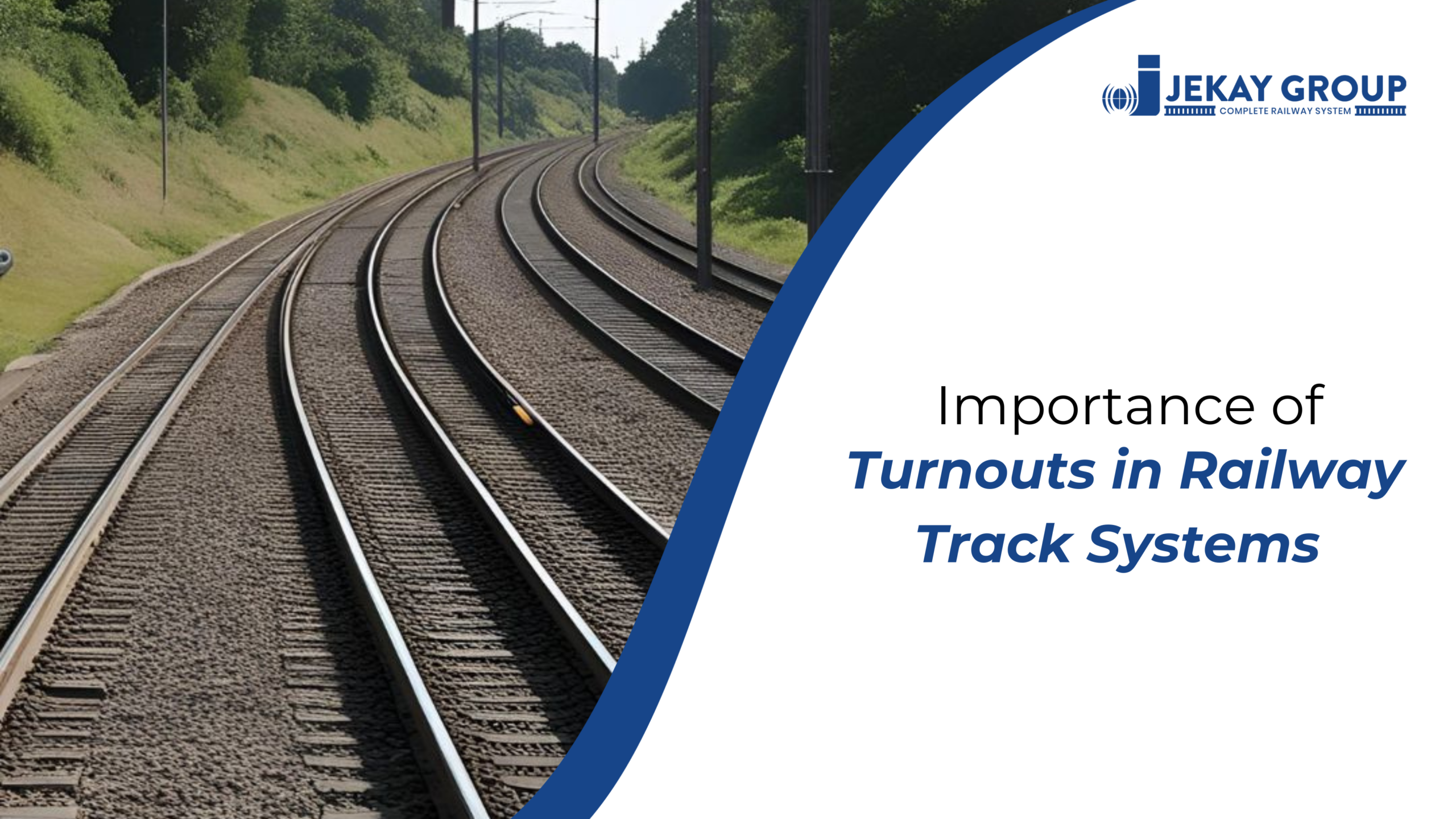
Most infrastructure teams treat turnouts like any other track component — spec them, order them, move on. That approach costs more than it saves. Turnouts carry 3-5 times the dynamic stress of straight track, concentrate every major failure mode into a few meters of assembly, and decide how much capacity your network actually has. Get the specification wrong and you inherit speed restrictions, unplanned maintenance, and derailment risk that plain track never creates. This post breaks down what turnouts do, why they matter more than most buyers assume, and what to look for before you place an order.
What a Turnout Actually Does
A turnout is a mechanical track assembly that lets a train move from one line to another without stopping. It’s built from switch points, a frog (or crossing), guard rails, and closure rails, all working together to guide wheels through a route change.
The Three Working Zones
- Switch zone — where point blades physically move to select the route
- Closure zone — the curved transition that sets the turnout’s speed limit
- Crossing zone — where wheels pass through the frog gap, taking the highest impact load in the entire assembly
Why Turnouts Matter More Than Buyers Think
Turnouts make up less than 5% of total track length on most networks. Yet they account for 20-30% of track-related derailments. That gap alone should change how procurement teams think about them.
Capacity and Flexibility
Turnouts let two trains share one line from opposite directions, and they let a single line branch into sidings, yards, and stations. Without them, network capacity is fixed. With them, the same physical track handles far more traffic.
Efficiency and Reduced Delay
A single malfunctioning turnout can stall an entire section of network, and the delay costs stack up fast when trains queue behind it. Reliable turnouts keep trains moving instead of waiting.
Wear Distribution
By spreading traffic across multiple routes instead of one, turnouts reduce the concentrated wear that comes from single-track overuse.
Types of Turnouts and Why the Choice Matters
- Simple turnout — one straight route, one diverging branch; the standard for sidings and station connections
- Three-way turnout — one assembly, three routes; compact but maintenance-heavy
- Double/scissors crossover — lets trains switch between two parallel tracks in either direction
- Diamond crossing with slip — maximum track density for tight yard layouts
- Swing-nose crossing — eliminates the impact gap at the frog, enabling diverging speeds of 100-160 km/h instead of the 30-50 km/h ceiling on fixed frogs
The turnout number — expressed as a ratio like 1:12 or 1:16 — determines diverging speed, lead length, and how much space the assembly needs. A 1:8.5 turnout limits passenger speed to around 15 km/h; a 1:16 allows roughly 50 km/h. Specify the wrong number and you’re stuck with a permanent speed restriction.
Safety: The Part Buyers Underestimate
Turnout zones concentrate switch point impacts, frog loads, and geometric complexity into a short stretch of track. That’s the direct reason the derailment numbers skew so heavily toward turnouts.
What Actually Fails
- Loose fasteners — the single most cited cause in derailment investigations, because turnout maintenance schedules often reuse plain-track intervals on components under far higher load cycling
- Worn or misaligned switch points — must seat fully against the stock rail with no gap or debris
- Undersized fish plates and joint bars — turnout zones see 2-3 times the dynamic impact of plain track, and standard flat plates crack or loosen within a few years where turnout-rated plates would last the full service life
How to Choose the Right Turnout Manufacturer
This is the step most guides on this topic skip, and it’s the one that determines whether your turnout performs or becomes a recurring cost.
What to Check Before You Order
- Compliance documentation — RDSO, EN 13481, UIC, or IRS certificates matched to your specific project, not generic catalog sheets
- Metallurgy over price — alloy grades, tensile strength, and heat treatment records with batch traceability; a cheaper crossing that fatigues early costs more over its service life
- Turnout-specific components — fish plates, base plates, and clips engineered for turnout stress levels, not borrowed from mainline catalogs
- Customization capability — pad stiffness, clip toe load, and shoulder geometry should match your actual turnout number, not the nearest standard size
- Complete assembly supply — sourcing switches, crossings, and fastenings from one manufacturer removes the coordination risk of split purchasing
- Technical support — laying templates, sleeper plans, and installation guidance that get the geometry right the first time
- Track record — decades of manufacturing history across multiple rail standards signal a manufacturer that’s solved these problems before
FAQs
How much more stress does a turnout carry compared to straight track? Turnouts typically experience 3-5 times the dynamic stress of adjacent plain track, concentrated at the switch points, closure rails, and frog.
What determines a turnout’s speed limit? The turnout number — the ratio describing the angle of divergence. Larger numbers mean gentler curves and higher permissible speeds; smaller numbers mean tighter curves and lower speeds.
Why do turnout fastenings fail faster than plain-track fastenings? Because many maintenance schedules apply plain-track tightening intervals to components experiencing significantly higher load cycling, which lets clips lose toe load and allows progressive misalignment.
Is a swing-nose frog worth the extra cost? Yes, if diverging speeds above roughly 80 km/h are part of your operation. It removes the impact gap at the frog, cutting wear and long-term maintenance despite a higher upfront price.
What’s the biggest procurement mistake buyers make with turnouts? Specifying turnout components — fish plates, clips, base plates — from standard mainline catalogs instead of turnout-rated designs built for the higher loads these zones actually see.
Get Turnouts Built for the Load They’ll Actually Carry
Jekay International Track Pvt. Ltd. has manufactured precision turnout systems since 1980, supplying switches, crossings, and fastening components engineered to RDSO, EN, and UIC standards across 13+ countries. Our promise is straightforward: components specified to your actual turnout number and traffic load, not a nearest-standard approximation.
Share your turnout numbers, rail sections, and traffic parameters with our engineering team, and get a component-by-component recommendation built for your project.
