
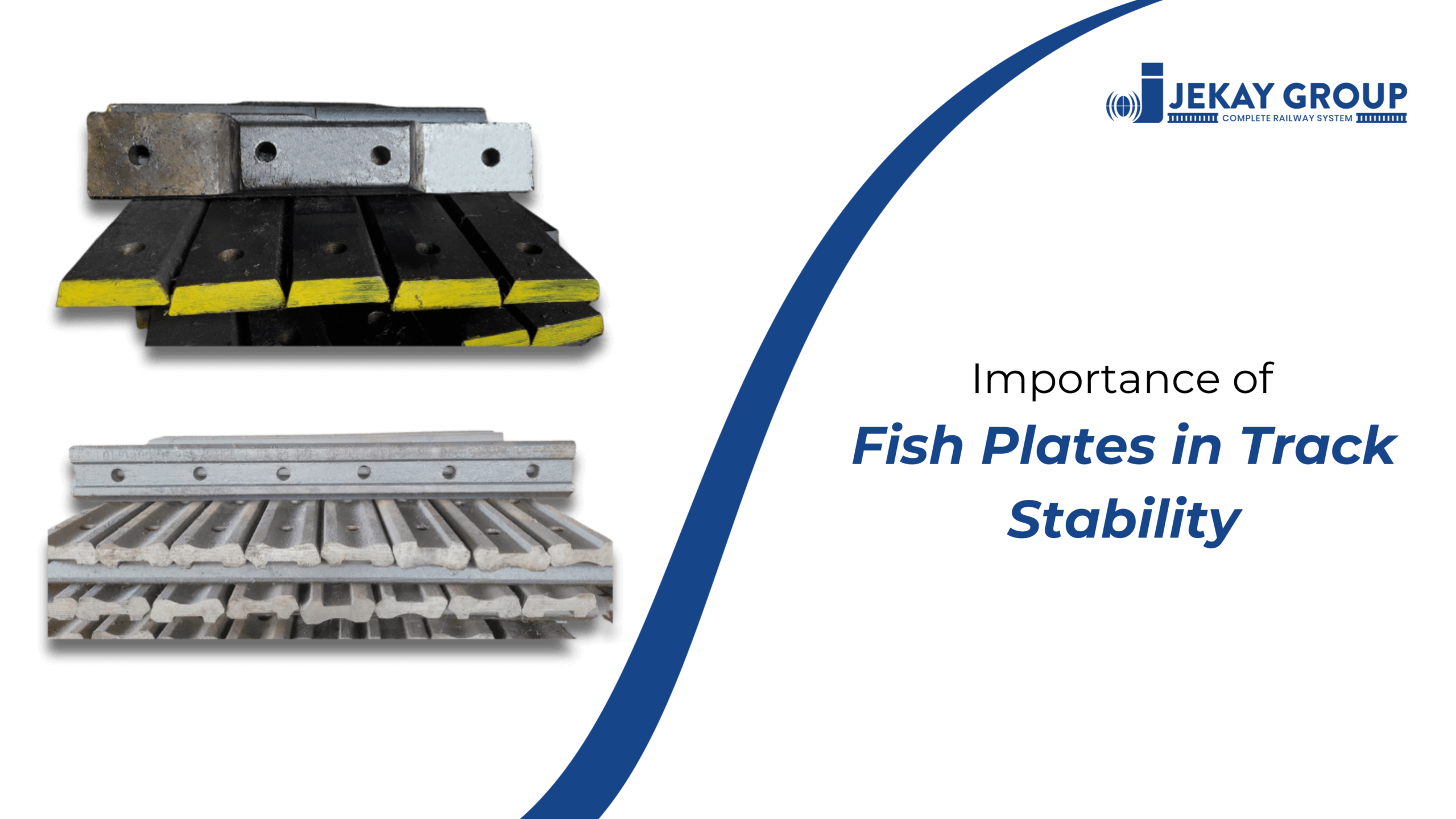
Most track failures don’t start in the middle of a rail. They start at the joint — the point where two rail ends meet and take turns bearing the full weight of every passing wheel. Fish plates are the component built to hold that joint together, yet they’re often specified as an afterthought, priced on catalog size rather than actual load conditions. That gap between how critical they are and how casually they get sourced is where most premature track failures begin.
This post covers what fish plates actually do, why they decide track stability more than people assume, and what to check before you buy.
What Is a Fish Plate
A fish plate — also called a splice bar or joint bar — is a flanged steel bar bolted to both sides of the rail web where two rail ends meet. The plates clamp the joint from each side, sandwiching the rail ends into a locked connection that holds them in alignment both vertically and horizontally.
A Short History
Before fish plates became standard in the 1800s, rail sections were joined with rope lashings and crude welds. Those methods failed under repeated heavy loads, which is exactly the problem fish plates were engineered to solve. The basic design — a bolted steel bar across the joint — has changed little since, because the mechanical problem it solves hasn’t changed either.
Key Functions of Fish Plates
Fish plates do four distinct jobs at once, and all four happen simultaneously every time a wheel crosses the joint.
Load Sharing
Fish plates transfer vertical wheel load between the departing and arriving rail sections. This cuts peak stress at the unsupported rail end by 40-50%, which is the single biggest reason unjointed rail ends fail so much faster than properly fished ones.
Alignment Retention
The clamping action keeps rail ends locked in place, both side to side and up and down. Without that lock, rail ends drift out of line under repeated axle loads, and that drift is what eventually shows up as a rough ride or a flagged track defect.
Thermal Movement Control
Rails expand in heat and contract in cold. Fish plates allow small, controlled movement at the joint instead of forcing the rail to buckle or crack under thermal stress.
Vibration and Shock Absorption
Every wheel passage over a joint creates an impact. Fish plates absorb part of that impact through bolt clamping force, which reduces noise and slows the onset of fatigue cracking at the rail end.
Why Fish Plates Are Critical for Track Stability
Rail joints are where track defects concentrate. Globally, joint-related issues account for more than 60% of track maintenance calls — a number that surprises most buyers who assume open track is the bigger maintenance driver.
Preventing Misalignment and Derailments
A loose or undersized fish plate lets rail ends separate slightly under load. That gap grows with every train that crosses it, and eventually it becomes a geometry defect serious enough to trigger a speed restriction or worse.
Supporting Heavy Loads
Freight corridors put far more cyclical stress through joints than passenger-only lines. Fish plates sized for passenger loads but installed on freight routes wear out early — a mismatch that’s more common than it should be.
Reducing Downtime
Because fish plates bolt on rather than weld on, damaged joints can be repaired quickly without shutting down a line for extended periods. That’s a meaningful advantage anywhere unplanned downtime carries a real cost per hour.
Types of Fish Plates
Not every joint needs the same plate. Matching the type to the application is where a lot of buyers cut corners without realizing it.
- Standard fish plates — for general-purpose joints on plain track with matching rail sections
- Compromise fish plates — for joining two different rail profiles or sizes, common during partial track upgrades
- Insulated fish plates — maintain electrical isolation for signaling circuits at track-circuit boundaries
- Joggled fish plates — feature an offset that clears weld collars at switch rail joints, avoiding point-contact impact concentration
- Combination plates — asymmetric fishing surfaces machined to match mixed rail webs on either side
Fish Plate Material and Thickness
Thickness and material grade decide whether a fish plate holds up for decades or fails within a couple of years.
Why Thickness Is a Balancing Act
A plate that’s too thin bends or breaks under repeated heavy axle loads. A plate that’s too thick adds stiffness in the wrong place, concentrating stress instead of distributing it. The right thickness depends on rail section, traffic type, and axle load — not a single default spec applied across every project.
Material Considerations
Fish plates are typically alloy steel, heat-treated for strength and fatigue resistance. Material certificates should confirm chemical composition and heat treatment records for each production batch, because two plates that look identical can perform very differently depending on how they were processed.
Installation Process
Getting installation right protects the investment made in choosing the correct plate.
- Prepare rail ends — clean away rust, dirt, or debris so the plate seats flush against the rail web
- Position the fish plates — place one on each side of the joint, aligning bolt holes precisely
- Insert bolts with spring washers — spring washers maintain clamping tension as the joint settles under traffic
- Torque to specification — under-torqued bolts loosen under vibration; over-torqued bolts can deform the plate
- Verify alignment — check that rail ends sit level and in line before releasing the joint to traffic
Maintenance and Common Issues
Fish plates aren’t a fit-and-forget component. Regular inspection catches problems while they’re still cheap to fix.
Warning Signs to Watch For
- Cracking or visible deformation in the plate body
- Bolt hole elongation from repeated cyclic loading
- Loosened bolts or missing spring washers
- Visible gap or step at the rail joint
What Neglect Actually Costs
A fish plate that loses clamping force doesn’t fail all at once — it degrades gradually, and by the time the problem is visible, the rail ends have likely already sustained damage that requires more than a simple bolt tightening to fix. Scheduled inspection intervals matched to traffic density catch this before it compounds.
Choosing the Right Fish Plate Supplier
This is the step that determines whether everything above actually holds up in the field.
What to Verify Before You Order
- Compliance documentation — IRS, EN 13481, or RDSO certification matched to your specific project, not a generic catalog sheet
- Batch traceability — material certificates confirming chemical composition and heat treatment for the actual batch you’re buying, not a representative sample
- Application-specific design — joggled, compromise, or insulated plates chosen for the actual joint conditions, not a one-size-fits-all standard plate
- Dimensional tolerances — fishing surface flatness and bolt hole accuracy tight enough to avoid stress concentration at the joint
- Single-source supply — sourcing fish plates alongside base plates and fastening hardware from one manufacturer removes coordination risk on-site
FAQs
How often should fish plates be inspected? Inspection frequency should scale with traffic density and axle load, with freight-heavy corridors needing more frequent checks than light passenger lines. Most operators build fish plate checks into standard track inspection cycles rather than treating them separately.
Can fish plates be reused after removal? Reuse is generally not recommended once a plate has been in service under heavy cyclic loading, since fatigue damage isn’t always visible externally. A fresh plate with verified material certification is the safer and more predictable choice.
What’s the difference between a fish plate and a joint bar? Nothing functionally — these are two names for the same component, with “fish plate” more common in British and Commonwealth usage and “joint bar” more common in North America.
Do fish plates need to match the rail section exactly? Standard plates do, but compromise plates are specifically designed for situations where two different rail sections meet, such as during partial upgrades. Using a standard plate on a mismatched joint creates uneven contact and premature wear.
Why do some fish plates need to be insulated? Insulated joints maintain electrical isolation between track circuit sections, which signaling systems depend on to detect train position accurately. A non-insulated plate at a signaling boundary can create a false or missing signal reading.
Build Track Stability Where It Actually Starts
Jekay International Track Pvt. Ltd. has manufactured fish plates and fastening components since 1980, engineered to IRS, EN 13481, and RDSO specifications with fishing surfaces and dimensional tolerances matched to actual joint loading — not adapted from generic mainline catalogs. Our promise is simple: components specified for the joint conditions you actually have, with full material certification behind every batch.
Share your rail section, traffic type, and joint locations with our engineering team, and get a component-by-component recommendation for your project.
