
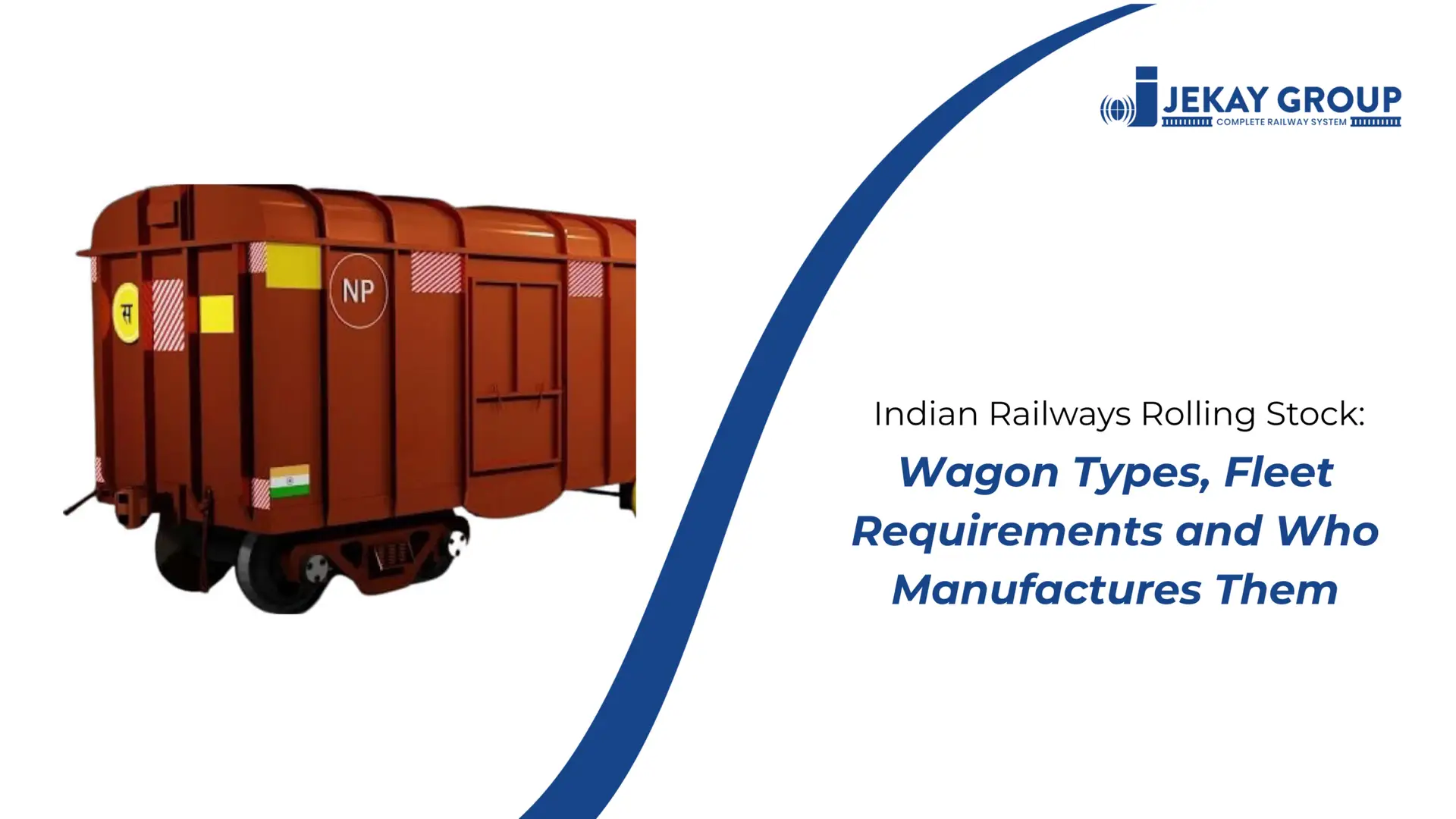
India moves more freight by rail than almost any country on earth. In 2024–25, Indian Railways loaded 1,617 million tonnes and became the world’s second-largest freight-carrying railway. Yet rail still holds only about 27% of the country’s freight share, and the plan is to push it to 45% by 2030.
That gap translates into a very large order book for wagons. This guide explains the wagon types that make up the Indian fleet, how to read their codes, how many wagons the network needs, and how manufacturing is organised. It is written by a manufacturer that builds wagons, bogies and couplers for Indian and export markets.
Overview of Indian Railways Rolling Stock
Indian Railways rolling stock falls into three groups: locomotives, passenger coaches and freight wagons. Wagons are the workhorses. Freight brings in close to 65% of the railway’s total earnings, while passenger services, parcels and other sources make up the rest.
Wagon designs are set by RDSO, the standards body of the Ministry of Railways. Every wagon running on the network follows an approved design and an Indian Railway Standard specification.
Indian Railways Wagon Fleet at a Glance
The fleet stood at roughly 3.18 lakh wagons in April 2024, and it has grown fast since. Production hit a record 41,929 wagons in 2024–25, up from 37,650 a year earlier. Between 2004 and 2014, the average was only 13,262 a year.
The mix tells you what India actually ships. A 2022 census put the fleet at:
- Open wagons: about 46%
- Flat wagons: about 22%
- Covered wagons: about 13%
- Hopper wagons: about 11%
- Tank wagons: about 8%
Nearly half the fleet is built to carry loose bulk, mostly coal and ore. That is a direct mirror of India’s energy and steel economy.
Wagon Nomenclature: How to Read a Wagon Code
Indian wagon codes look cryptic, but they follow a simple logic. Each letter describes one feature.
| Letter | Meaning |
| B (first) | Bogie wagon |
| O | Open |
| C | Covered |
| B (second) | Hopper |
| R | Rail-carrying flat |
| T | Tank |
| X | High-sided |
| N | Air-braked (pneumatic) |
| H / HS | Higher axle load or higher speed |
| L | Lighter body, usually stainless or corrosion-resistant steel |
So a BOXNHL reads as a bogie open, high-sided, air-braked wagon with a higher axle load and a lighter stainless body.
Types of Indian Railway Wagons
Open Wagons
Open wagons haul coal, iron ore and other minerals that can sit exposed to weather. Payloads run from about 58 to 80 tonnes depending on the variant. Common types include BOXNHL, BOXNS, BOSTHS and BOY.
Covered Wagons
Covered wagons protect cement, food grains, fertiliser and other bagged goods. Payloads typically range from 56 to 70 tonnes, with volumes from 80 to 104 cubic metres. BCN, BCNA, BCNAHS and BCNHL are the familiar codes.
Hopper Wagons
Hoppers have bottom or side doors so cargo drops out by gravity. A coal rake can be emptied in minutes instead of hours. BOBRN, BOBSN and BOBYN are widely used for coal and ballast.
Flat and Container Wagons
Flat wagons carry rails, steel sections and coils. Container flats such as BLC and BLSS carry ISO containers on dedicated freight and port routes.
Well Wagons
Well wagons have a lowered deck between the bogies. This keeps tall or heavy loads, such as steel coils, within the loading gauge.
Tank Wagons
Tank wagons move petroleum products, caustic soda, alumina, LPG and even milk. BTPN is the standard petroleum tank wagon on Indian Railways.
Brake Vans
Brake vans such as BVZI and BVCM sit at the rear of a goods train. They house the guard and an emergency brake valve.
Fleet Requirements and Procurement Plans
National Rail Plan Targets
The National Rail Plan aims to lift rail’s freight share to 45% by 2030. Hitting that number means more wagons, faster turnaround and heavier axle loads, all at once.
Annual Procurement Volumes
The Ministry placed its first major order for 1,17,229 wagons to be built over three years from 2022. Plan projections call for about 40,000 to 46,000 wagons a year from 2025–26 to 2029–30, with a second order of over 2 lakh wagons expected across five years.
Here is the uncomfortable part. A parliamentary committee once noted that, despite years of orders, the railway held 45,000 fewer wagons than it had 12–13 years earlier. Old wagons were condemned faster than new ones arrived. Building capacity, not just placing orders, decides fleet growth.
Why Axle Load Matters
Fleet size is only half the story. How much each wagon carries matters just as much. For decades, most Indian freight wagons ran at a 22.9-tonne axle load. Since 2015, 25-tonne axle load designs such as the upgraded BOXNHL have entered service, and heavier designs are planned for dedicated freight corridors.
A higher axle load lets the same rake of around 58 wagons carry several hundred extra tonnes per trip without adding a single wagon. That is why new procurement leans toward high-capacity types. Industry plans for 2024–27 put roughly 60% of new wagons in the high-capacity category, led by BOXNHL, BCNHL and BOST.
Heavier axle loads put more stress on bogies, couplers and springs. Castings that were adequate at 22.9 tonnes need tighter metallurgy and better heat treatment at 25 tonnes and above.
Private Wagon Ownership
Industries can also own or lease wagons under Indian Railways’ private investment schemes. A Standing Committee report in December 2025 urged the railway to set clear targets for private wagon ownership. Cement, steel, power and container operators increasingly buy their own rakes to secure capacity.
Who Manufactures Wagons in India
Wagon manufacturing in India sits across three groups.
Railway Production Units and Workshops
Indian Railways builds a share of its wagons in its own workshops. These units also handle periodic overhaul of the existing fleet.
Public Sector and Private Wagon Builders
Most new wagons come from dedicated wagon builders in the public and private sectors. They compete in open tenders and must hold design approvals and capacity certificates for each wagon type they supply.
The real differentiator is vertical integration. A builder with its own foundry, spring plant and fabrication lines controls bogies, couplers and springs in-house. One that buys these parts in depends on outside schedules for the most critical components.
Component Manufacturers
A wider supplier base makes cast steel bogies, couplers, draft gears, wheelsets, springs, brake equipment and fabricated parts. Many of these suppliers also need RDSO approval before they can supply directly or to wagon builders.
What Buyers Should Check Before Ordering Wagons
Whether you are a railway authority or a private wagon owner, check these points:
- Design approval for the exact wagon code you need
- Installed capacity against your delivery schedule
- In-house castings for bogies and couplers
- Material traceability for steel to IS:2062 or IRS:M44
- Testing labs for chemical, mechanical and metallurgical checks
- Delivery record on past railway orders
Frequently Asked Questions
What is the most common wagon type on Indian Railways?
Open wagons make up the largest share, close to half the fleet. Most of them carry coal and iron ore.
Who approves wagon designs in India?
RDSO, the Research Designs and Standards Organisation under the Ministry of Railways, approves wagon designs and specifications.
Can private companies buy their own wagons?
Yes. Indian Railways runs investment schemes that let industries and logistics operators own or lease wagons and run them on the network.
Which bogie do Indian freight wagons use?
Most use three-piece cast steel bogies from the CASNUB family, such as CASNUB-22HS. Newer designs use bogies rated for 25-tonne axle loads.
Conclusion
The Indian wagon fleet is growing at its fastest pace in history, and the codes, approvals and capacity rules can feel dense. Once you read a wagon code and check a builder’s in-house capability, the choice gets much clearer.
If you are planning a wagon purchase or a private rake, share your commodity and route with us and we will suggest the right wagon type.
Your Wagon Partner: Jekay International
Since 1980, Jekay International Track Pvt. Ltd. has built railway products for developers, governments and private operators across 27 countries. Our 250,000 sq ft wagon plant can produce up to 4,800 wagons a year, covering open, covered, flat, hopper, well, tank and brake van types. Cast steel bogies, high tensile CBC couplers and bogie springs are all made in-house.
We promise wagons built to approved specifications, with the critical castings controlled from melt to final inspection.