
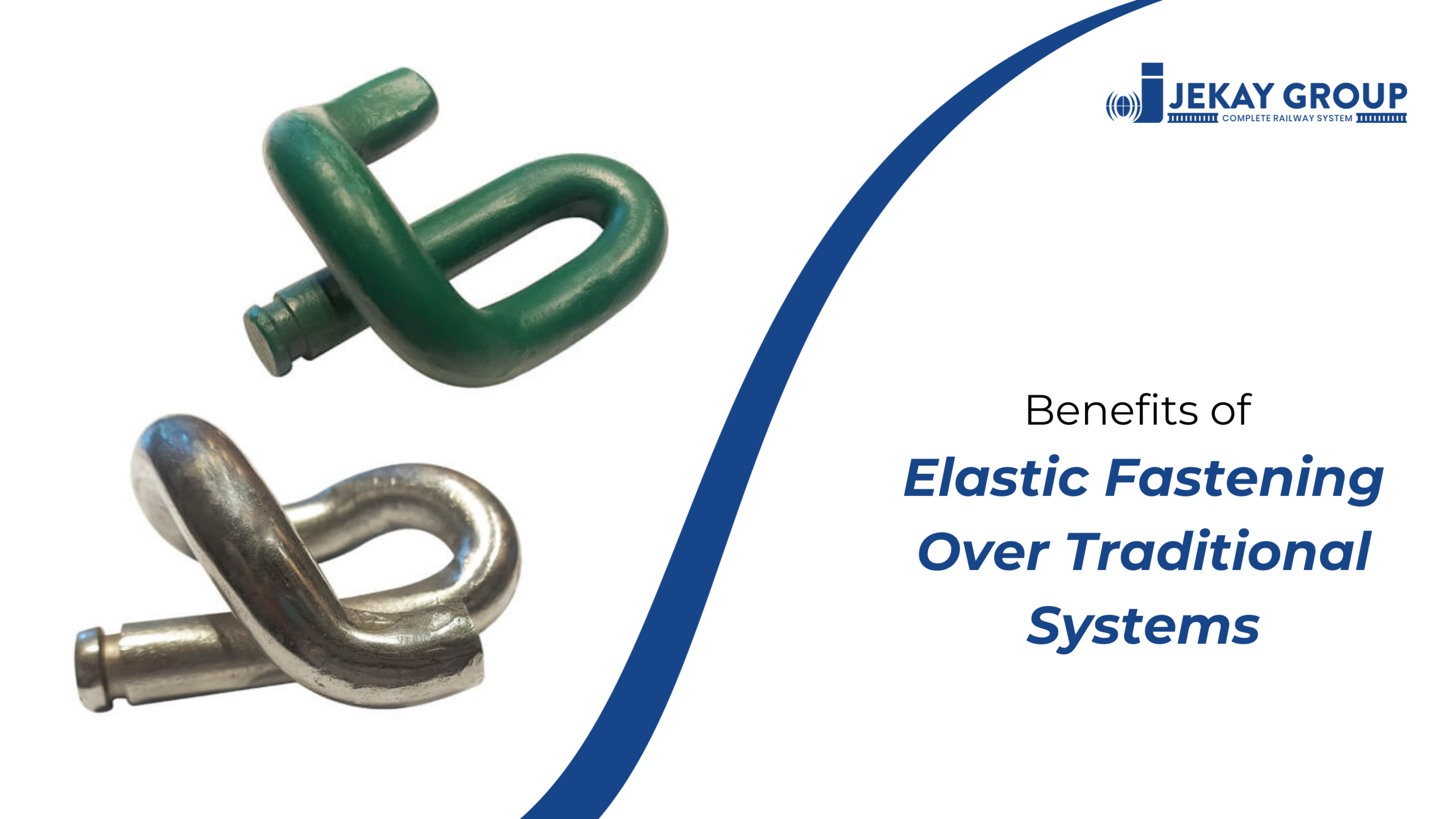
The management of rail infrastructure assets requires a balancing of operational safety, long-term fiscal responsibility, and engineering durability. As network demands increase through higher speeds and axle loads, the selection of fastening systems becomes a primary factor in asset lifecycle management. Traditional rigid fastening methods often necessitate intensive maintenance schedules to mitigate the effects of dynamic loading and vibration.
This guide shows why elastic rail fastening delivers 30–40% lower lifecycle costs, extends track life, and cuts maintenance frequency. We’ll compare mechanical performance, maintenance requirements, installation speed, and total cost economics across both systems.
What Are Traditional Fastening Systems
Traditional systems use rigid metal components that secure rails directly to sleepers through friction and point contact. The main types include dog spikes hammered into wooden sleepers, screw spikes requiring torque-controlled installation, and bolted clamps with rigid clips.
These methods utilize static clamping force to secure the rail. However, technical observations indicate several performance limitations under high-traffic conditions:
- No gauge adjustment possible after installation
- Point contact causes rail indentation and wear
- Clamping force drops 40–60% within 5 years
- Require torque checks every 6–12 months
- Insufficient resistance to lateral forces and rail creep
Traditional fastening is typically utilized on low-speed corridors and secondary routes with annual traffic under 10 million gross tonnes. Engineering assessments suggest decreased stability on high-speed or heavy-haul corridors when using these systems.
What Are Elastic Fastening Systems
Elastic systems use spring steel clips that maintain constant clamping force through deflection. The key components are elastic rail clips (Pandrol, SKL, E-class, KPO), rubber rail pads, plastic shoulders, and screw spikes with liners.
The clip bends slightly when installed, creating a self-tensioning effect. This maintains 12–15 kN of toe load even after thermal expansion and vibration cycles. Rail pads absorb shocks between the rail and sleeper, reducing peak vibrations by 50–70%.
Elastic fastening works on concrete, wooden, and steel sleepers. It’s the standard for Indian Railways’ high-speed corridors, European EN 13481-compliant tracks, and heavy-haul lines carrying 25+ tonne axle loads.
Mechanical Performance Comparison
Technical data indicates that elastic clips provide enhanced mechanical stability compared to traditional spikes across several key performance indicators:
Clamping Force Retention
Elastic systems maintain 80%+ of initial toe load after 5 years. Traditional screw spikes drop to 40–60% in the same period. Below 8 kN, rails start creeping. Elastic stays above 12 kN.
Vibration Damping
Rail pads in elastic systems absorb 50–70% of high-frequency vibrations. This reduces noise by 5–10 dB on urban transit lines and extends ballast life by reducing particle breakdown.
Gauge Maintenance
Elastic fastening provides 2–3× higher lateral rail restraint than cut-spike systems. Field tests on Norfolk Southern’s 8-degree curve showed elastic zones had over three times higher gage strength without additional gage rods. Lateral deflection on cut-spike tracks was almost twice that of elastic zones.
Durability Under Load
Elastic clips endure 2–3 million load cycles before fatigue. Traditional spikes fail at 500,000–1 million cycles. This translates to 25+ year service life for elastic vs. 8–12 years for screw spikes.
Maintenance Differences
Loosening is the biggest maintenance driver. Traditional systems require re-tightening because spikes lose torque as wood fibers compress or concrete settles.
Loosening Resistance
Elastic clips是自-tensioning. As the rail moves thermally, the clip deflects and returns to its original position. No routine re-tightening needed.
Service Intervals
Elastic systems generally require inspection cycles of 3–5 years on heavy-haul lines, compared to annual checks for traditional systems. On high-traffic corridors, this results in a significant reduction in maintenance labor requirements.
Total Maintenance Cost Savings
Over a 25-year track life, elastic fastening reduces total maintenance costs by 30–40%. The premium upfront cost recovers in 5–7 years on lines carrying 30+ million gross tonnes annually.
Installation and Track Laying Efficiency
Mechanized clip applicators install elastic systems 40–60% faster than traditional methods. No torque wrenches needed. Workers just press the clip onto the shoulder.
Traditional installation requires skilled hammer crews for dog spikes or torque-controlled screw drivers. Quality varies with operator fatigue. A tired crew might under-torque screw spikes, creating weak points.
Elastic components adapt to any sleeper type. You can reposition rails without full disassembly—just release the clip, slide the rail, and re-clamp.
Cost Analysis and Lifecycle Economics
Elastic fastening costs 20–50% more per sleeper upfront. Multiple precision components add to the price. But lifecycle economics flip the picture.
Component Lifespan
Elastic clips last 25+ years. Screw spikes need replacement every 8–12 years. Rail pads in elastic systems extend ballast life by reducing vibration breakdown.
ROI Calculation
On a 100-km heavy-haul line carrying 35 million gross tonnes yearly:
- Traditional: ₹120 crore upfront, ₹45 crore maintenance over 25 years
- Elastic: ₹160 crore upfront, ₹28 crore maintenance over 25 years
- Net savings with elastic: ₹17 crore
The premium pays back in 6 years.
Benefits Summary: Elastic vs. Traditional
| Benefit | Elastic Fastening | Traditional Fastening |
| Vibration damping | 50–70% reduction | Minimal |
| Noise reduction | 5–10 dB lower | Higher |
| Toe load retention | 80%+ after 5 years | 40–60% loss |
| Maintenance frequency | 3–5 years | 6–12 months |
| Service life | 25+ years | 8–12 years |
| Gauge maintenance | 2–3× better | Lower |
| Installation speed | 40–60% faster | Slower |
| Lifecycle cost | 30–40% lower | Higher |
Applications by Railway Type
High-speed rail (≥200 km/h) requires elastic fastening. Vibration absorption is non-negotiable at these speeds.
Heavy-haul lines carrying 25+ tonne axle loads need elastic clips for lateral force resistance. Traditional spikes fail under these loads.
Urban transit prioritizes noise reduction. Elastic systems cut vibrations by 50–70%, making them essential for city tunnels.
Low-speed freight under 10 million gross tonnes can use traditional systems. But elastic still justifies the premium if maintenance budgets are tight.
Ballasted and ballastless tracks both work with elastic fastening. The rail pad absorbs shocks in both configurations.
Frequently Asked Questions
Can elastic fasteners work on existing wooden sleepers?
Yes. Elastic clips attach to plastic or metal shoulders that sit on wooden sleepers. Indian Railways uses them on both wood and concrete sleepers.
How much toe load do elastic clips maintain after 10 years?
Studies show 75–80% retention after 10 years. Traditional spikes drop to 30–40% in the same period.
What happens if an elastic clip fails in service?
Failure is rare. If one clip breaks, adjacent clips maintain clamping force. You can replace it during routine inspection without removing the rail.
Are elastic fasteners suitable for low-speed freight-only lines?
Yes, but traditional systems may be cheaper if traffic stays under 10 million gross tonnes annually. Elastic becomes justified when maintenance labor costs are high.
Conclusion
In summary, technical evaluations demonstrate that elastic rail fastening provides higher mechanical performance and reduced lifecycle costs over a 25-year service life. While traditional systems may be suitable for low-traffic environments with limited initial capital, elastic systems offer greater fiscal efficiency for high-demand infrastructure.
