
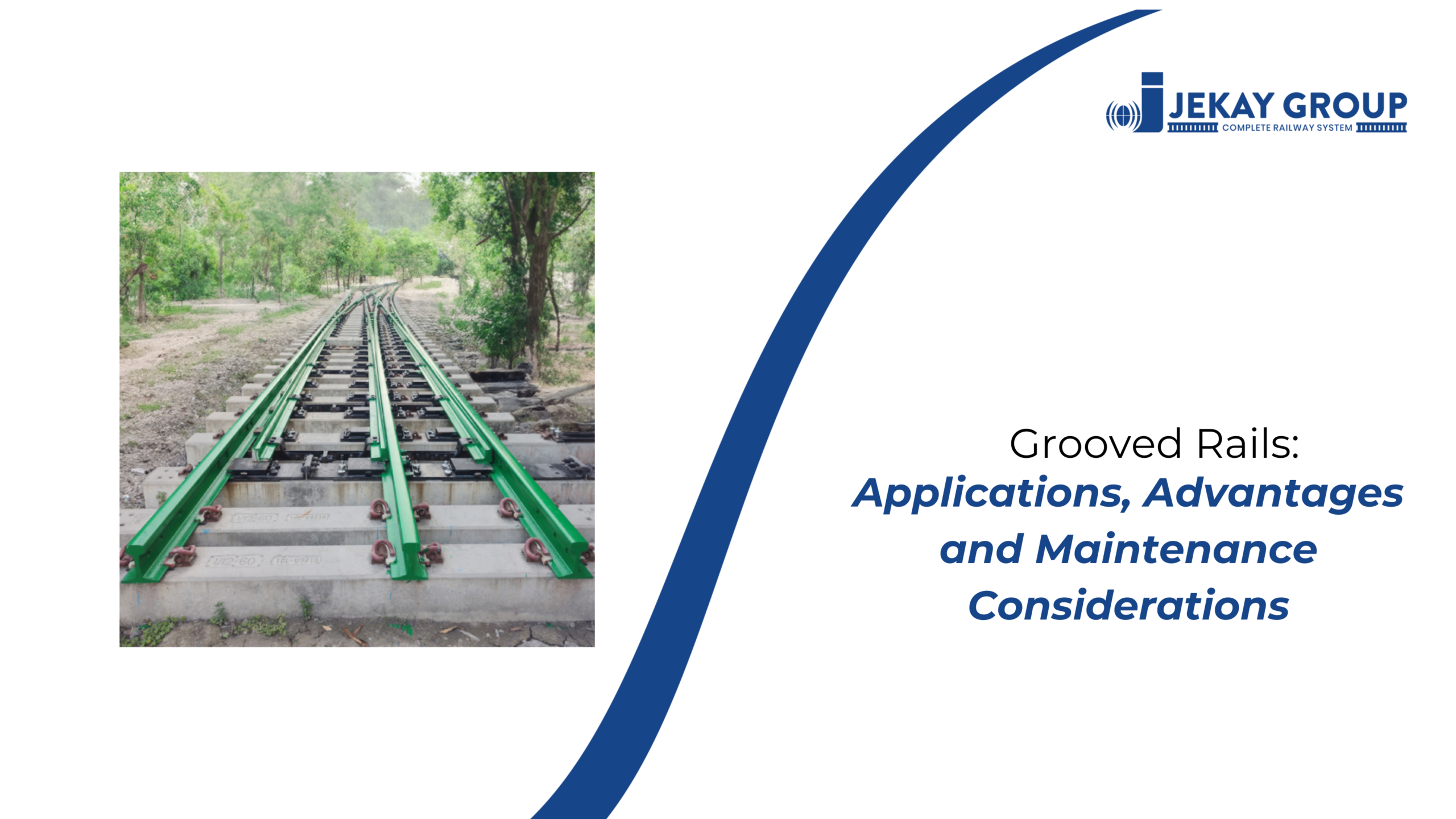
Grooved rail is the only track component that shares its working surface with road traffic. It sits flush in a carriageway, carries trams, gets driven over by buses and lorries, fills with grit, and cannot be inspected by walking the sleeper ends because there are none. That changes the economics completely. A rail you cannot reach without closing a street has to be specified for the life you want, not the budget you have. This guide covers where grooved rail is used, what it does well, and the maintenance realities that come with embedding steel in a road.
What Grooved Rail Is
Grooved rail — also called girder rail — carries a groove alongside the running surface, formed between the rail head and a raised check on the field side. The wheel flange runs in that groove.
That single feature does two jobs. It lets the rail sit flush with a road surface so rubber-tyred traffic can cross safely, and it guides the wheel without a separate check rail. Conventional flat-bottom rail cannot do either.
The design has been in service since the 1850s and has changed remarkably little, because the constraint it solves has not changed either.
Where Grooved Rail Is Used
- Tramways and light rail running in shared or segregated street track
- Urban depots and turning loops, where curve radii are extremely tight
- Port, dock and industrial paving, where cranes and vehicles cross the track
- Level crossings and yard paving, where a flush surface is required
- Heritage and city-centre schemes, where the track must disappear into the streetscape
The common thread is not the vehicle. It is the requirement for a flush, trafficable surface over the top of a guided rail.
Profiles and Standards
European grooved rail is covered by EN 14811, which defines two families.
- R series — 51R1, 53R1, 54R1, 55R1, 57R1, 59R1, 59R2, 60R1, 60R2, 62R1, 62R2
- G series — 54G1, 54G2, 54G4, 55G3
To give a sense of the range: a 54R1 section runs around 54 kg/m at 152.5 mm high with a groove around 41 mm wide, while a 60R2 runs about 60 kg/m at 180 mm high with a narrower groove near 36 mm. Height and groove width are the two dimensions that drive most design decisions.
Groove width has to suit your wheel profile, including worn wheels, not just new ones. Get it wrong and you either bind the flange or allow the wheel to climb.
Advantages
- Flush running surface — road vehicles and pedestrians cross without a step or a trap
- Integral guidance — the check is part of the section, so no separate guard rail is needed on most curves
- Very tight curves — grooved track routinely works down to radii around 25 m, which is what makes street running possible at all
- Compact structure — the rail plus its embedment replaces a full ballasted formation in a road build-up
- Noise and vibration control — embedded systems with resilient encapsulation reduce transmitted noise and ground-borne vibration materially compared with unresilient designs
- Street-level integration — no fencing, no crossing gates, no separated corridor
Maintenance Considerations
This is where grooved track differs from everything else, and where the whole-life cost is decided.
The Groove Fills Up
Grit, leaf litter, road detritus, ice and compacted mud all collect in the flangeway. A packed groove lifts the wheel, degrades ride quality and eventually causes flange climb on curves. Groove clearing is a scheduled operational task on any street tramway, not an occasional one.
Drainage points along the groove have to be designed in and then actually maintained. A blocked drain turns the flangeway into a channel.
Check Wear on Curves
On curves, both the running head and the check take heavy wear — the check more so, because it is doing the guiding. Wear on curved track outpaces straight track substantially, which is why heavier check sections are often specified through tight radii. Plan curve renewals separately from plain line; they will not fall due at the same time.
You Cannot See Most of It
The web, foot, fastenings and encapsulation are buried. Visual inspection covers the running surface, the groove and the interface with the paving — and nothing else. Which means:
- Corrosion at the foot develops unseen
- Encapsulation degradation shows up as a paving failure, not a rail one
- Stray current from traction return can corrode buried steel where insulation has failed
- Ultrasonic and eddy current testing become the main condition tools
Corrugation and Surface Defects
Tight curves, frequent braking and stop-start running produce corrugation faster than main line conditions. Corrugation drives noise complaints in exactly the environment where noise complaints matter most. Grinding is the remedy, and access windows are short.
Replacement Is a Road Project
Changing a length of embedded rail means breaking out paving, cutting, removing, welding in, re-encapsulating and reinstating the surface — with traffic management around it. The rail is often the cheapest line on that invoice. That asymmetry should drive the original specification.
Welding and Joints
Grooved rail is welded by thermite or flash butt methods. The groove and check complicate the weld and the finishing. Get the weld profile wrong through the groove and you have created a permanent impact site in a place you cannot easily revisit.
Grooved Rail Compared With Paved Flat-Bottom Track
Some schemes pave over conventional flat-bottom rail rather than using a grooved section. It is cheaper up front and it creates problems that grooved rail was invented to solve.
- Flangeway — paved flat-bottom track needs a separate flangeway former, which becomes a maintenance item and a failure point in its own right
- Guidance — without an integral check, tight curves need separate guard rails, adding components and fixings inside the paving
- Surface interface — the transition between rail head and paving is harder to detail cleanly, and that edge is where paving failures start
- Wheel compatibility — groove geometry designed around the wheel profile handles worn wheels more predictably than an improvised flangeway
Where the track is genuinely temporary or the traffic is very light, paved flat-bottom can be the right economic call. On a system that will run for decades in a public street, the section designed for the job usually wins on whole-life cost.
How to Specify Grooved Rail Sensibly
- Match groove width and depth to your wheel profile across its full wear range.
- Specify a harder grade through tight curves and braking zones, where wear concentrates.
- Design groove drainage in from the start, with access for cleaning.
- Choose encapsulation for electrical isolation as much as for vibration.
- Plan grinding access windows before the system opens, not after complaints start.
- Buy against the replacement cost, not the material cost.
FAQs
What is the difference between grooved rail and flat-bottom rail? Grooved rail has an integral check forming a flangeway alongside the running surface, so it can sit flush in a road and guide the wheel at the same time. Flat-bottom rail has neither feature and needs a separate check rail on tight curves.
How tight a curve can grooved rail take? Grooved track commonly works down to radii of around 25 m, which is what allows street running through junctions and depot loops. Very tight radii need heavier check sections and shorter maintenance cycles.
Why does grooved rail wear faster than main line rail? Because of where it operates. Tight radii, frequent braking and acceleration, contamination in the groove and lower speeds with higher curving forces all concentrate wear on the head and the check.
How is embedded grooved rail inspected? The visible surfaces get visual inspection and profile measurement. Everything buried needs non-destructive testing — ultrasonic and eddy current — plus monitoring of stray current and insulation resistance where traction return is a factor.
Does grooved rail reduce noise? The rail alone does not; the system around it does. Resilient encapsulation and correct fastening design reduce transmitted noise and ground-borne vibration significantly, which is usually the reason embedded systems are chosen in city centres.
Conclusion
Grooved rail solves a problem no other section can: guided steel running flush through a public street. The trade is access. Everything about specifying it should account for the fact that reaching it later means closing a road — which makes profile choice, grade selection, drainage design and encapsulation quality decisions with a twenty-year tail.
Jekay International Track has manufactured railway track products since 1980 — grooved and light rail sections, rolled sections, fish plates, base plates, elastic fastenings, sleepers and CMS crossings — with in-house rolling mills, forging plants, CNC machining and foundry capability. We roll to section and to standard, for track that has to last where you cannot easily reach it.
Specifying grooved rail for a tramway, depot or paved industrial track? Send us your profile requirement and we will confirm the right section.