
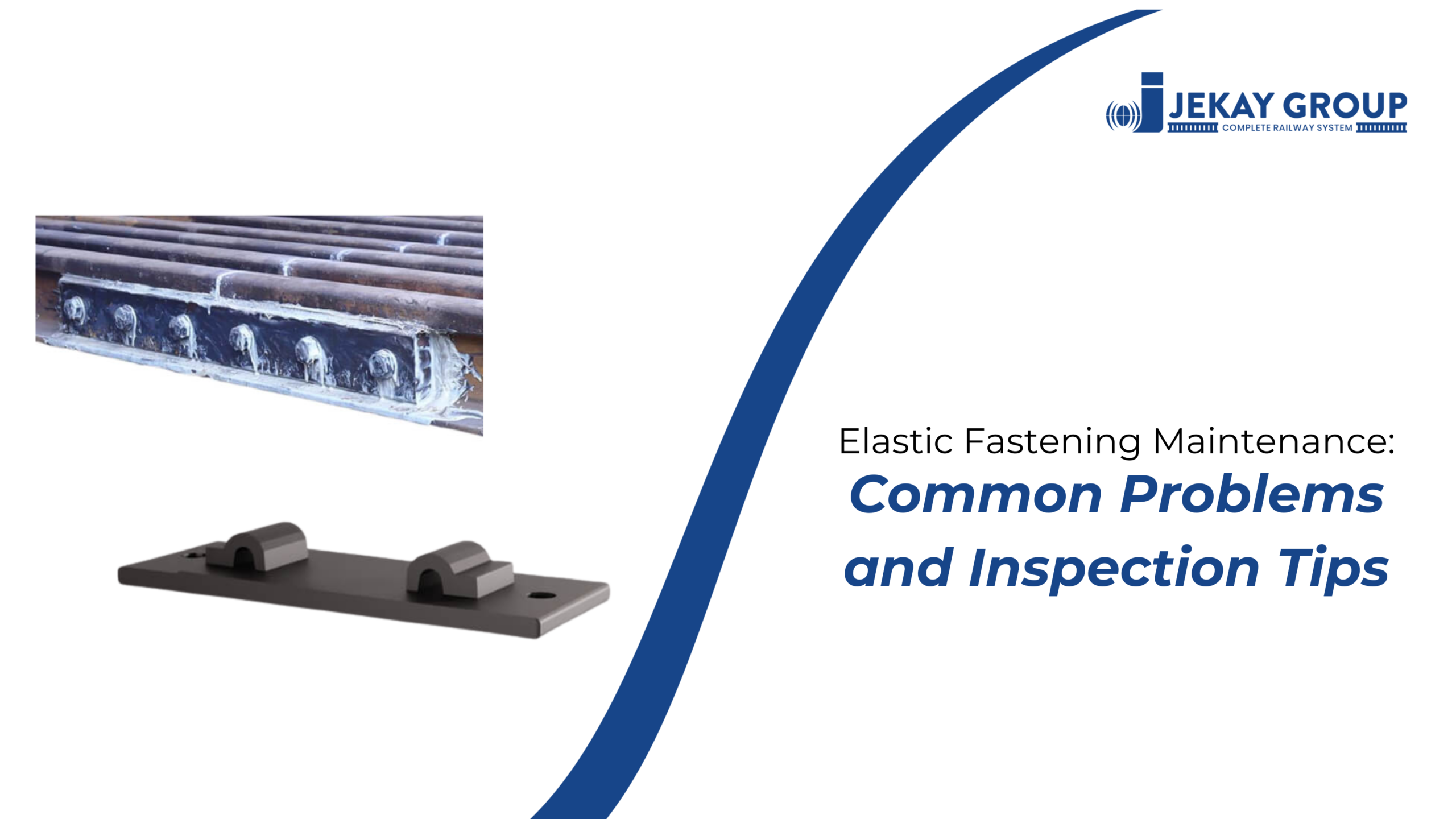
Elastic fastenings are sold as fit-and-forget, and mostly they behave that way — until a stretch of track starts losing gauge and nobody can say when it began. Clips do not fail loudly. They lose toe load, they crack at a point you cannot see from a walking pace, or they sit slightly out of position and quietly do half a job. This guide covers what actually goes wrong with elastic fastening systems, how to inspect for it, and which findings mean act now. We manufacture these components, so the failure modes below are ones we see come back.
What the Clip Is Holding
An elastic rail clip applies a designed downward force — the toe load — onto the rail foot. That force does three things at once.
- Holds the rail down against uplift as the wheel approaches and leaves
- Resists longitudinal creep, keeping the rail from walking under braking and thermal movement
- Maintains gauge by holding the rail against the shoulder or insert
The clip is a spring, not a clamp. It works by staying in a specific deflected shape. Anything that changes that shape — wear, corrosion, repeated removal, a shifted insulator — changes the force it delivers.
Common Problems
Toe Load Loss
The most common failure and the hardest to see. A clip that looks perfectly normal can be delivering a fraction of its design force.
Causes are cumulative: repeated removal and refitting, corrosion pitting on the spring section, a compressed or missing insulator, and wear on the rail foot or shoulder that changes the deflection geometry. Age alone is not the measure. A clip removed and refitted six times during maintenance work has had a harder life than one left alone for twenty years.
Cracked and Broken Clips
Fatigue cracks nucleate at the point of highest stress in the bend, then run. Once a clip breaks, the neighbouring clips carry more load and the failure tends to spread along a run.
Here is the part that surprises people. Fatigue testing on elastic clips found that under normal wheel loads, clips at high, normal and low toe load all survived past five million cycles. Add impact loading, and the picture inverts sharply — clips installed at high toe load failed at around 5,500 cycles, normal toe load at around 16,800 cycles, while low toe load clips ran out past five million.
Two conclusions follow. Over-tightening is not a safety margin; it is a fatigue penalty. And impact loading — from corrugation, dipped joints, wheel flats and bad welds — is what actually breaks clips. Fixing the source of impact protects more clips than any amount of retensioning.
Malposition
A clip driven too far, not far enough, or sitting skewed on the insert delivers a different force than designed, and puts its peak stress somewhere the geometry was not made for. Malposition is an installation defect that reads as a material failure two years later.
Insulator and Pad Degradation
On track-circuited sections, insulating liners take wear from both the clip and the rail foot. Worn liners let the clip sit lower, dropping toe load, and eventually cause electrical problems. Rail pads that have hardened, thinned or migrated out of position pass more impact into the sleeper and change the clip’s working deflection.
Corrosion
Coastal air, tunnels, level crossings and anywhere that holds moisture. Corrosion reduces the effective section of the spring and creates pitting that acts as a crack initiation site. A clip losing material is losing toe load whether or not it looks broken.
Shoulder and Insert Wear
The clip is only as located as the thing holding it. Worn cast-in shoulders on concrete sleepers, or elongated inserts, let the clip move under load. Gauge widens even though every clip is present and looks fine.
How to Inspect
On the Walk
- Missing clips — count them, do not scan them; a run of three missing is a different problem from three scattered
- Cracked or deformed clips — look at the bend, not the toe
- Position — clips seated inconsistently along a run point to an installation batch, not to service wear
- Rust staining and fretting marks at the toe, which indicate movement
- Displaced or extruded rail pads and worn insulators
- Rail foot marking — a bright polished patch where the toe bears means the clip is moving
Measured Checks
Toe load measurement is the only way to confirm what a clip is delivering. Sample it rather than test everything — a set of measurements at fixed locations, repeated on a cycle, tells you the rate of loss across the section. That trend is what justifies renewal.
Also record gauge at the same locations. Toe load loss and gauge widening travel together, and gauge is easier to measure at scale.
Where to Look First
Some locations degrade faster and deserve a shorter cycle.
- Curves and transitions, where lateral force is highest
- Approaches to joints, points and crossings, where impact loads concentrate
- Gradients and braking sections, where longitudinal creep is highest
- Level crossings, tunnels and coastal stretches, for corrosion
- Any section with known corrugation or rail surface defects
What to Do With What You Find
- Isolated missing or broken clips — replace, and check the neighbours either side
- A run of failures — stop replacing and find the cause; it is usually impact loading or a shoulder problem
- Consistent malposition — retrain and re-inspect the installation, do not just refit
- Widespread toe load loss — plan renewal for the section rather than chasing individual clips
- Worn shoulders or inserts — the clip is a symptom; the sleeper needs attention
Never refit a clip that has been removed more times than its specification allows, and never reuse a clip that shows any crack, deep pitting or permanent set.
Choosing Fastenings That Stay Serviceable
Service life is decided partly by what you buy.
- Steel grade and heat treatment determine fatigue strength at the bend
- Dimensional consistency across the batch determines whether every clip in a run delivers the same toe load
- Surface finish and protective treatment determine corrosion resistance in the environment you actually operate in
- Insulator material quality determines how long the assembly holds its geometry
A fastening system is only as consistent as its worst part. That is a manufacturing question before it is a maintenance one.
FAQs
How often should elastic fastenings be inspected? Set the cycle by tonnage and location rather than by calendar alone. Curves, joints, crossings and braking sections need shorter intervals than plain line. Add an inspection after any tamping or rail work in the area.
Can a removed elastic clip be reused? Within limits set by its specification. Each removal and refit works the spring, and repeated cycles reduce toe load permanently. Clips with cracks, deep corrosion pitting or visible permanent deformation should be scrapped, not refitted.
Does a clip that looks fine still hold its design toe load? Not necessarily. Visual condition is a poor predictor of toe load. Sample measurement is the only reliable check, which is why trend data from fixed locations is more useful than a one-off inspection.
Why do clips break in clusters rather than singly? Because the cause is usually local rather than random — corrugation, a dipped joint, a bad weld or a worn shoulder generating impact loads. When one clip fails, the load redistributes to its neighbours and the run propagates.
Is a tighter fastening a safer fastening? No. Fatigue testing shows clips installed at higher than design toe load fail markedly sooner under impact loading than clips at normal or lower toe load. Install to specification, and treat the design figure as the target rather than a minimum.
Conclusion
Elastic fastening maintenance is mostly about seeing what is not obvious: toe load you cannot judge by eye, malposition that reads as material failure, and clusters of breakage that point at something else entirely. Inspect on a cycle set by tonnage, measure a sample rather than guessing, and treat repeated failures as a signal to look upstream.
Jekay International Track has manufactured railway track fastenings since 1980 — elastic fastenings, rail pads, base plates, fish plates, bolts, sleepers and CMS crossings — with in-house forging, spring plant, rolling mills and CNC machining. We control grade and geometry across the batch, because a fastening system performs at the level of its least consistent part.
Seeing gauge loss or repeat clip failures on a section? Talk to our team about the right fastening specification for your track.