
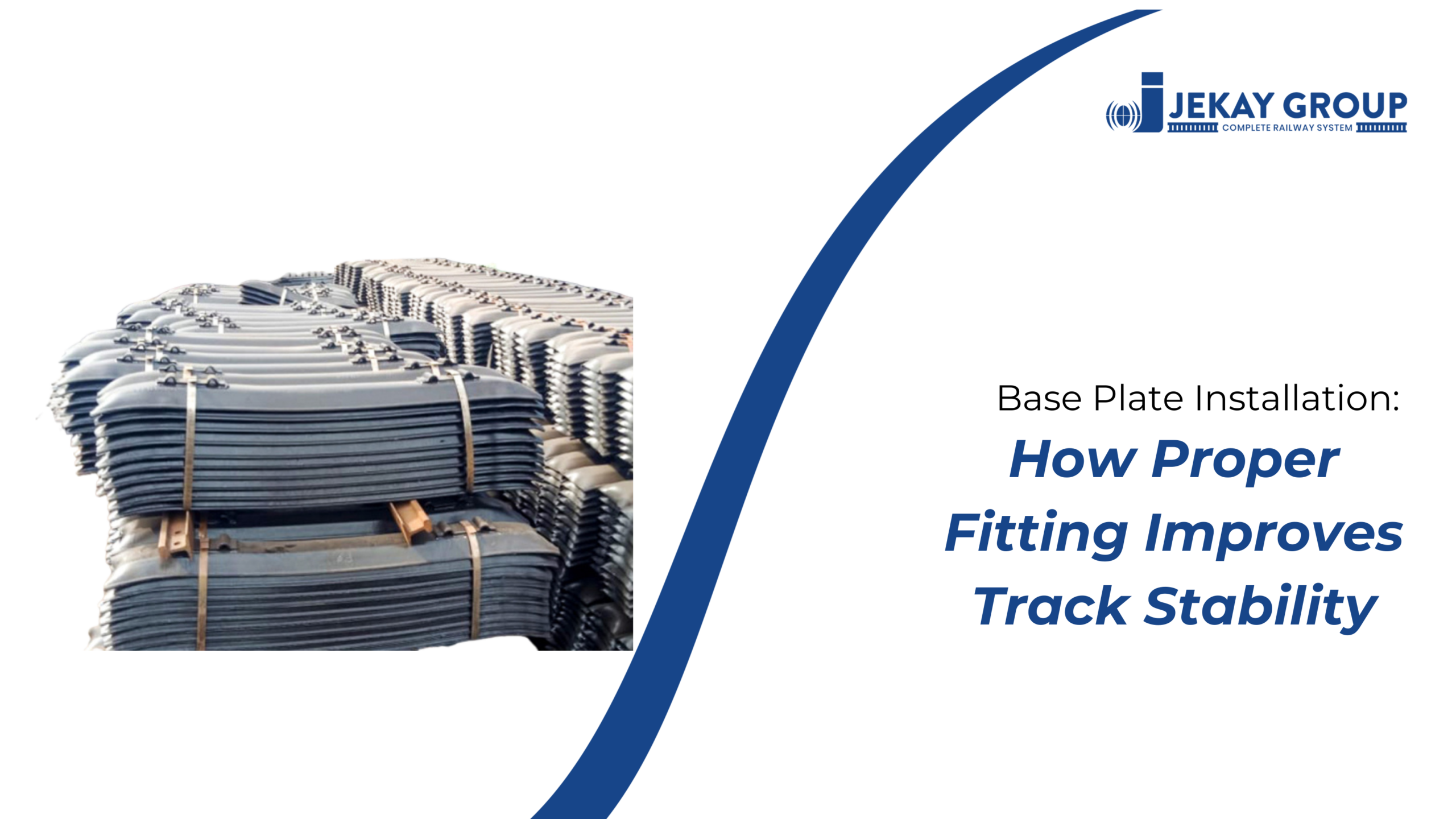
A base plate that is fitted badly does not announce itself. The track passes inspection, trains run, and the damage accumulates underneath — rail seat wear, cracked sleepers, gauge creeping wide on curves. By the time it shows up in the geometry car readings, you are replacing sleepers instead of adjusting plates. Most guides explain what base plates are. This one covers the fitting itself: preparation, seating, cant, torque, and the checks that catch a bad installation while it is still cheap to fix. We manufacture these plates, so the failure patterns here are ones we see returned.
What the Base Plate Is Doing Under Load
The base plate sits between the rail foot and the sleeper. It has four jobs, and each one depends on the plate being seated correctly.
- Spreads load from the narrow rail foot across a wider area of the sleeper
- Holds gauge through its shoulders, which resist the rail being pushed outward
- Sets cant — the inward tilt that matches the coned wheel profile
- Anchors the fastening by giving clips or bolts a fixed, located seat
Miss the seating and all four degrade at once. That is why fitting quality matters more than the plate’s headline specification.
Preparing the Sleeper Seat
Most installation faults start here, before the plate goes down.
On Concrete Sleepers
The cast rail seat should be clean, dry and undamaged. Check for spalling, chipped shoulders and grout residue. A plate bridging a chipped seat bears on two points instead of a full face, which concentrates load and starts rail seat abrasion.
On Timber Sleepers
Clean out the old spike or screw holes, and check the seat is flat. Where the previous plate has cut into the timber, adze the seat back to a level bearing surface or the new plate inherits the same tilt. Plugging worn holes with treated dowels gives the screws something to hold.
On Steel Sleepers
Check the pressed seat for distortion and the cast-on shoulders for wear. Deformed shoulders will not hold gauge no matter how well the clip is fitted.
Before the Crew Starts
Installation quality is decided partly by what is ready before anyone lifts a plate.
- Calibrated torque wrenches — a wrench that has not been checked in a year is a guess with a handle
- Track gauges at the work face, not in the van
- Correct plate variant confirmed against the drawing, including hand and shoulder type
- Pads, liners, clips and bolts sorted and counted before the possession starts
- Sleeper condition surveyed so replacements are on site rather than discovered mid-shift
Most rushed installations are rushed because something was missing, not because the work is slow. Time spent on the setup buys the tolerance the fit depends on.
Getting the Fit Right
Seating and Alignment
The plate must sit flush on its full bearing face with no rock. Test it before fastening — push down on each corner. Any movement means the seat is uneven, and packing shims is a repair, not a fix.
Square the plate to the rail and set it to the design gauge before anything is tightened. Working from a gauge tool at every plate is slower on the day and far cheaper over the following decade.
Rail Inclination
Base plates carry the rail at a designed cant, commonly 1:20 or 1:40 depending on the system and rolling stock. That angle matches the coned wheel tread so the contact patch sits where it should.
Get it wrong and the wheel contacts near the gauge corner instead of the crown. The result is accelerated gauge face wear on curves, rolling contact fatigue on the head, and a rail that has to come out early. Cant is not a detail — it is the reason the plate has a taper.
Fastening and Torque
Fasten to the specified torque, not to feel. Bolted plate systems typically call for something in the region of 200 to 250 Nm, but the figure that governs is the one on your drawing.
- Tighten in sequence, not one corner at a time
- Use a calibrated torque wrench and check its calibration
- Re-check torque after the first traffic has passed over new work
- Record what you set, so you can see which locations keep loosening
Rail Pads and Insulation
Where the design includes a rail pad, it goes in clean, flat and the right way up. A folded or misplaced pad transmits impact straight into the sleeper. On track-circuited sections, check insulating liners and bushes are seated before the clip goes on — an installation that shorts the circuit gets found immediately, which is at least honest.
What Bad Fitting Costs You
The consequences are all delayed, which is why they get tolerated.
- Rocking plates hammer the sleeper seat and crack concrete
- Wrong cant shifts wheel contact and shortens rail life
- Under-torqued fastenings lose toe load, letting the rail creep and the gauge widen
- Over-torqued fastenings damage the clip and the plate shoulders
- Uneven seating turns full-face bearing into point loading
None of these produce an immediate defect. All of them shorten the life of components far more expensive than the plate.
Post-Installation Checks
Run these before the section goes back into service.
- Gauge measured and recorded at every plate on curves, and at intervals on straight track.
- Cant checked against the design figure.
- Every plate confirmed flush, with no rock under load.
- Torque verified on a sample and logged.
- Pads, liners and insulation confirmed in place and undamaged.
- Sleeper seats checked for fresh cracking after first tamping.
Then repeat the torque check after the first few weeks of traffic. New installations settle, and that is when the losses show up.
Choosing Plates That Fit Easily
Some plates install cleanly and some fight the crew. The difference is manufacturing tolerance.
- Flatness of the bearing face decides whether the plate seats fully or rocks
- Shoulder dimensional accuracy decides whether gauge is repeatable across a batch
- Hole position and finish decide whether the fastening lines up without persuasion
- Consistency batch to batch decides whether a crew can work to a standard torque without sorting parts
A crew installing five hundred plates a shift cannot compensate for parts that vary. Buying to tolerance is what makes correct installation achievable at scale.
FAQs
How do I know if a base plate is seated correctly? It should sit flush across the full bearing face with no visible gap and no movement when loaded at any corner. If it rocks, the sleeper seat needs attention before the plate is fastened, not shimming afterwards.
What rail inclination should I use? Follow the design for your system. Indian and many European networks commonly use 1:20, while 1:40 appears in other systems. The plate must match the rolling stock’s wheel profile, so this is a design decision rather than a site decision.
How often should base plate fastenings be re-torqued? Check after the first traffic on new work, then on a tonnage-based cycle. Curves, gradients, joints and approaches to points loosen faster than plain line and need shorter intervals.
Can a damaged sleeper seat be repaired instead of replacing the sleeper? Sometimes. Minor spalling on concrete can be repaired with approved mortar systems, and timber seats can be adzed and plugged. Widespread cracking around the rail seat usually means the sleeper is past repair.
Do base plates matter on concrete sleepers with cast-in shoulders? Yes, in the systems that use them. Where the design has no separate plate, the same principles transfer to the pad and shoulder — a clean, flat, correctly located seat is what holds gauge and cant.
Conclusion
Base plate installation is a set of small disciplines: a clean seat, a flush fit, the right cant, the right torque, and a record of what was set. None of it is difficult work. It is simply work that shows its value years later, in sleepers you did not have to replace and rail you did not have to relay early.
Jekay International Track has manufactured railway track fastenings since 1980 — base plates, fish plates, elastic fastenings, rail pads, sleepers, bolts and CMS crossings — with in-house forging, rolling mills, CNC machining and foundry capability. We hold tolerance across the batch, because installation quality on site depends on it.
Reviewing a fastening specification or planning a renewal? Send us your drawings and we will confirm the right base plate for your track.
