
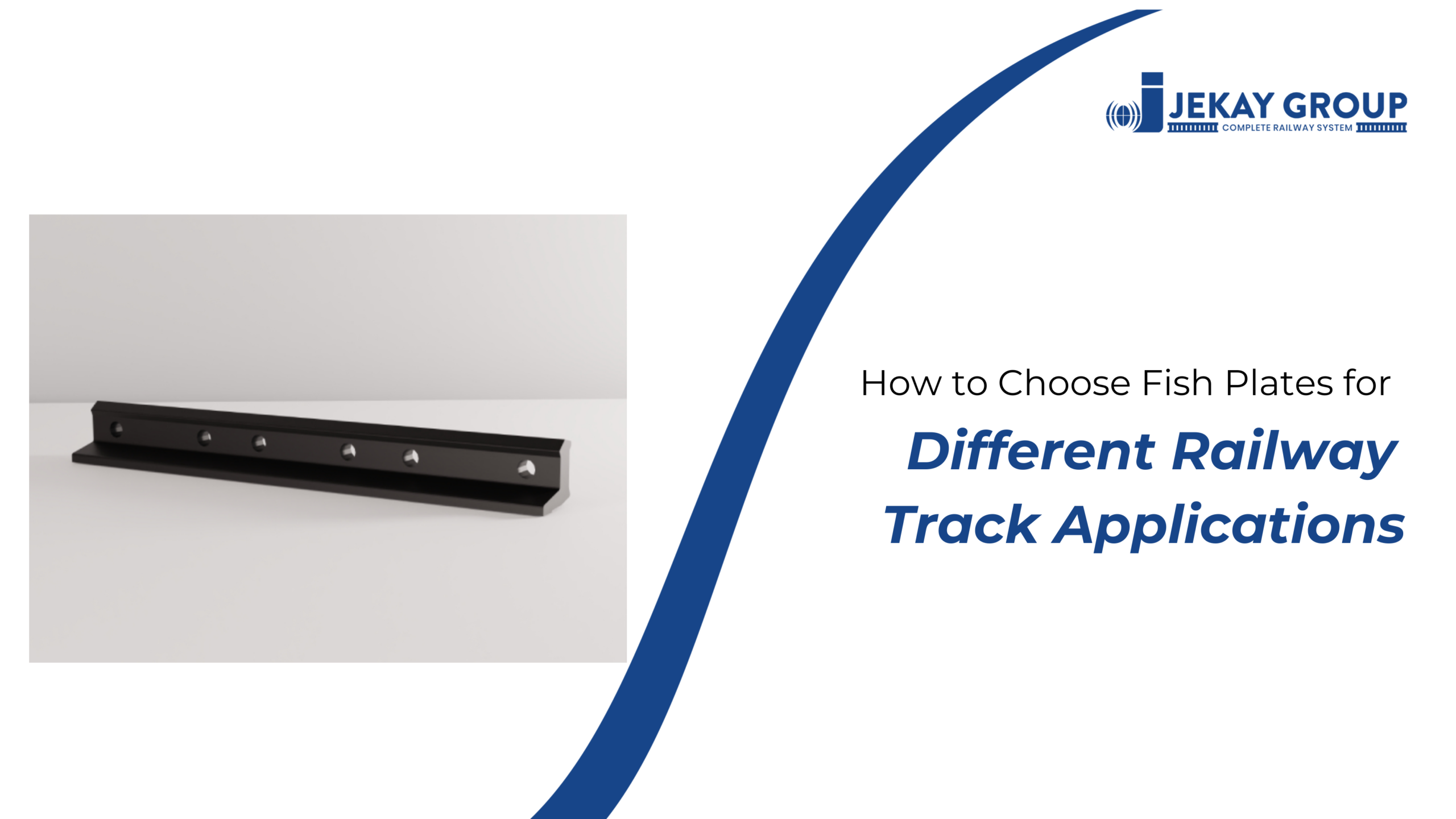
Order the wrong fish plate and you find out on site, with a possession booked and a crew standing still. The plate does not seat, the holes do not line up, or it fits and then starts cracking through the bolt holes eighteen months later. Most selection guides list plate types and leave you to work out which one your track needs. This one runs the other way — by application. Main line, curve, insulated joint, section change, yard, emergency repair. We manufacture these plates, so the guidance below comes from what gets specified correctly and what comes back cracked.
What a Fish Plate Actually Has to Do
A fish plate is not a strap that holds two rails together. It is a structural member carrying bending and shear across a gap in the rail, while keeping both rail ends aligned in gauge, level and cant.
It does this through the fishing surfaces — the angled faces that wedge against the underside of the rail head and the top of the foot. Load transfers through those contact faces, not through the bolts. The bolts only supply clamping force. Get that distinction right and most selection decisions follow from it.
The Four Specs That Decide the Choice
Everything else is detail. These four are the ones that make a plate fit or fail.
- Rail section — the plate must match the exact profile, not just the weight class. Two 60 kg rails to different standards can have different fishing angles.
- Hole pattern — number, diameter, spacing and pitch. Four-hole plates cover most main line work. Longer six-hole plates appear where bending load needs spreading over more length.
- Material and grade — decides fatigue life at the bolt holes, which is where plates usually fail.
- Governing standard — IRS and RDSO drawings in India, UIC in Europe, AREMA joint bars in North America. Mixing standards along one stretch of rail creates problems that are painful to unwind.
Choosing Fish Plates by Track Application
Main Line and Heavy Haul
High axle loads and high tonnage mean fatigue, not wear, is the limiting factor. Specify a higher-grade steel with controlled hardness and clean bolt holes — drilled and reamed, not punched, because punched holes leave micro-cracks that grow. Heavy-haul sections benefit from longer plates that distribute bending over more rail length.
Curves and Steep Gradients
Curves add lateral force and longitudinal creep. Plates on curves see bolt loosening at a higher rate, and gauge widening starts at the joint. Choose plates rated for the higher clamping torque you will need, and plan a shorter inspection cycle for these locations. On sharp curves, consider whether the joint should be there at all — relocating it away from the transition is often cheaper than maintaining it.
Signalled Sections and Insulated Joints
Track circuits need electrical separation, so the joint carries insulating liners, bushes and an end post alongside the mechanical job. That makes it the shortest-lived component in the joint family. Field studies put insulated joint service life at around 200 million gross tonnes — roughly a fifth of what an equivalent non-insulated joint achieves — with replacement intervals as short as 12 to 18 months in harsh conditions.
Two things extend it: bolt tension held to spec, and an end post that is not being crushed by metal flow from the rail ends. Both are inspection items, not purchase items.
Rail Section Changes and Combination Plates
Where a 52 kg section meets a 60 kg section, a standard plate cannot work — the fishing geometry differs on each side. Combination plates, also called compromise plates, are machined to two profiles in one piece. They are made to order, so give the manufacturer both rail sections and both drilling patterns. Improvising with a standard plate and packing pieces is the most reliable way to produce a dipped joint.
Yards, Sidings and Industrial Track
Low speed, low tonnage, frequent shunting. Fatigue is not the driver here — availability and cost are. Standard carbon steel plates in common sections are the sensible choice. What matters more is stocking the sections you actually have, because yard track is often a mix of whatever was laid over forty years.
Emergency Repairs and Joggled Plates
A joggled fish plate is stepped so it clears the rail foot and can be clamped over a cracked or broken rail without removing it. It buys you a speed-restricted running line until a proper repair. Keep them in stock for the sections you operate, in the right rail profile. A joggled plate you have to source after the fact is not an emergency plate.
Coastal, Humid and High-Temperature Routes
Corrosion attacks the bolt holes and the fishing surfaces, both places you cannot see. Salt air and industrial atmospheres call for protective coating or a corrosion-resistant grade, plus a greasing regime that is actually followed. In high ambient temperatures, expansion gaps and bolt torque both need checking more often — a plate clamped too tight in winter fights the rail in summer.
Material and Grade Selection
Grade selection is a fatigue decision, not a strength decision. Plates rarely fail by bending; they fail by cracking at a bolt hole under millions of load reversals.
- Carbon steel — proven, economical, right for sidings, yards and light traffic
- Alloy steel — higher fatigue strength for main line, heavy haul and high speed
- Heat-treated grades — where hardness has to be controlled across the section
- Coated or corrosion-resistant — coastal, tunnel, chemical plant and mining environments
Pay attention to the hole finish and the surface finish on the fishing faces. Both influence service life more than the headline tensile figure.
Common Fish Plate Selection Mistakes
- Specifying by rail weight alone instead of by full rail profile and standard.
- Accepting punched bolt holes on a high-tonnage line.
- Mixing plate standards along a continuous stretch of rail.
- Ordering standard plates for a section transition that needs combination plates.
- Treating insulated joints as a fit-and-forget item.
- Buying to lowest unit price on a component whose replacement cost is mostly labour and possession time.
What to Send Your Manufacturer
Send this and you will get the right plate on the first order:
- Rail section and governing standard for both rails at the joint
- Drawing number or the applicable IRS, RDSO, UIC, AREMA or EN reference
- Hole count, diameter, pitch and centre distances
- Plate length required
- Axle load, annual tonnage, maximum line speed
- Insulated or non-insulated
- Environment — coastal, tunnel, industrial, temperature range
- Quantity, delivery schedule and any inspection or test certificate requirement
FAQs
Can I use a 60 kg fish plate on a 52 kg rail?
No. The fishing surfaces will not seat, so load transfers through the bolts instead of the plate faces. That produces a loose joint and cracked bolt holes quickly. A section change needs a combination plate machined for both profiles.
How often should fish plate bolts be checked?
Follow the tonnage on the section rather than a fixed calendar. Joints on curves, gradients and approaches to points need checking more often than plain straight track. Record torque values so you can see which joints keep loosening.
Are four-hole or six-hole plates better?
Neither is better in general. Six-hole plates are longer and spread bending over more rail, which suits heavier tonnage. Four-hole plates cover most main line applications. The right answer is whatever the governing drawing for your section specifies.
Why do fish plates crack at the bolt holes?
The hole is a stress concentration, and the joint is a discontinuity that generates impact loading every time a wheel crosses it. Poor hole finish, punched rather than drilled holes, a dipped joint, or under-tensioned bolts all accelerate it.
What is a joggled fish plate for?
Emergency use. Its stepped profile lets it clamp over a cracked or broken rail without lifting the rail out, so you can run traffic under restriction until a permanent repair is done.
Conclusion
Fish plate selection comes down to matching geometry exactly, choosing grade for fatigue rather than headline strength, and treating each application on its own terms. A joint in a yard and a joint in a signalled main line section are different engineering problems wearing the same name.
Jekay International Track has manufactured railway track fastenings since 1980 — standard, joggled, combination and insulated fish plates, base plates, elastic fastenings, bolts, rail pads and CMS crossings — with in-house forging, rolling mills and CNC machining. We make to drawing, to standard, and to the rail sections our clients actually run.
Have a section transition, an insulated joint problem, or a drawing to quote? Send us your specification and we will confirm the right plate before you order.
