
Introduction
A crossing is where the rail runs out. There is a physical gap in the running surface, the wheel drops into it, and every axle that passes hammers the nose. In Network Rail’s seven-year defect study, the crossing panel accounted for 53% of all switches-and-crossings failures — more than the switch panel. Squats on the casting alone made up about a third of all turnout failures. This guide covers what a railway crossing is made of, the four ways it gets built, the design numbers that decide its life, and how to specify one that does not become your worst maintenance location.
What Is a Railway Crossing?
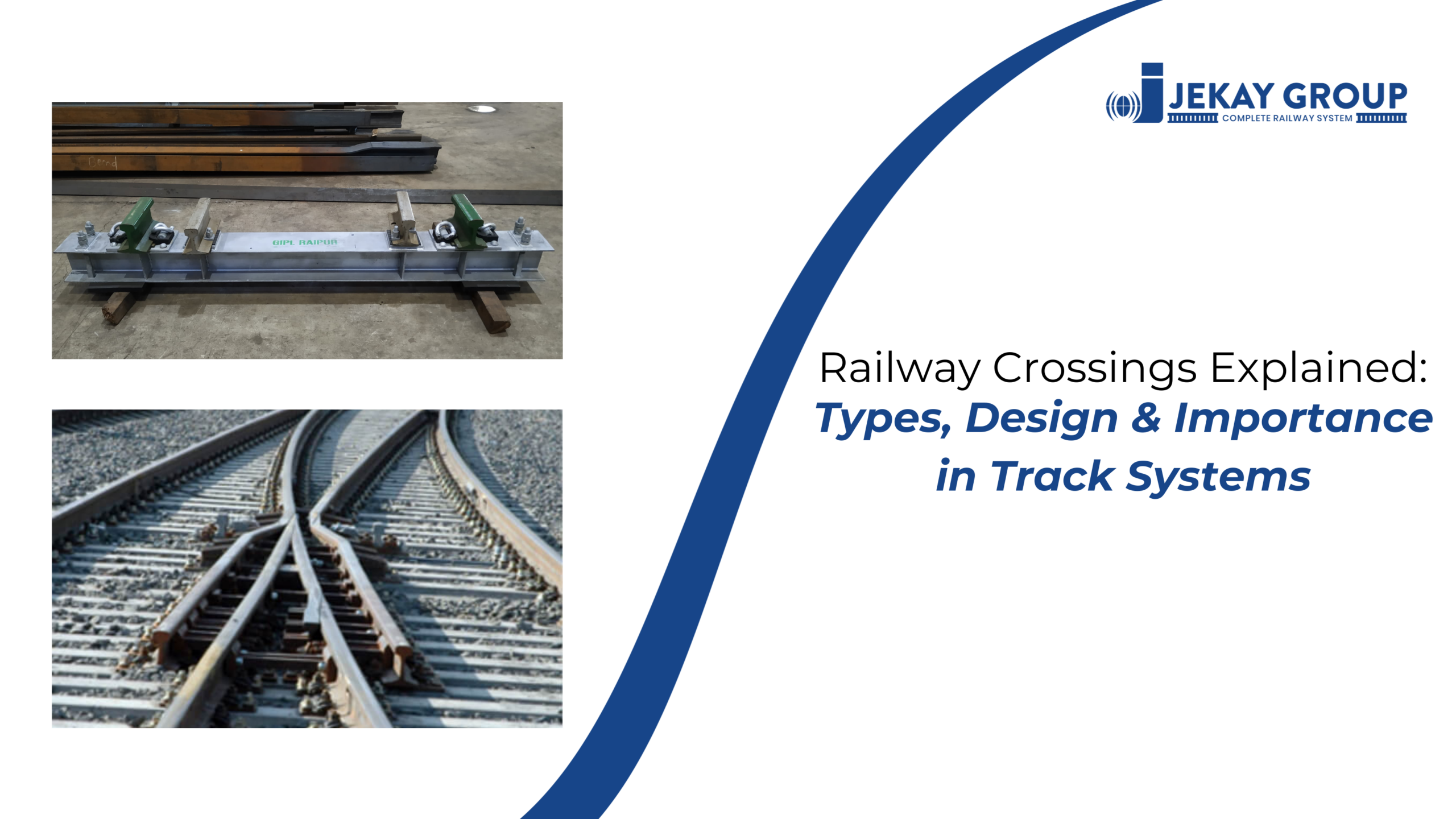
A railway crossing is the fixed assembly at the rear of a turnout where the two routes physically intersect. It carries the wheel across the gap that the intersecting rail must leave. It is also called a frog, and on Indian Railways it is usually just “the crossing.”
The crossing takes the highest impact loading anywhere on the track. There is a moment where the wheel transfers from the wing rail onto the nose. That transfer is never perfectly smooth, and the resulting impact is what drives every failure mode in this article.
Crossings vs Level Crossings
Two different things share the word. A level crossing is where a road meets a railway at grade — gates, barriers, road surface. A crossing in track terms is a component inside a turnout or a diamond. This article covers the second. If you are sourcing barriers and road panels, that is a separate product family.
Components of a Railway Crossing
Crossing Nose (Point Rail)
The V-shaped section where the two gauge lines converge. The nose is machined to a theoretical point but always built with a practical blunt tip, because a true knife edge would break off under the first heavy axle.
Wing Rails
The two rails that flare away on either side of the nose. They carry the wheel while the nose is still too thin to take load, then hand it over. Wing rail height relative to the nose is one of the few things a maintenance team can adjust in the field, and one of the most commonly wrong.
Splice Rails and Leg Ends
The rails that run out from the crossing body to meet plain track. Leg ends accounted for 10% of crossing failures in the Network Rail data — a reminder that the joint between the casting and the running rail matters as much as the casting.
Check Rails and Flangeway
A check rail sits opposite the crossing and bears on the back of the far wheel flange. It holds the wheelset laterally so the near flange cannot strike the nose. Check rail clearance on broad gauge is 44 mm nominal with a service maximum of 48 mm. Junction of head clearance is a minimum of 38 mm. Let the check rail wear past limit and you are steering wheels directly into the nose.
Baseplates, Fastenings and Bearers
Crossings sit on wide baseplates spanning long bearers. Support stiffness under the casting drives impact loading. A hanging bearer under a crossing does more damage in a month than a year of normal traffic.
Types of Railway Crossings
Fabricated / Built-Up Crossings
Standard rail sections cut, machined and bolted or welded together with fillers and spacers. Cheap, repairable in the field, and easy to make in any angle. They loosen under heavy traffic and need regular bolt checks. Best for sidings, yards and low-tonnage lines.
Rail Bound Manganese (RBM) Crossings
A cast manganese steel insert forming the nose and wing area, bound by standard rail legs on both sides. You get manganese where the impact is and ordinary rail where it is not. RBM crossings are the workhorse of main line turnouts because they combine wear resistance with an easier weld to plain track.
Cast Monoblock Manganese Crossings
The whole crossing — nose, wings, legs — cast as a single piece of austenitic manganese steel. No bolts, no internal joints, nothing to loosen. Heavier, more expensive, and harder to repair, but the right answer where tonnage and axle loads are high.
Swing Nose (Movable Point) Crossings
The nose itself moves to close the flangeway gap, so the wheel never leaves a continuous running surface. Manufacturers report service life several times that of a fixed manganese crossing and a large drop in maintenance effort. The trade-off is a second point machine, a second set of detection, and a signalling interface. Standard on high-speed lines, hard to justify on a yard.
Diamond Crossings and Slips
Where two tracks cross without connection, you get a diamond — four crossings in one assembly. Add switches and it becomes a single or double slip. Diamonds are geometry-hungry and maintenance-hungry, which is why designers avoid them where a pair of turnouts will do.
Crossing Design: Angle, Materials and Geometry
Crossing Angle and Number
The angle is written 1 in N, where N is the cotangent. Common values are 1 in 8.5, 1 in 12, 1 in 16 and 1 in 20. Flatter angles mean a longer crossing, a narrower and longer gap, gentler wheel transfer, and higher permissible speed. They also mean more steel and more land.
Austenitic Manganese Steel and Work Hardening
Manganese steel is the counterintuitive part. As cast, it is relatively soft. Traffic itself hardens the running surface — the metal transforms under impact and gets progressively tougher while the core stays ductile.
That creates a specific vulnerability window. During initial hardening, metal flows over the gauge corner as a burr or lip. Standard practice is to inspect within the first week of operation and remove any lip within four working days, repeating until hardening completes. Skip that window and you lock a defect into a surface that is about to get very hard.
Explosive depth hardening pre-hardens the casting before installation and shortens the window. It costs more up front and buys you out of the most failure-prone period of the crossing’s life.
Flangeway and Check Rail Clearance
Flangeway width and check rail clearance work as a pair. Widen one without the other and the wheelset finds the nose. These are inspection dimensions, not design curiosities — they should be on the maintenance schedule from day one.
Why Crossings Matter in Track Systems
- They set the permissible speed on the diverging route
- They are the single highest-impact location in the layout
- They govern how often a possession is needed on that line
- Their angle drives turnout length, which drives land take and layout design
- A worn crossing produces noise and vibration complaints long before it produces a defect report
Where Crossings Fail
The Network Rail data is worth reading closely. Six failure types accounted for 80% of crossing failures. By location: the nose at 46%, leg ends at 10%, wing rails at 10%.
The uncomfortable conclusion is that crossing failure is concentrated and predictable. Nearly half of it happens at one place you can point to on the drawing. That makes it a specification problem more than an inspection problem — material grade, hardening treatment and support stiffness under the nose decide most of the outcome before a train ever runs.
How to Select the Right Railway Crossing
- Fix the crossing angle from diverging speed. Everything else follows.
- Match the type to tonnage. Fabricated for yards, RBM for main line, monoblock for heavy haul, swing nose for high speed.
- Ask for explosive depth hardening on any manganese crossing going into a high-tonnage location.
- Specify the weld or joint detail between manganese and carbon rail — this is where leg-end failures start.
- Check bearer support and baseplate design under the nose, not just the casting spec.
- Get material certification and casting inspection records with delivery, not after a failure.
FAQs
What is the difference between a frog and a crossing? Nothing. “Frog” is North American usage, “crossing” is the British and Indian term. Both describe the fixed V assembly where two routes intersect.
Why is manganese steel used for crossings? It work hardens. Impact from passing wheels transforms the surface into a much harder layer while the body stays tough and resists cracking. Most other steels would either wear out or fracture.
How long does a railway crossing last? It depends on tonnage, angle and whether the early lipping is ground off on schedule. A well-maintained cast manganese crossing on a main line typically outlasts the switch blades in the same turnout.
Are swing nose crossings worth the cost? On high-speed main lines and heavy freight routes, usually yes — the gap in the running surface is what causes impact damage, and closing it removes the root cause. On low-speed yard turnouts, the extra point machine and detection rarely pay back.
What is a diamond crossing? Two tracks intersecting without any connection between them, forming four crossings in one assembly. Add switches and it becomes a slip, which lets trains transfer as well as cross.
Conclusion
Crossings fail in a small number of ways, in a small number of places, for reasons that trace back to the specification sheet. Pick the angle from speed, the type from tonnage, and insist on hardening treatment and certified castings. The maintenance saving shows up in year two and keeps showing up.
Source Your Crossings From Jekay International
Jekay International has manufactured railway track components since 1980 for railway developers and government bodies across Asia, Africa, Europe and the Americas. We produce complete turnout systems — switches, crossings, expansion joints, fish plates, base plates, elastic fastenings and insulated rail joints — from our own flaskless foundry, high-pressure moulding line, forging plant, rolling mills, CNC planers and CMS welding facility.
Castings, machining and assembly under one roof means one set of tolerances and full traceability on every crossing we ship.
Send us your turnout geometry or crossing drawings and our team will come back with a manufacturing proposal and material certification schedule. Contact Jekay International to start the conversation.
