
Introduction
Steel moves about 12 mm per 100 metres for every 10°C of temperature change. On an Indian summer day, rail temperature swings across a 40°C band in Zone I and up to 76°C in Zone IV. Weld that rail into a continuous ribbon and it cannot expand — so the stress goes into the rail instead, and the outcome is a buckle in July or a fracture in January. The expansion joint is the release valve. This guide covers what an expansion joint does, the types available, the numbers behind breathing length, and how to specify and install one properly.
What Is a Railway Expansion Joint?
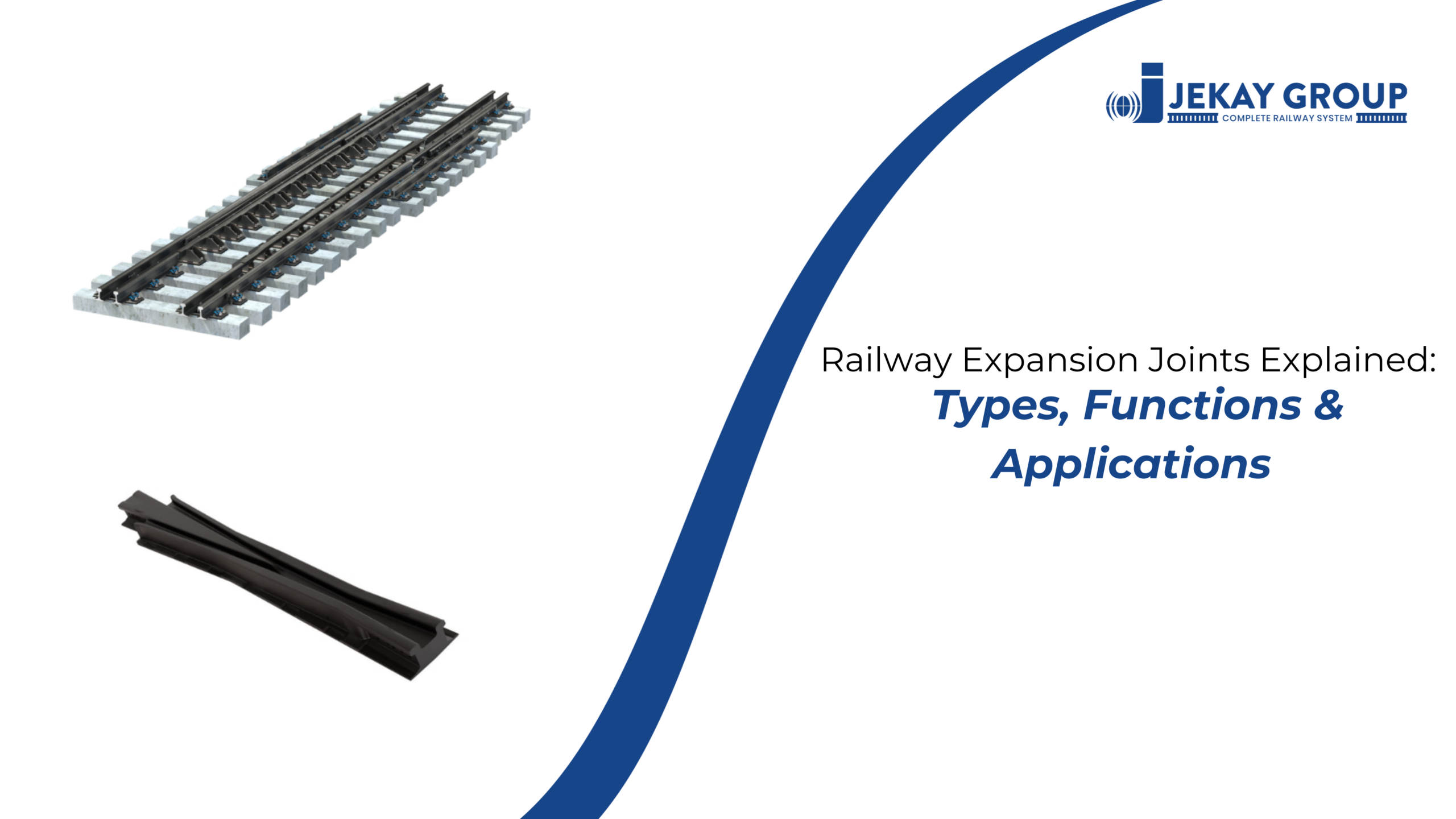
A railway expansion joint is a fabricated assembly that lets two rail ends slide past each other while keeping a continuous running surface for the wheel. It replaces the old fishplated joint gap with an overlapping pair of tapered rails.
The common form on track is the switch expansion joint — SEJ, also called a breather switch. A tongue rail and a stock rail are machined with long diagonal scarf cuts, typically between 1:10 and 1:20, and laid overlapping. As the rail expands, the overlap shortens. As it contracts, the overlap lengthens. The wheel never sees a gap.
Why Continuous Welded Rail Needs One
Long welded rail is defined on Indian Railways as welded rail whose central portion does not move longitudinally with temperature — over 250 m on broad gauge, over 500 m on metre gauge. The middle is locked in place by ballast resistance and fastening toe load. Only the ends move.
Those ends are where you put the joint. Everything in between is held by friction, and that is the whole design principle of CWR.
The Physics: How Much Does Track Actually Move?
Breathing Length
The breathing length is the section at each end of an LWR that actually expands and contracts. It is shorter than most people expect, and it depends on rail section and sleeper density:
| Rail section | 1540 sleepers/km | 1660 sleepers/km |
| 52 kg | 66 m | 64 m |
| 60 kg | 77 m | 74 m |
Heavier rail and fewer sleepers mean a longer breathing length. That is the trade-off buried in your sleeper spacing decision — it changes how much movement the joint has to absorb.
Rail Temperature Zones and Destressing
Indian Railways divides the country into four rail temperature zones by annual range: Zone I at 40–50°C, Zone II at 51–60°C, Zone III at 61–70°C and Zone IV at 71–76°C. Destressing temperature is set at the mean rail temperature to mean plus 5°C for Zones I to III, and mean plus 5 to 10°C for heavy rail in Zone IV.
Destress at the wrong temperature and no expansion joint will save you. The joint absorbs movement; it does not correct a stress-free temperature that was set 8°C off.
Components of a Switch Expansion Joint
Tongue Rail and Stock Rail
The two working rails, machined as a matched pair. The tongue is tapered to slide inside the stock rail’s gauge face. Both are machined from the same section as the running rail so wheel transfer stays smooth.
Scarfed Overlap Geometry
The diagonal cut is what makes it work. A shallow scarf angle spreads the wheel transfer over a long distance, keeping impact low. It also makes the assembly long — a genuine constraint when you are fitting one into a bridge approach.
Gauge Tie Bars
Tie bars couple the two rails so both sides of the joint move together and gauge stays constant. Without them, one rail can slide while the other sticks, and gauge opens up under traffic.
Slide Chairs, Baseplates and Sleepers
The joint sits on special sleepers with slide chairs that let the tongue move laterally and longitudinally under load. Fastening toe load here is deliberately different from plain track — clamp it like plain line and you have just removed the joint’s ability to breathe.
Types of Railway Expansion Joints
Standard Switch Expansion Joints (SEJ)
The default at LWR and CWR ends on ballasted track. Typical design accommodation is around ±60 mm of movement, with an in-service gap range of roughly 40 to 120 mm. Actual thermal demand for a 100 m breathing length across ±35°C is closer to ±20 mm — the extra allowance covers rail fracture, creep and installation error.
High-Capacity and Double-Gap SEJs
Where breathing length is longer or the temperature range is wider, double-gap designs split the movement across two overlaps. Each gap handles less, so the individual gaps stay smaller and the assembly stays shorter than a single joint of equivalent capacity.
Bridge Rail Expansion Joints (REJ)
A different product for a different problem. On long steel bridges and viaducts the deck itself moves independently of the embankment track. Bridge REJs are built for far larger travel — up to around ±300 mm at large installations — and are always installed in matched pairs, one at each end of the moving span.
Buffer Rails and Legacy Arrangements
Older layouts used buffer rails: a set of short rails with progressively increasing joint gaps. They work, but they reintroduce the joints CWR was meant to eliminate. Most modern renewals replace them with SEJs.
Functions of a Railway Expansion Joint
- Absorbs thermal expansion and contraction at LWR and CWR ends
- Keeps a continuous running surface, so there is no impact gap for the wheel
- Prevents compressive buildup that leads to track buckling in hot weather
- Prevents tensile buildup that leads to rail fracture in cold weather
- Isolates structural movement of bridges and viaducts from adjacent track
- Provides a controlled, monitorable location for rail movement instead of an uncontrolled one
Applications: Where Expansion Joints Are Installed
- LWR and CWR terminations — at the end of each welded stretch, commonly about every kilometre
- Bridge and viaduct approaches — in pairs at each end of the moving structure
- Approaches to turnouts — where welded track meets a layout that cannot absorb longitudinal movement
- Tunnel portals — where temperature regime changes abruptly
- Metro and elevated corridors — where structural expansion dominates thermal rail expansion
- Heavy haul lines — where high axle loads and long welded sections combine
Installation and Gap Setting
- Record the actual rail temperature at the time of installation. Not the forecast, not the air temperature.
- Set the initial gap from the gap-setting table for that temperature and rail section. Standard initial setting is 40 mm at the reference temperature.
- Check gauge tie bars are free and correctly torqued.
- Verify slide chairs are clean and lubricated before the first train.
- Confirm fastening toe load matches the joint specification, not plain-line specification.
- Log the installation temperature and gap in the track record. You will need it at the first inspection.
Common Failure Modes and Maintenance
Seizing is the failure that matters. When slide chairs dry out, corrode or fill with ballast dust, the joint stops sliding. It then behaves like a rigid welded joint — and the compressive stress it was installed to relieve builds up in the track behind it. The joint stays intact while the track buckles a hundred metres away.
Two more to watch:
- Gap out of range — a joint sitting near its limit in mild weather has already lost its margin for the extreme. This usually means creep, not thermal movement.
- Tongue rail wear at the scarf — wheel transfer wears the thin end of the tongue. Left alone, it lips like a switch blade.
The maintenance list is short: keep it lubricated, measure the gap against the temperature table, and record creep. None of that is complicated. It is just easy to skip on a component that looks fine from a passing train.
How to Specify an Expansion Joint
- Calculate breathing length first from rail section and sleeper density, then size the joint to it
- Use your actual temperature zone, not a national average
- Add allowance for creep and fracture, not just calculated thermal movement
- Separate the bridge problem from the track problem — a track SEJ will not absorb structural deck movement
- Match rail section and grade to the adjoining welded rail so the transition weld is straightforward
- Ask for the gap-setting table with the joint, tied to your temperature zone
FAQs
What is the difference between an SEJ and a fishplated joint? A fishplated joint leaves a physical gap that the wheel strikes. An SEJ uses overlapping tapered rails, so the running surface stays continuous while the rails still slide relative to each other.
How far apart are expansion joints placed? On ballasted LWR track they typically sit at the ends of each welded stretch, often around a kilometre apart. On bridges, spacing is set by structural movement, not by rail length.
Can you weld through an expansion joint? No. Welding a joint closed removes the movement capacity and transfers the stress into adjacent track. If a joint is being removed, the section either needs a replacement joint or a full destressing exercise.
What happens if the gap is set wrong at installation? The joint runs out of travel at one temperature extreme. Set too tight in winter and it goes hard against its stop in summer, creating exactly the compressive stress it was meant to release.
Do metro and elevated lines need expansion joints? Usually yes, and often more of them. Elevated structures move with their own thermal and creep behaviour, which is independent of the rail sitting on them.
Conclusion
An expansion joint is a small assembly protecting a very long asset. Size it from real breathing length and a real temperature zone, install it at a recorded rail temperature, and keep the slide chairs free. Do those three things and the joint stops being a maintenance liability and starts doing what it was bought for.
Get Your Expansion Joints From Jekay International
Jekay International has manufactured railway track components since 1980 for railway developers and government bodies across Asia, Africa, Europe and the Americas. Our turnout system range covers switch expansion joints, switches, crossings, fish plates, base plates, elastic fastenings, rail pads and insulated rail joints — produced in-house across our forging plant, rolling mills, CNC planers, flaskless foundry, high-pressure moulding line and CMS welding facility.
Machining tolerance on a scarfed tongue rail is the whole product. Doing it under our own roof is how we hold it.
Send us your rail section, breathing length and temperature zone, and our engineering team will return a joint specification with a gap-setting table. Contact Jekay International to get a proposal.